
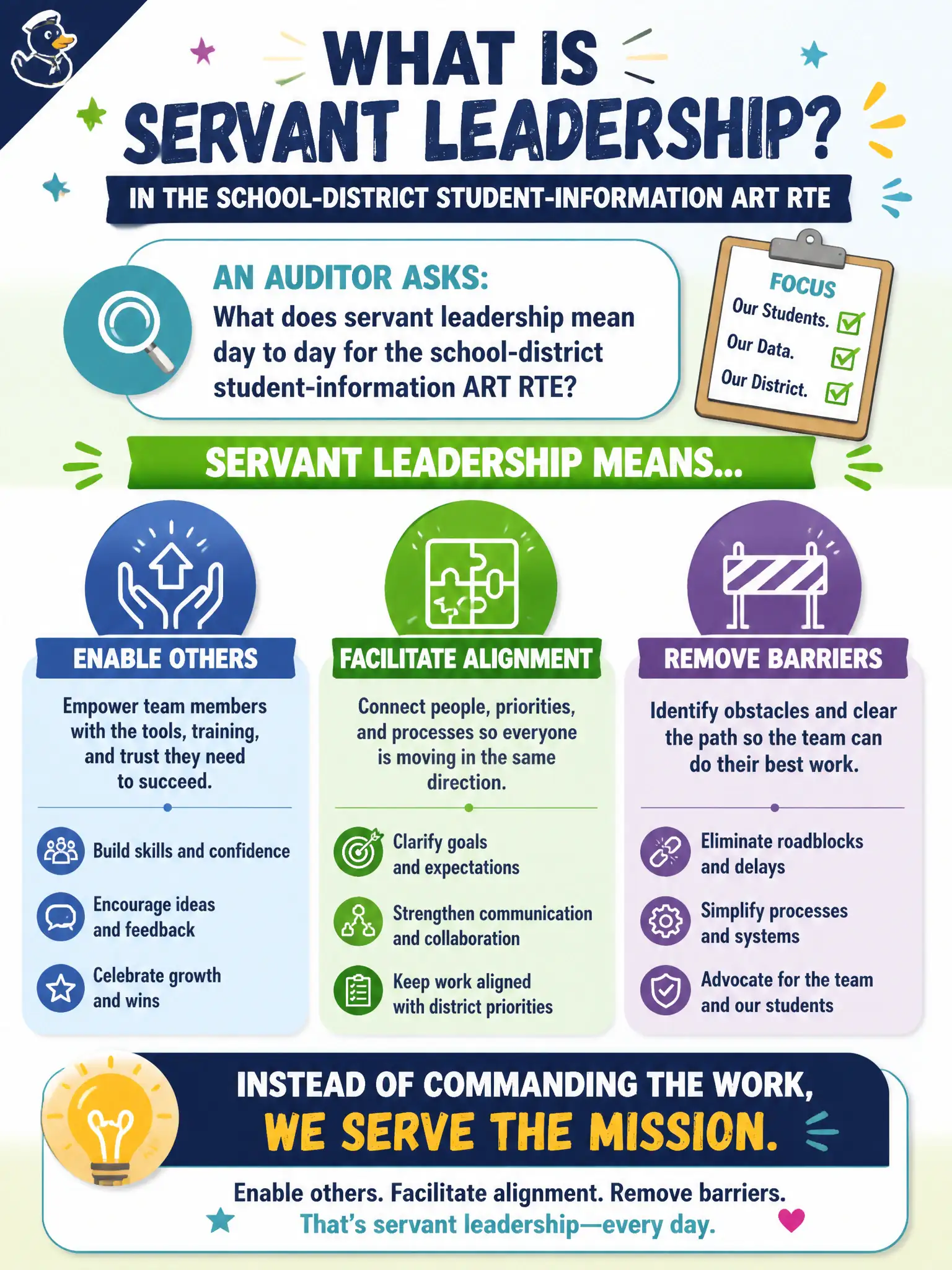
An auditor asks what servant leadership means day to day for the school-district student-information ART RTE. Which description is accurate?
Select an answer to reveal the explanation.
Short Explanation
Servant leadership on a student-information ART looks like clearing the hallway so teachers' data can move—not barking assignments. Enable the teams, line people up on a shared mission, and pull the blockers. Orders and approval stamps are the opposite pose.
Full Explanation
Servant leadership for an RTE means enabling others, facilitating alignment, and removing barriers rather than commanding the work. On a school-district student-information ART, that shows up as clearing systemic blockers around enrollment data, coaching Scrum Masters, and keeping planning and demos effective so teachers and registrars get working increments. The RTE uses authority to serve the train's delivery system, not to issue personal task orders. Issuing daily orders to each student-information squad and grading them on obedience is classic command-and-control and directly contradicts servant leadership. Sitting above the ART as the single approver of every enrollment story centralizes product content decisions that belong with Product Owners and Product Management. Protecting the RTE's authority by speaking first and last in every ART event models dominance, suppresses psychological safety, and turns facilitation into performance. Exam caveat: Servant leadership is not passivity or endless consensus; RTEs still timebox debates, escalate unresolved impediments, and hold cadence when the student-information train drifts. Operational check: After the next ART Sync, ask whether teams left with clearer ownership and fewer barriers—or with a longer list of RTE directives—and adjust facilitation toward enablement.