
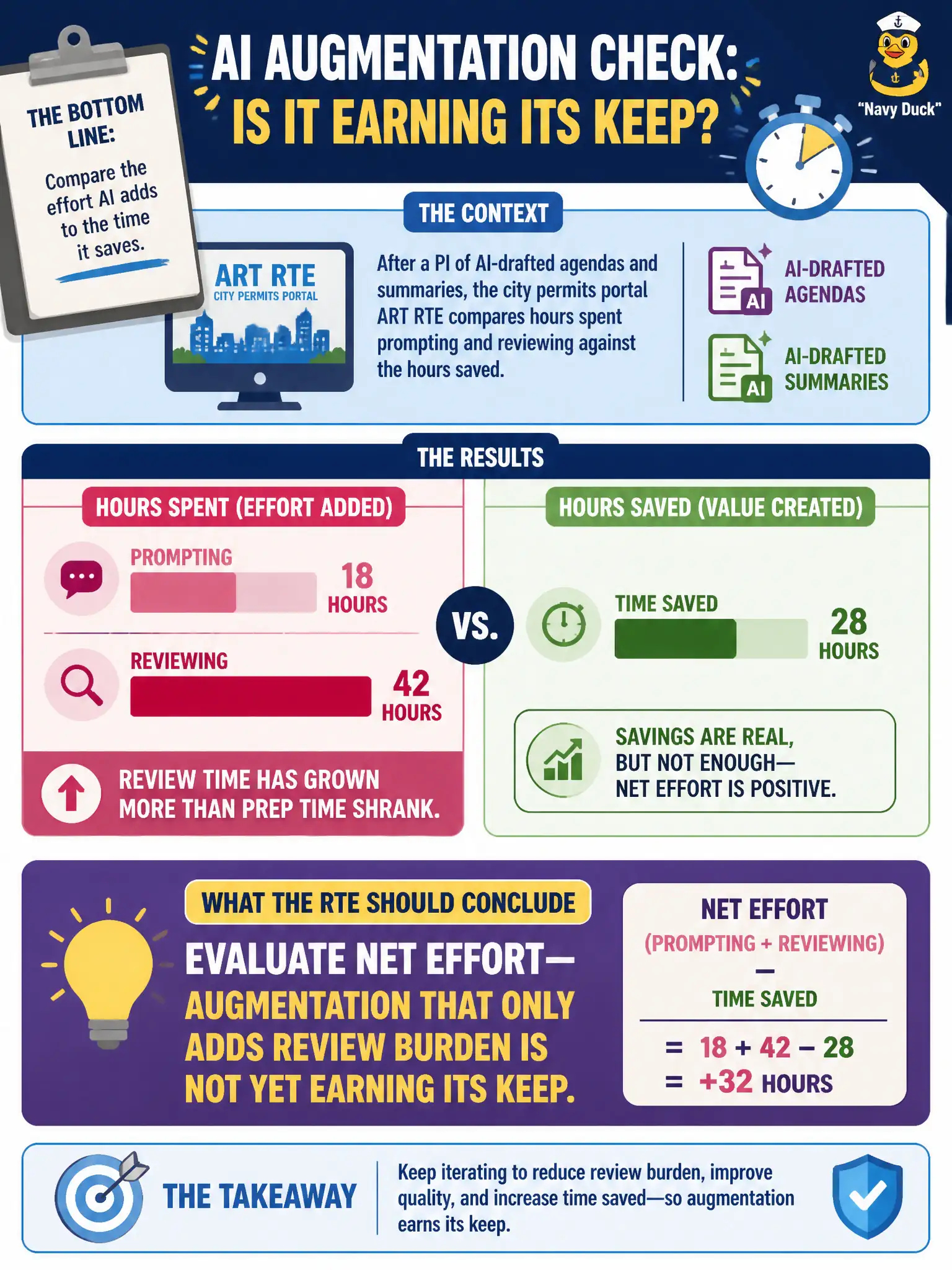
After a PI of AI-drafted agendas and summaries, the city permits portal ART RTE compares hours spent prompting and reviewing against the hours saved. Review time has grown more than prep time shrank. What should the RTE conclude about augmentation?
Select an answer to reveal the explanation.
Short Explanation
If the helper creates a second full-time job of fixing its drafts, the permits train did not get faster. Count both the time saved and the time spent reviewing. Net effort is the score, not the demo.
Full Explanation
Augmentation should be evaluated on net effort: if review burden grows more than prep time shrinks, the workflow is not yet earning its keep. After a PI of AI-drafted agendas and summaries on the city permits portal ART, when prompting and reviewing consume more hours than were saved, the RTE should conclude that. Keeping every AI workflow forever once tried once ignores empiricism. Stopping measurement because Lean “does not apply to facilitation” abandons improvement. Doubling the number of tools so review load spreads out usually increases coordination cost. Exam caveat: some high-risk artifacts warrant heavier review; the point is conscious tradeoffs, not automatic expansion. Operational check: timebox a two-PI experiment, keep only workflows with positive net savings and acceptable quality on the permits ART, and retire the rest. Keep the civic mission visible when applying the technique so resident-facing outcomes stay the measure of success. In municipal ART practice, capture the rationale in facilitation notes so future coaches inherit the same standard. Re-validate after the next PI cadence event that the same control still fits current civic constraints. Keep the civic mission visible when applying the technique so resident-facing outcomes stay the measure of success.