
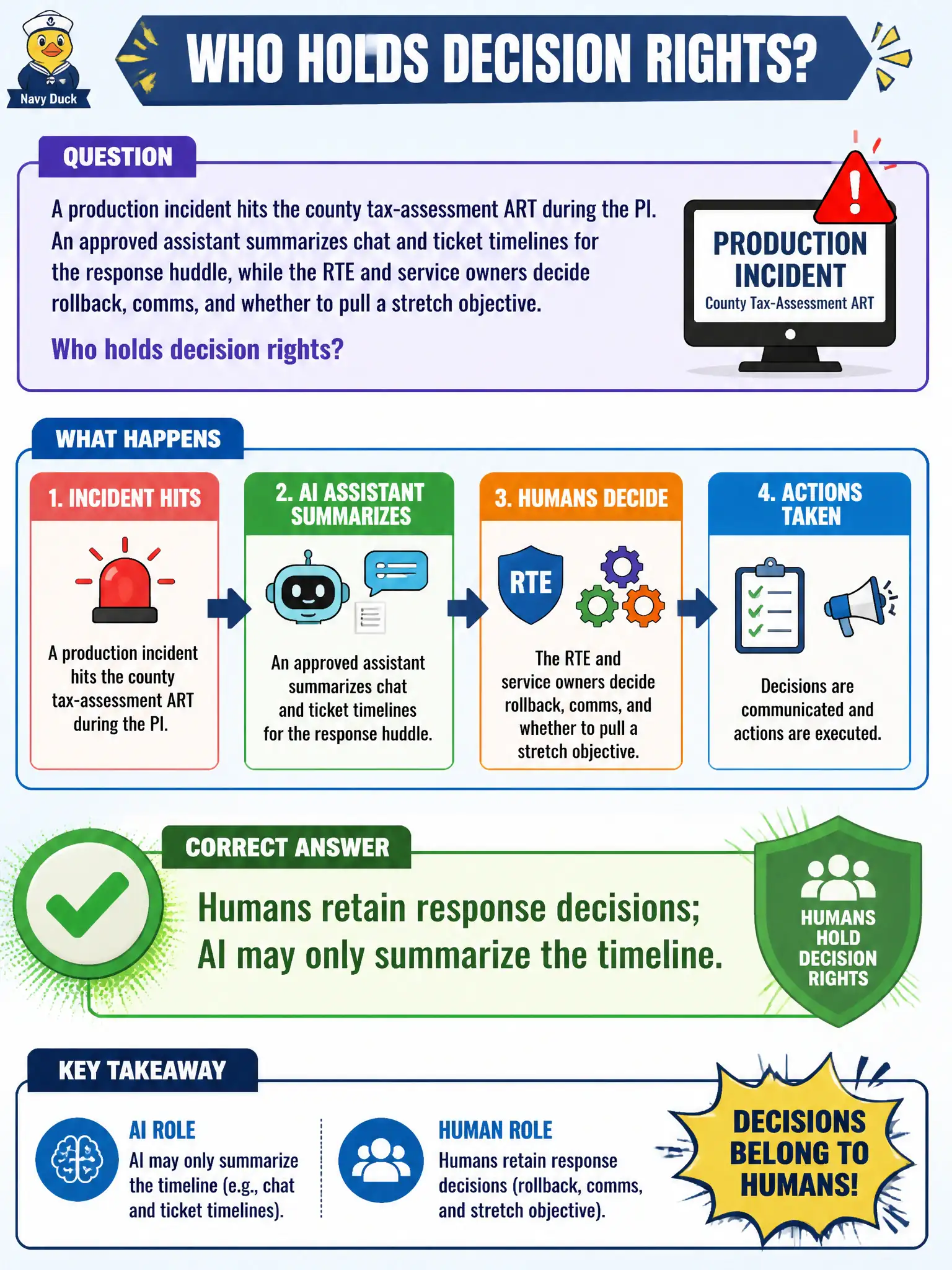
A production incident hits the county tax-assessment ART during the PI. An approved assistant summarizes chat and ticket timelines for the response huddle, while the RTE and service owners decide rollback, comms, and whether to pull a stretch objective. Who holds decision rights?
Select an answer to reveal the explanation.
Short Explanation
A timeline recap is the incident whiteboard, not the incident commander. Tax-assessment rollback, public comms, and stretch-objective calls stay with people who own the service. Summarize fast; decide human.
Full Explanation
Humans retain incident-response decisions; AI may only summarize timelines and supporting material. When a production incident hits the county tax-assessment ART during the PI and an approved assistant summarizes chat and ticket timelines for the response huddle while the RTE and service owners decide rollback, communications, and whether to pull a stretch objective, decision rights stay human. Letting the model choose rollback versus forward-fix without service owners is unsafe automation. Pausing all human incident command until the assistant writes a full root-cause analysis delays containment for a document. Treating the summary as a Business Owner confidence vote for the remainder of the PI misuses an incident artifact. Exam caveat: summaries can be wrong or incomplete—verify critical timestamps before acting. Operational check: use the summary as a huddle aid, confirm key facts with ticket systems, decide rollback/comms/objective impacts with service owners, and record human decision owners in the tax-assessment incident log. Keep the civic mission visible when applying the technique so resident-facing outcomes stay the measure of success. In municipal ART practice, capture the rationale in facilitation notes so future coaches inherit the same standard.