
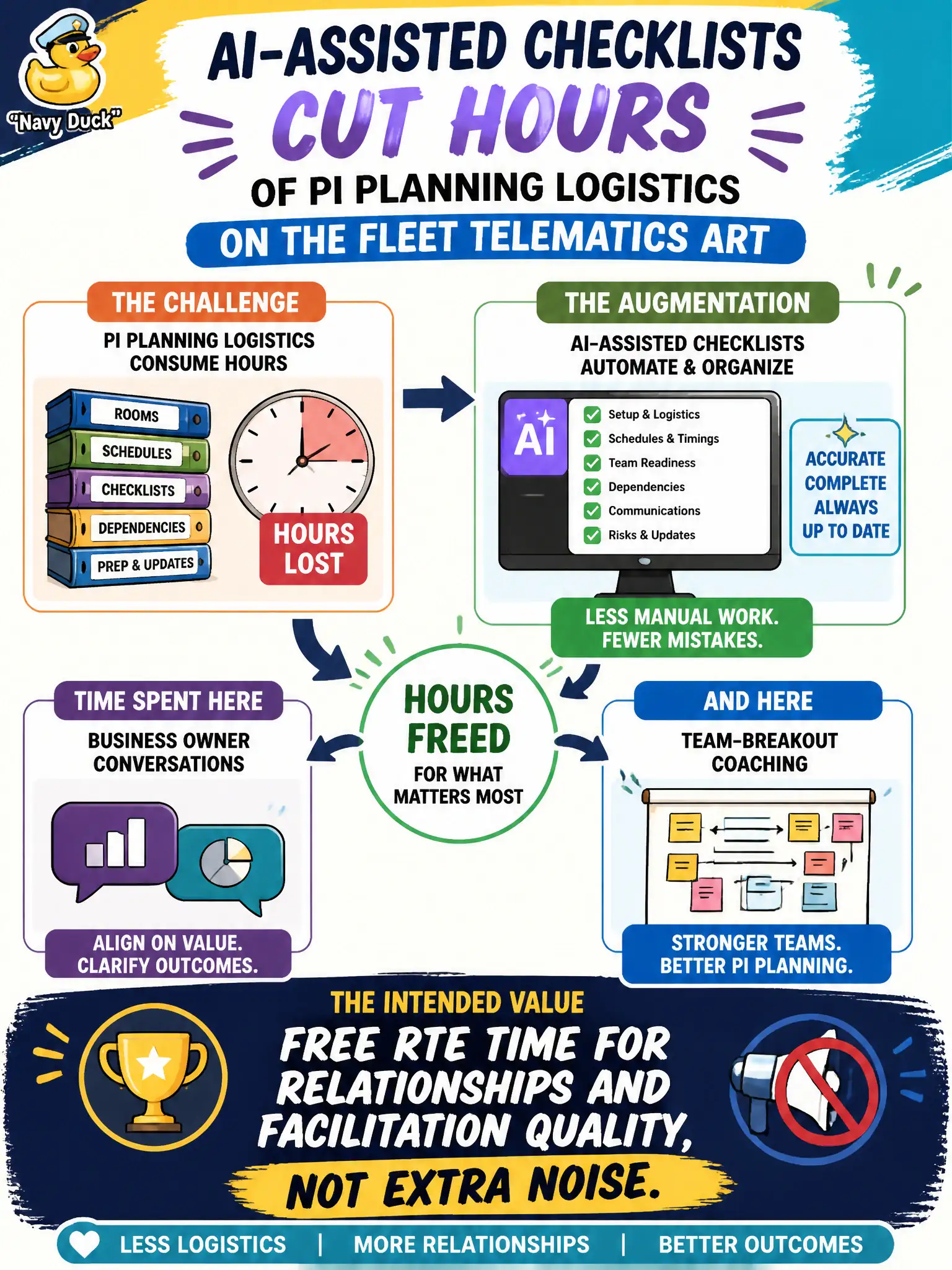
AI-assisted checklists cut hours of PI Planning logistics on the fleet telematics ART. The RTE spends the recovered time on Business Owner conversations and team-breakout coaching instead of adding more slideware. What is the intended value of that augmentation?
Select an answer to reveal the explanation.
Short Explanation
The win is not a thicker binder. If the bot packed the telematics planning bags, the RTE should be on the floor with Business Owners and teams. Time saved is for people, not more slides.
Full Explanation
The intended value of AI augmentation that cuts PI Planning logistics time is freeing RTE capacity for relationships and facilitation quality, not creating extra noise. On the fleet telematics ART, when checklists cut hours and the RTE spends recovered time on Business Owner conversations and team-breakout coaching instead of adding slideware, that is the right reinvestment. Filling every recovered hour with additional AI-generated decks the ART must read recreates waste. Eliminating Business Owner conversations because logistics are automated removes a core alignment mechanism. Measuring success only by how many prompts the RTE sent optimizes activity, not outcomes. Exam caveat: time savings should show up as better planning quality or fewer late discoveries, not vanity productivity metrics. Operational check: after the next telematics PI Planning, compare dependency discovery and Business Owner engagement to the prior PI and keep reinvesting saved logistics time in coaching. Keep the civic mission visible when applying the technique so resident-facing outcomes stay the measure of success. In municipal ART practice, capture the rationale in facilitation notes so future coaches inherit the same standard.