
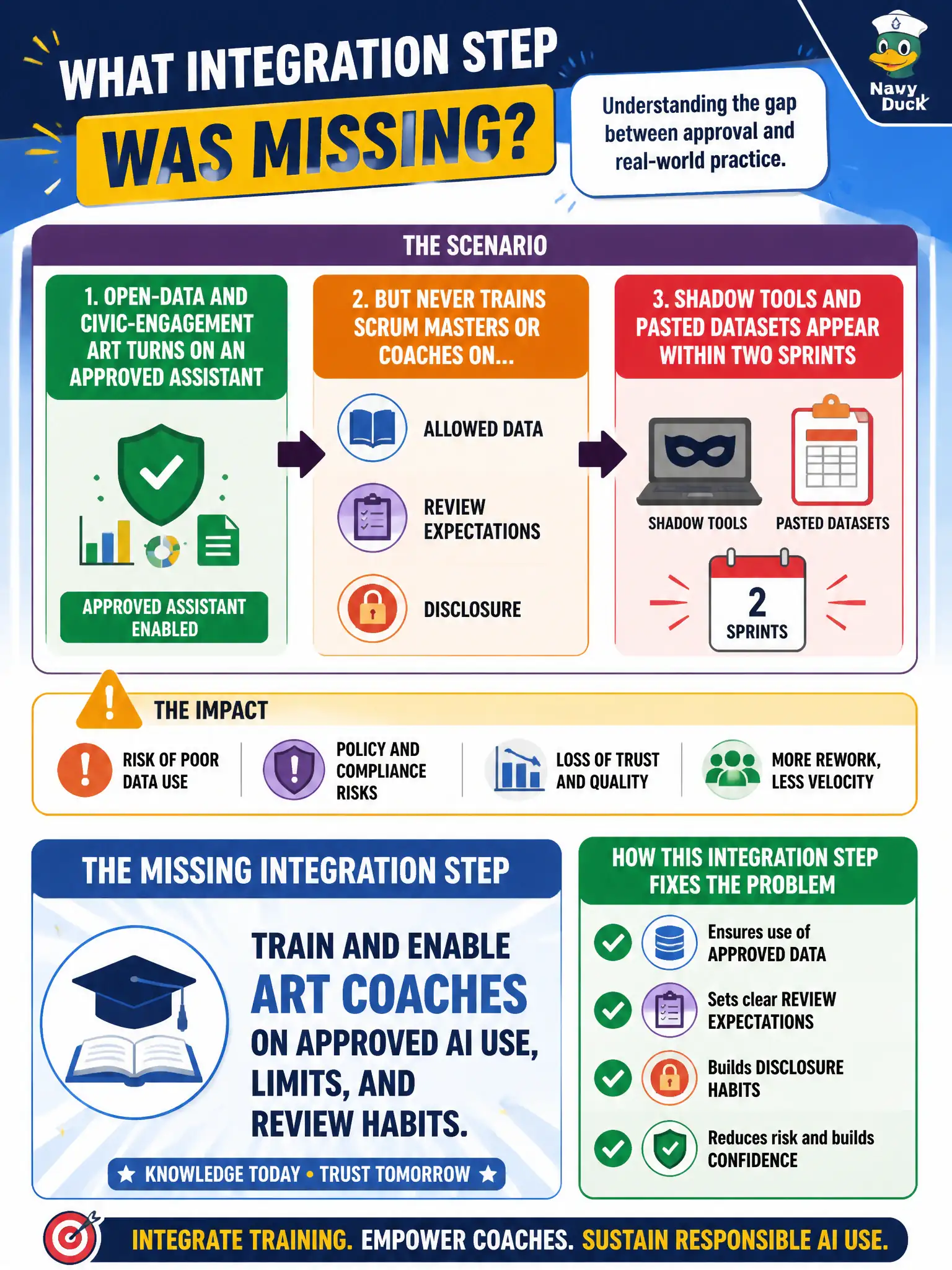
The open-data and civic-engagement ART turns on an approved assistant but never trains Scrum Masters or coaches on allowed data, review expectations, or disclosure. Shadow tools and pasted datasets appear within two sprints. What integration step was missing?
Select an answer to reveal the explanation.
Short Explanation
Handing out a power tool with no safety briefing is how shadow shops start in the garage. Civic-engagement coaches will fill the vacuum with whatever chatbot is handy. Integration includes enablement, not just a license.
Full Explanation
Integrating AI into an ART includes training and enabling coaches on approved use, limits, and review habits. When the open-data and civic-engagement ART turns on an approved assistant but never trains Scrum Masters or coaches, shadow tools and pasted datasets appear within two sprints because enablement was missing. Banning coach involvement so only the RTE may touch the assistant creates a bottleneck and underground usage. Assuming tools are self-explaining and skipping policy walkthroughs invites mistakes. Publishing API keys in the open-data portal to increase transparency is a security failure, not enablement. Exam caveat: training should cover data classes allowed in prompts, review expectations, and disclosure norms. Operational check: run a short enablement session for civic-engagement coaches, publish a one-page allowed-use guide, revoke any exposed keys, and audit for shadow tools. Keep the civic mission visible when applying the technique so resident-facing outcomes stay the measure of success. In municipal ART practice, capture the rationale in facilitation notes so future coaches inherit the same standard. Re-validate after the next PI cadence event that the same control still fits current civic constraints.