
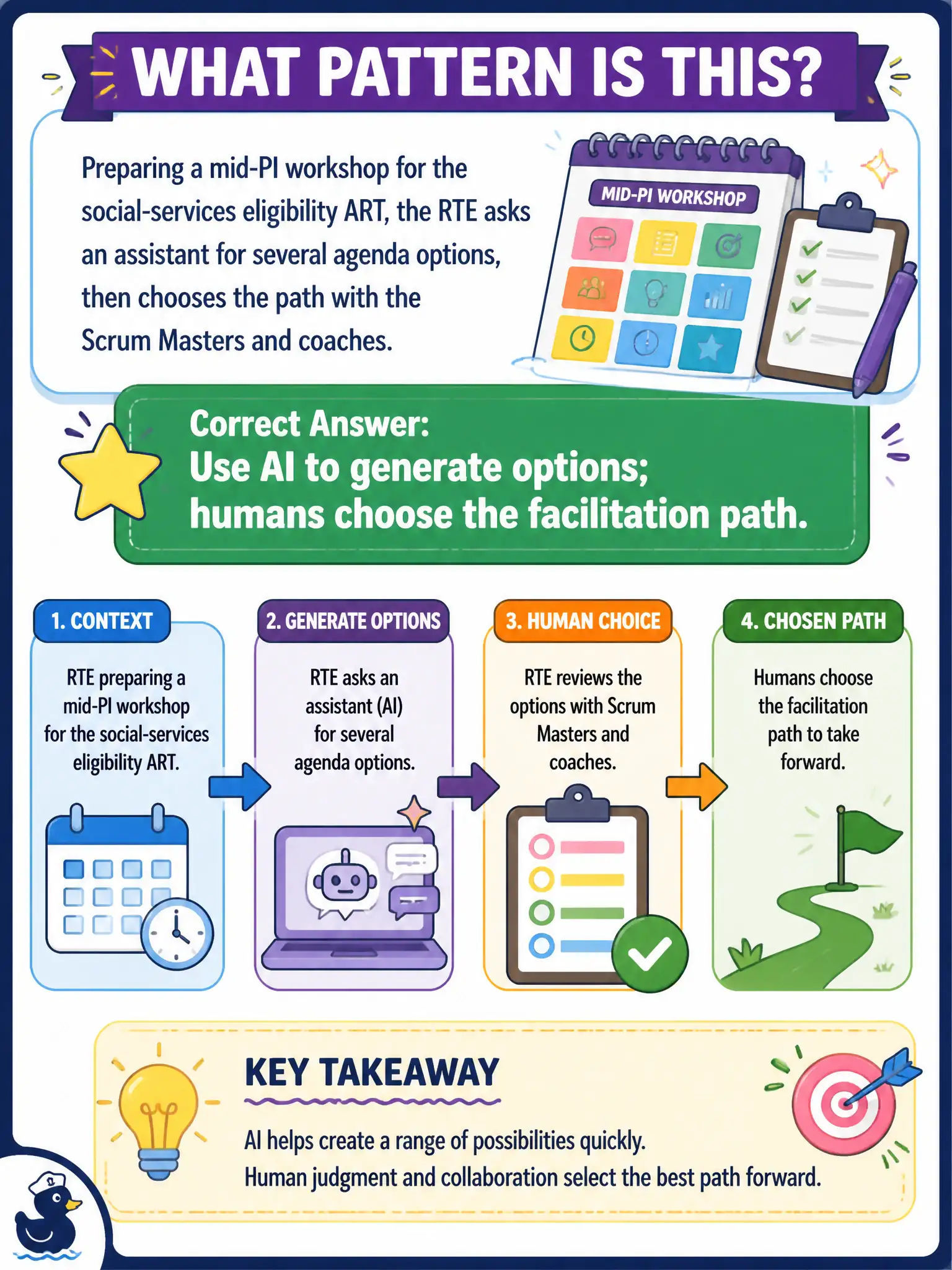
Preparing a mid-PI workshop for the social-services eligibility ART, the RTE asks an assistant for several agenda options, then chooses the path with the Scrum Masters and coaches. What pattern is this?
Select an answer to reveal the explanation.
Short Explanation
Brainstorming three workshop outlines is like asking for three route maps to the same eligibility office. The coaches still pick the road that fits the room. Options from the model, choice from the humans.
Full Explanation
A sound pattern is using AI to generate options while humans choose the facilitation path. Preparing a mid-PI workshop for the social-services eligibility ART, asking an assistant for several agenda options, then choosing with Scrum Masters and coaches, illustrates that split. Letting the model lock the agenda so coaches cannot change the room design removes facilitation ownership. Skipping the workshop because option generation already equals facilitation confuses prep with the event. Asking Business Owners to vote on every generated icebreaker as a PI Objective misuses PI Objectives and Business Owner time. Exam caveat: generated options still need fit checks against eligibility ART goals and timeboxes. Operational check: generate three agenda options, select one with coaches, adjust for current impediments, and run the human-facilitated mid-PI workshop. Keep the civic mission visible when applying the technique so resident-facing outcomes stay the measure of success. In municipal ART practice, capture the rationale in facilitation notes so future coaches inherit the same standard. Re-validate after the next PI cadence event that the same control still fits current civic constraints. Keep the civic mission visible when applying the technique so resident-facing outcomes stay the measure of success.