
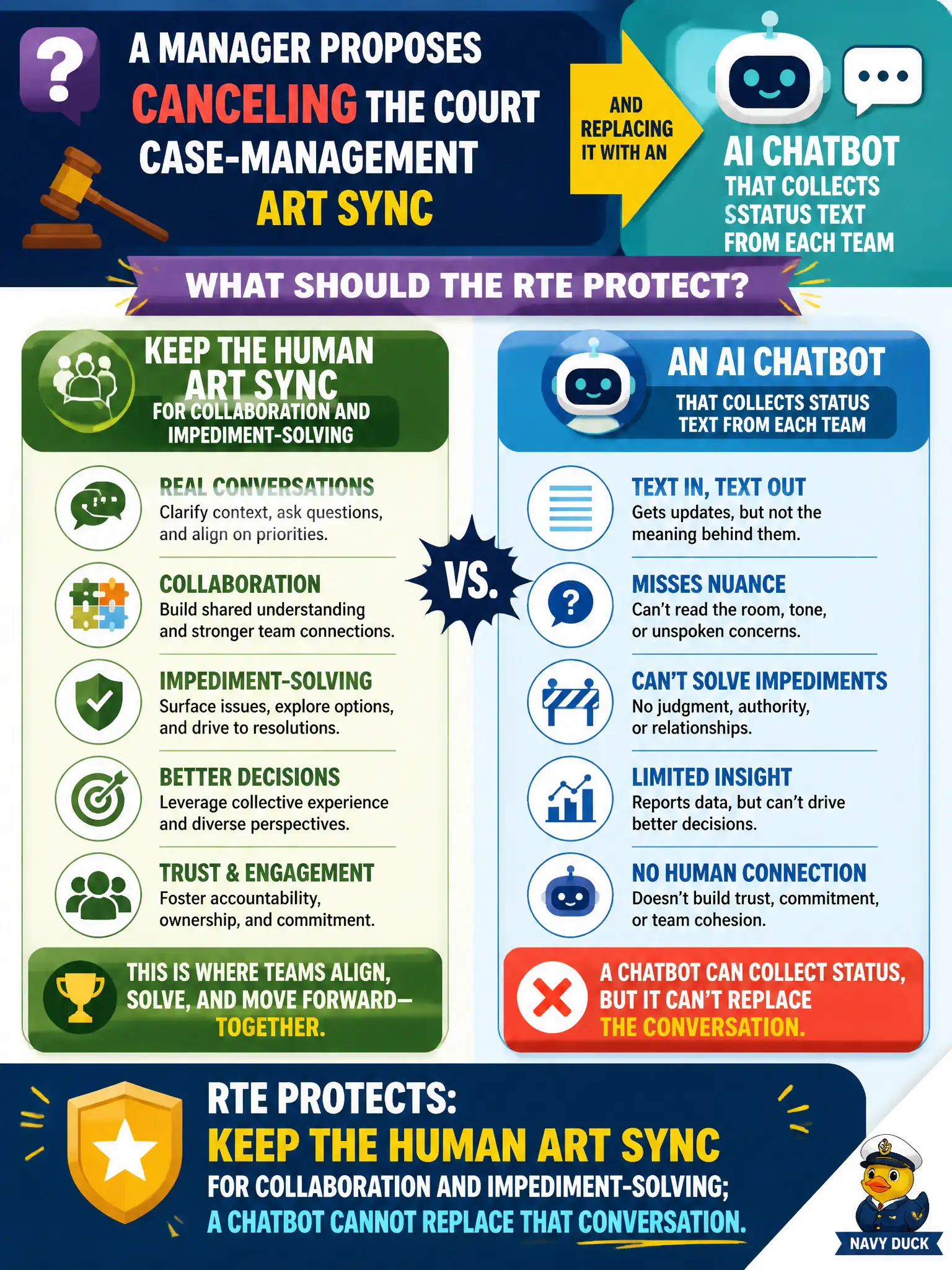
A manager proposes canceling the court case-management ART Sync and replacing it with an AI chatbot that collects status text from each team. What should the RTE protect?
Select an answer to reveal the explanation.
Short Explanation
Status in a drop-box is a voicemail, not a standup. Case-management teams need a live sync to surface blocked filings and negotiate help. Keep the meeting; maybe let a bot pre-collect topics.
Full Explanation
ART Sync exists for collaboration and impediment-solving, not merely status collection; a chatbot cannot replace that conversation. When a manager proposes canceling the court case-management ART Sync and replacing it with an AI chatbot that collects status text from each team, the RTE should protect the human sync. Status collection is not the only purpose of ART Sync, so a bot is not sufficient. Replacing Scrum of Scrums, PO Sync, and Coach Sync with the same chatbot collapses the ART’s coordination design. Using the chatbot to assign court-case story points without the teams removes estimation ownership. Exam caveat: chatbots may gather inputs before a sync; they do not facilitate dependency negotiation or impediment removal. Operational check: keep the court ART Sync on the calendar, optionally use AI to pre-aggregate status into a briefing pack, and spend the meeting on impediments and cross-team needs. Keep the civic mission visible when applying the technique so resident-facing outcomes stay the measure of success. In municipal ART practice, capture the rationale in facilitation notes so future coaches inherit the same standard. Re-validate after the next PI cadence event that the same control still fits current civic constraints.