
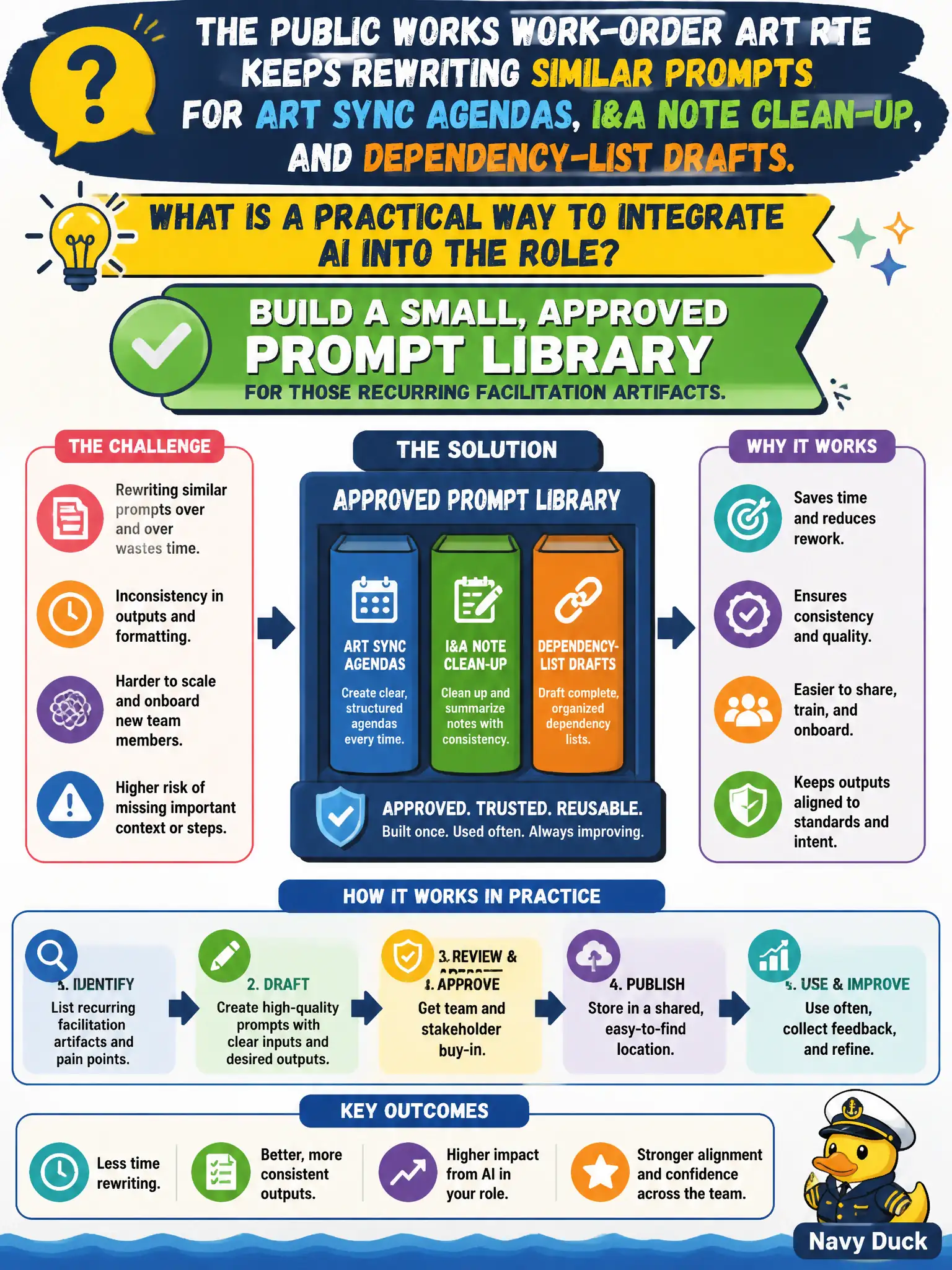
The public works work-order ART RTE keeps rewriting similar prompts for ART Sync agendas, I&A note clean-up, and dependency-list drafts. What is a practical way to integrate AI into the role?
Select an answer to reveal the explanation.
Short Explanation
If the same three recipes keep getting cooked, write them down. A short prompt library is a prep kit for ART Sync and Inspect and Adapt, not a robot RTE. Reuse the good prompts; keep a human in the kitchen.
Full Explanation
A practical way to integrate AI into the RTE role is a small, approved prompt library for recurring facilitation artifacts such as ART Sync agendas, I&A note clean-up, and dependency-list drafts. On the public works work-order ART, continually rewriting similar prompts from scratch wastes time and increases variance. Inventing a brand-new prompt every time to avoid creating process rejects useful standardization. Publishing one unrestricted prompt that pastes the entire work-order database risks data exposure. Outsourcing all public-works facilitation to an unattended agent removes the human RTE. Exam caveat: prompt libraries must live under approved tooling and data rules, with version notes for what each template is for. Operational check: create three reviewed templates for agenda, I&A cleanup, and dependency drafts; use them for one PI; and adjust based on Scrum Master feedback on output quality. Keep the civic mission visible when applying the technique so resident-facing outcomes stay the measure of success. In municipal ART practice, capture the rationale in facilitation notes so future coaches inherit the same standard. Re-validate after the next PI cadence event that the same control still fits current civic constraints.