
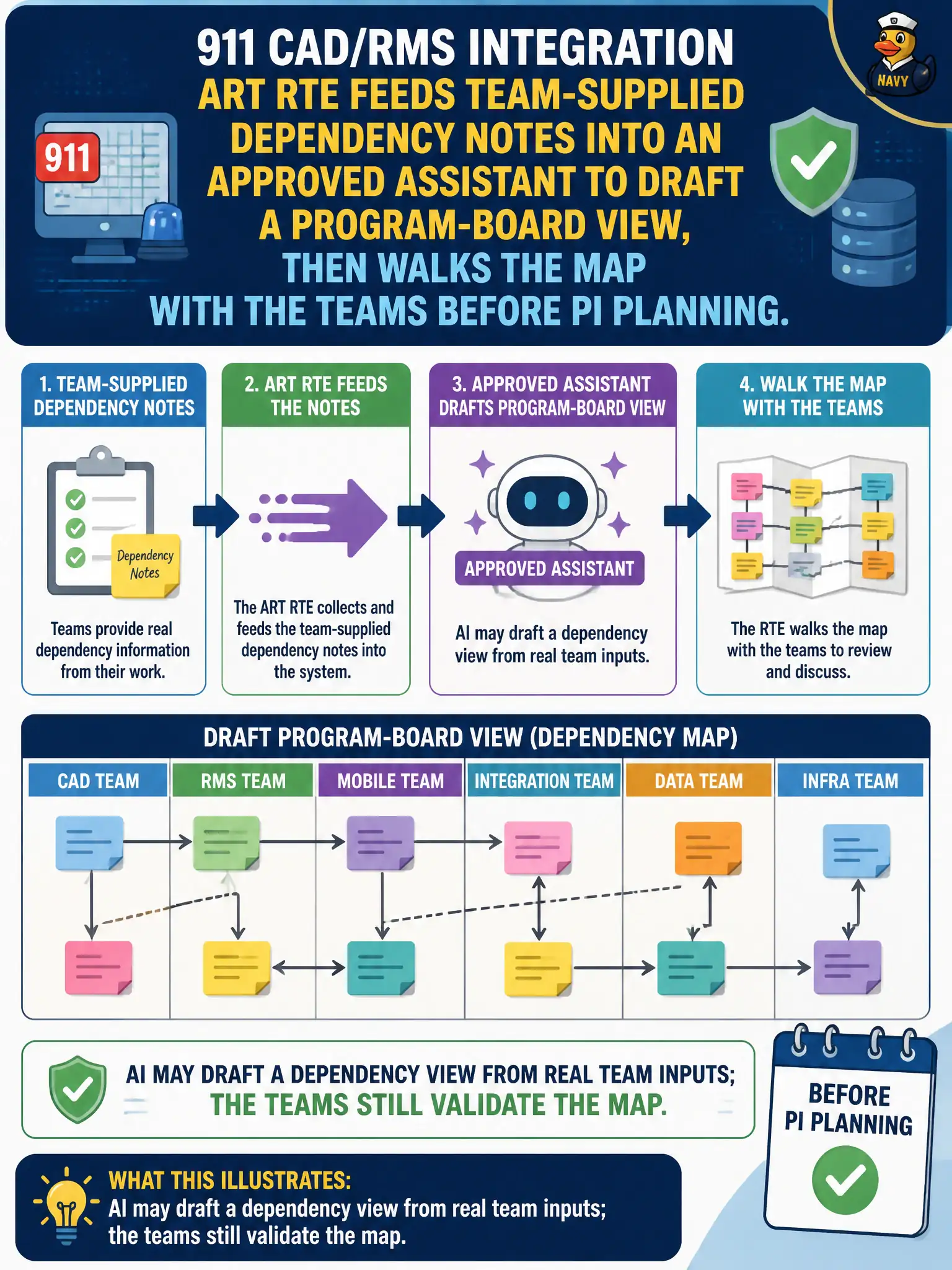
The 911 CAD/RMS integration ART RTE feeds team-supplied dependency notes into an approved assistant to draft a program-board view, then walks the map with the teams before PI Planning. What does this illustrate?
Select an answer to reveal the explanation.
Short Explanation
Think of the assistant as a copier that sorts sticky notes, not as the dispatcher who confirms the handoff. CAD and RMS teams still have to look at the map and say yes, that dependency is real. Draft, then validate.
Full Explanation
AI may draft a dependency view from real team inputs; the teams still validate the map. On the 911 CAD/RMS integration ART, feeding team-supplied dependency notes into an approved assistant to draft a program-board view, then walking the map with teams before PI Planning, illustrates that human-plus-AI split. The draft map does not replace team breakouts because the model already “heard” the notes—validation remains collaborative. Claiming dependency mapping must stay fully manual or it is not SAFe invents a purity rule that blocks useful drafting. Restricting AI-drafted dependency lists to Product Management alone excludes the teams who own the couplings. Exam caveat: only real team inputs should seed the draft; invented dependencies remain hallucinations. Operational check: regenerate only from supplied notes, facilitate a team walkthrough, and update the CAD/RMS program board with confirmed dependencies before planning commits. Keep the civic mission visible when applying the technique so resident-facing outcomes stay the measure of success. In municipal ART practice, capture the rationale in facilitation notes so future coaches inherit the same standard. Re-validate after the next PI cadence event that the same control still fits current civic constraints.