
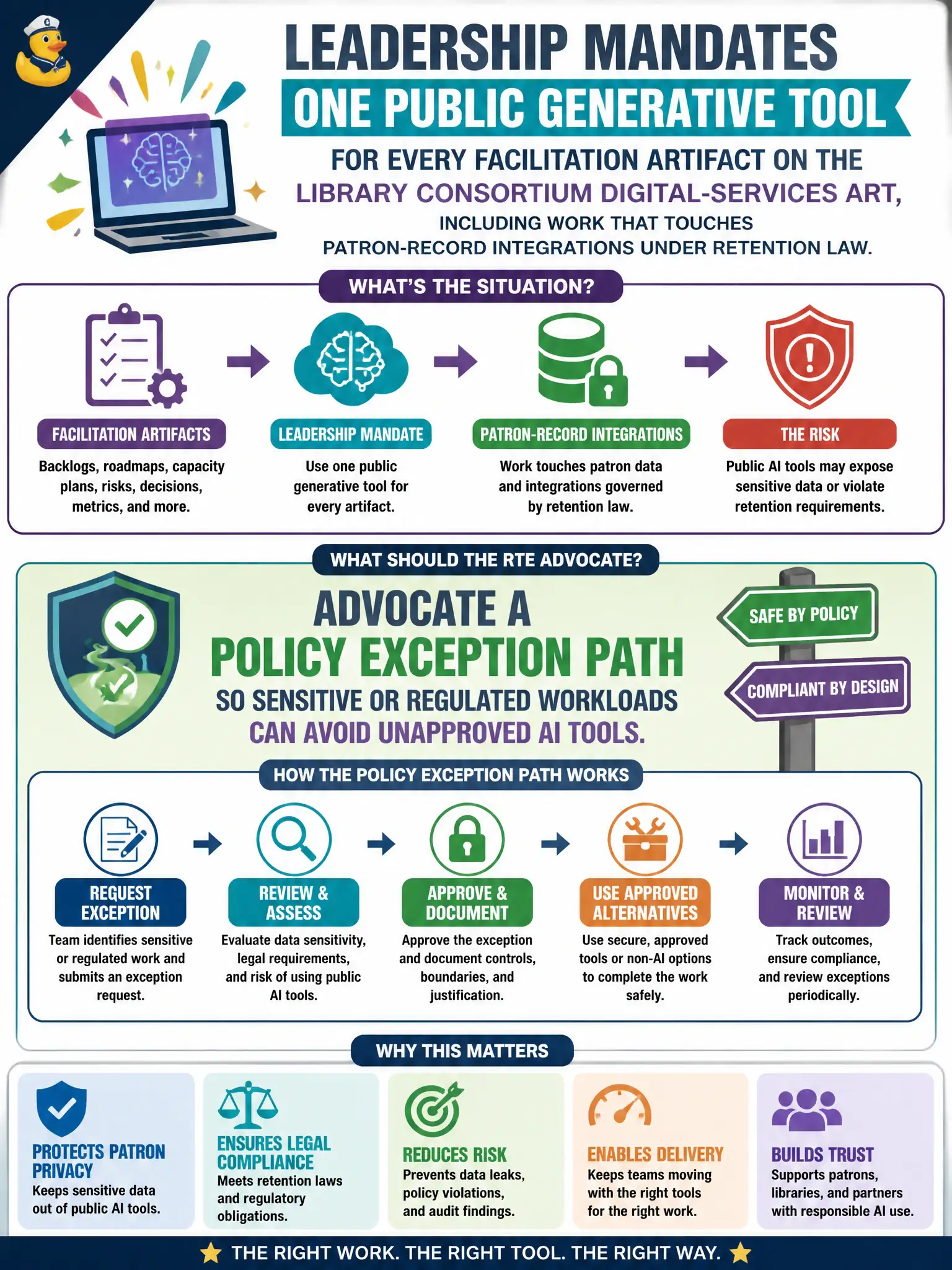
Leadership mandates one public generative tool for every facilitation artifact on the library consortium digital-services ART, including work that touches patron-record integrations under retention law. What should the RTE advocate?
Select an answer to reveal the explanation.
Short Explanation
A public catalog card is not a patron's borrowing history. One mandatory AI hose for every library artifact will spray regulated data into the wrong tank. Responsible use needs an off-ramp for sensitive paths.
Full Explanation
Sensitive or regulated workloads need a policy exception path so they can avoid unapproved AI tools even when leadership mandates one public generative tool for facilitation artifacts. On the library consortium digital-services ART, work touching patron-record integrations under retention law is such a case; the RTE should advocate that exception path. Mandating the same public tool for patron records to keep a single way of working prioritizes uniformity over legality and privacy. Treating library data as always shareable because online catalogs are public confuses catalog metadata with patron records. Replacing the consortium’s legal review with the model’s published privacy statement subordinates law to vendor marketing. Exam caveat: exceptions should be explicit and time-bounded with alternative approved tooling, not quiet shadow IT. Operational check: inventory which library facilitation artifacts touch patron data, route those off the public tool, and obtain a documented exception for regulated workloads. Keep the civic mission visible when applying the technique so resident-facing outcomes stay the measure of success. In municipal ART practice, capture the rationale in facilitation notes so future coaches inherit the same standard.