
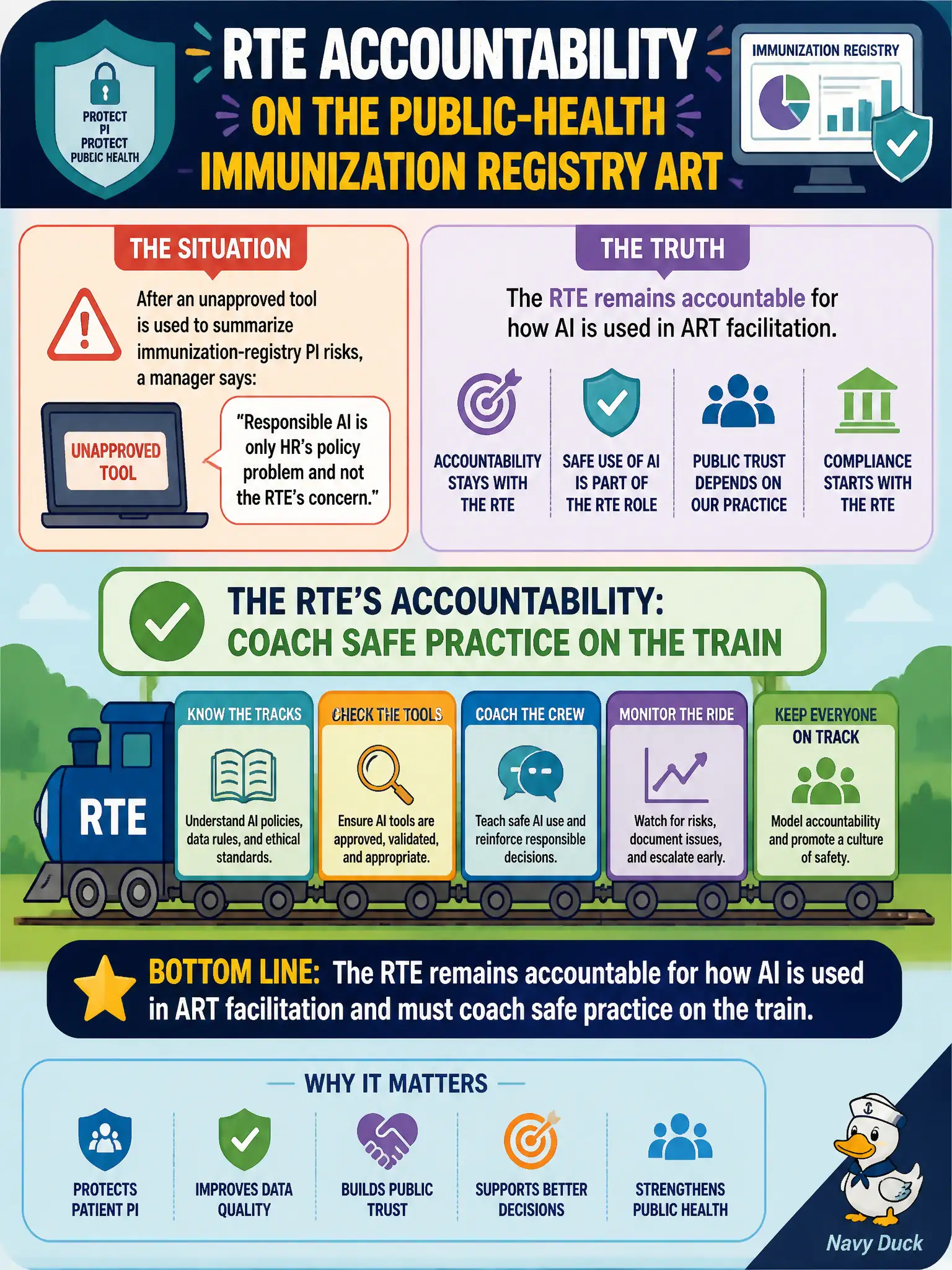
After an unapproved tool is used to summarize immunization-registry PI risks, a manager says responsible AI is only HR's policy problem and not the RTE's concern. What is the RTE's accountability on the public-health immunization registry ART?
Select an answer to reveal the explanation.
Short Explanation
HR writes employment policy; the RTE still runs the room. If a risky tool shows up in a registry risk huddle, that is facilitation, not a personnel form. Servant leadership includes how the train uses AI.
Full Explanation
The RTE remains accountable for how AI is used in ART facilitation and must coach safe practice on the train. After an unapproved tool summarizes immunization-registry PI risks and a manager says responsible AI is only HR’s policy problem, the RTE should reject that deflection. HR may own enterprise policy, but the RTE still coaches how tools are used in ART events that touch public-health work. Claiming public-health data exempts the ART from municipal AI policy is backward—health data usually tightens controls. Asserting only the System Architect can approve or reject AI in ART events ignores RTE facilitation ownership. Exam caveat: escalate policy exceptions through the proper channels, but do not abandon on-train coaching while waiting. Operational check: stop unapproved tool use on the immunization registry ART, brief coaches on approved alternatives, and document the incident with security/privacy partners. Keep the civic mission visible when applying the technique so resident-facing outcomes stay the measure of success. In municipal ART practice, capture the rationale in facilitation notes so future coaches inherit the same standard. Re-validate after the next PI cadence event that the same control still fits current civic constraints.