
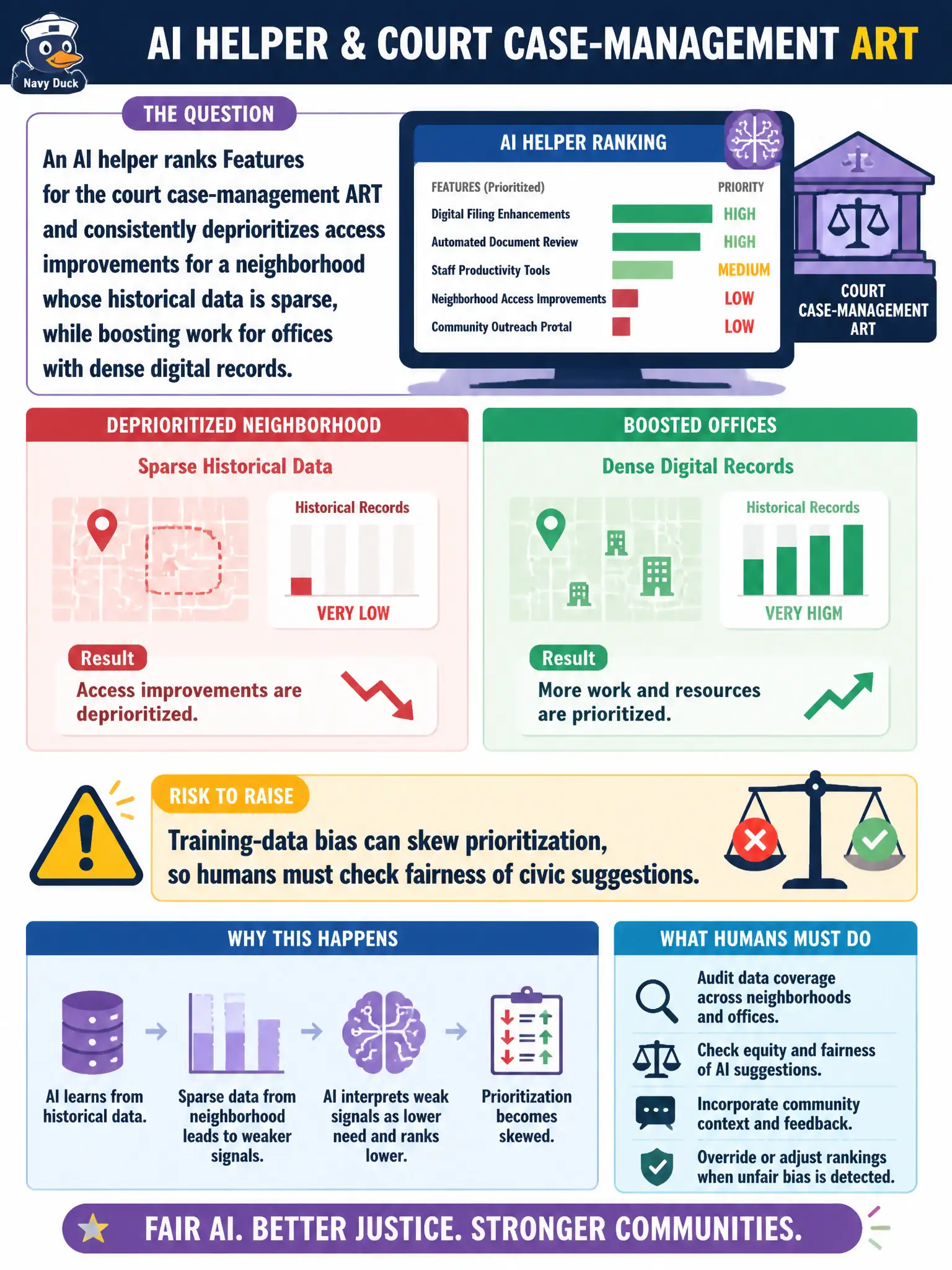
An AI helper ranks Features for the court case-management ART and consistently deprioritizes access improvements for a neighborhood whose historical data is sparse, while boosting work for offices with dense digital records. What risk should the RTE raise?
Select an answer to reveal the explanation.
Short Explanation
If the model only sees the offices that already have fancy data, it will keep feeding those offices. That is bias, not wisdom. Fairness in a courthouse backlog is a human check, not a vendor slogan.
Full Explanation
Training-data bias can skew AI prioritization, so humans must check fairness of civic suggestions. When an AI helper ranks Features for the court case-management ART and consistently deprioritizes access improvements for a neighborhood with sparse historical data while boosting offices with dense digital records, the RTE should raise that bias risk. Claiming sparse-data neighborhoods should always wait because the model is “mathematically fair” confuses statistical confidence with equity of access to justice. Asserting bias is impossible if the vendor’s marketing mentions ethics is not a control. Hiding the ranking from Business Owners so bias cannot be discussed prevents governance. Exam caveat: sparse data often needs human judgment and intentional policy weights, not quiet deprioritization by default model behavior. Operational check: compare the ranked list to court access goals, surface the sparse-neighborhood Features explicitly with Business Owners, and adjust priority with a fairness rationale recorded on the program backlog. Keep the civic mission visible when applying the technique so resident-facing outcomes stay the measure of success. In municipal ART practice, capture the rationale in facilitation notes so future coaches inherit the same standard.