
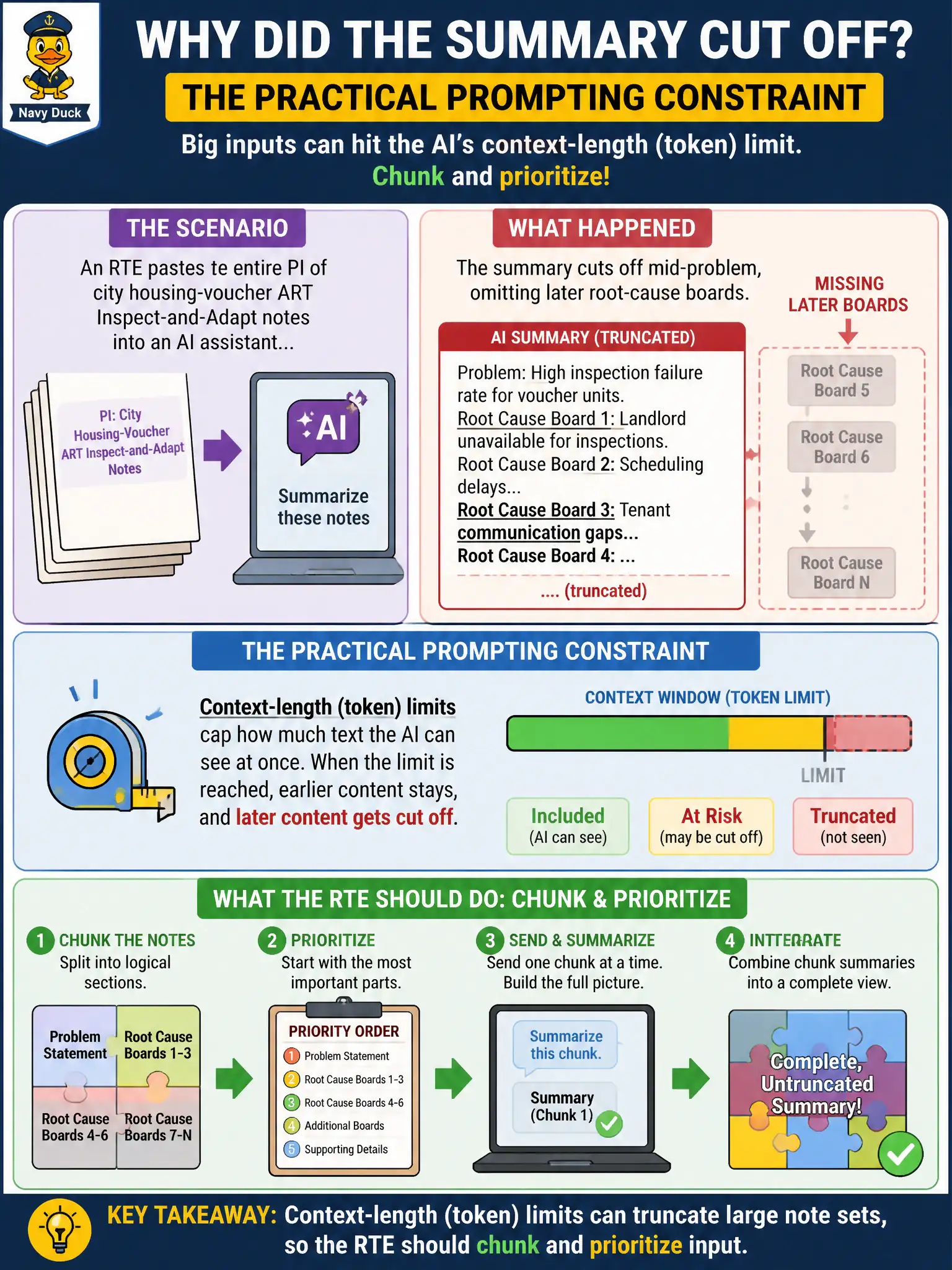
An RTE pastes an entire PI of city housing-voucher ART Inspect-and-Adapt notes into an AI assistant and the summary cuts off mid-problem, omitting later root-cause boards. What practical prompting constraint is showing up?
Select an answer to reveal the explanation.
Short Explanation
Assistants have a backpack, not a warehouse. Stuff a whole PI of Inspect-and-Adapt notes in at once and the zipper bursts—the last boards never make the summary. Break the notes into chunks and tell the model what matters most.
Full Explanation
Context-length (token) limits can truncate large note sets, so RTEs should chunk and prioritize input. When an RTE pastes an entire PI of city housing-voucher ART Inspect-and-Adapt notes and the summary cuts off mid-problem, omitting later root-cause boards, that constraint is showing up. The model is not refusing civic housing content as SAFe policy, I&A notes are not legally forbidden from summarization by any digital tool as a blanket rule, and truncation does not mean omitted boards had no findings. Ignoring later boards because they were dropped mid-summary loses real improvement work for residents. Exam caveat: chunking still requires approved tools and redaction of sensitive client data before paste. Operational check: split I&A notes by problem theme, summarize each chunk, then merge under human review so every root-cause board appears in the housing-voucher improvement record. Keep the civic mission visible when applying the technique so resident-facing outcomes stay the measure of success. In municipal ART practice, capture the rationale in facilitation notes so future coaches inherit the same standard. Re-validate after the next PI cadence event that the same control still fits current civic constraints.