
Leaders on the state DMV licensing ART want the RTE to generate all Team and ART PI Objectives with an AI tool and skip team and Business Owner conversations. What should the RTE do?
Select an answer to reveal the explanation.
Short Explanation
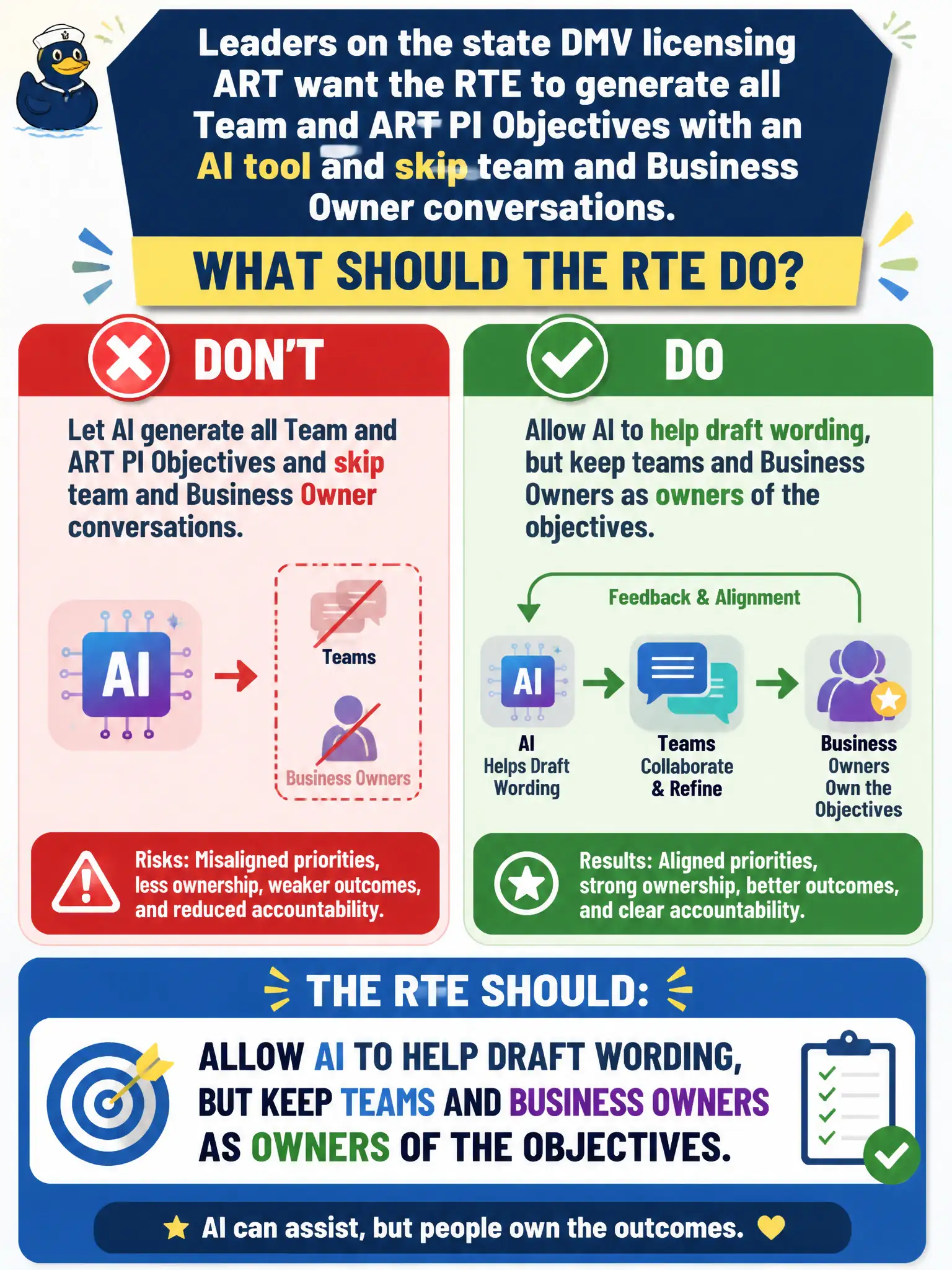
The model can polish a sentence, but it cannot sit in the room and own a PI Objective. Teams still write what they will deliver, and Business Owners still assign business value—drafts are help, ownership stays human.
Full Explanation
AI may help draft wording for Team and ART PI Objectives, but teams and Business Owners remain the owners of those objectives. On the state DMV licensing ART, leaders wanting the RTE to generate all objectives with a tool and skip conversations remove the collaboration that makes objectives meaningful. Publishing the model’s objectives as committed because generation speed proves alignment confuses velocity of text with alignment of people. Hiding generated objectives until after the confidence vote so teams cannot change them weaponizes AI against transparency. Replacing Business Owner business-value assignment with the model’s numeric scores displaces Business Owner accountability. Exam caveat: drafting assistance is fine in prep; commitment still happens through PI Planning conversations and Business Owner valuation. Operational check: allow AI-assisted wording polish on draft objectives, then walk every objective with DMV teams and Business Owners before any commitment or confidence vote. Keep the civic mission visible when applying the technique so resident-facing outcomes stay the measure of success. In municipal ART practice, capture the rationale in facilitation notes so future coaches inherit the same standard.