
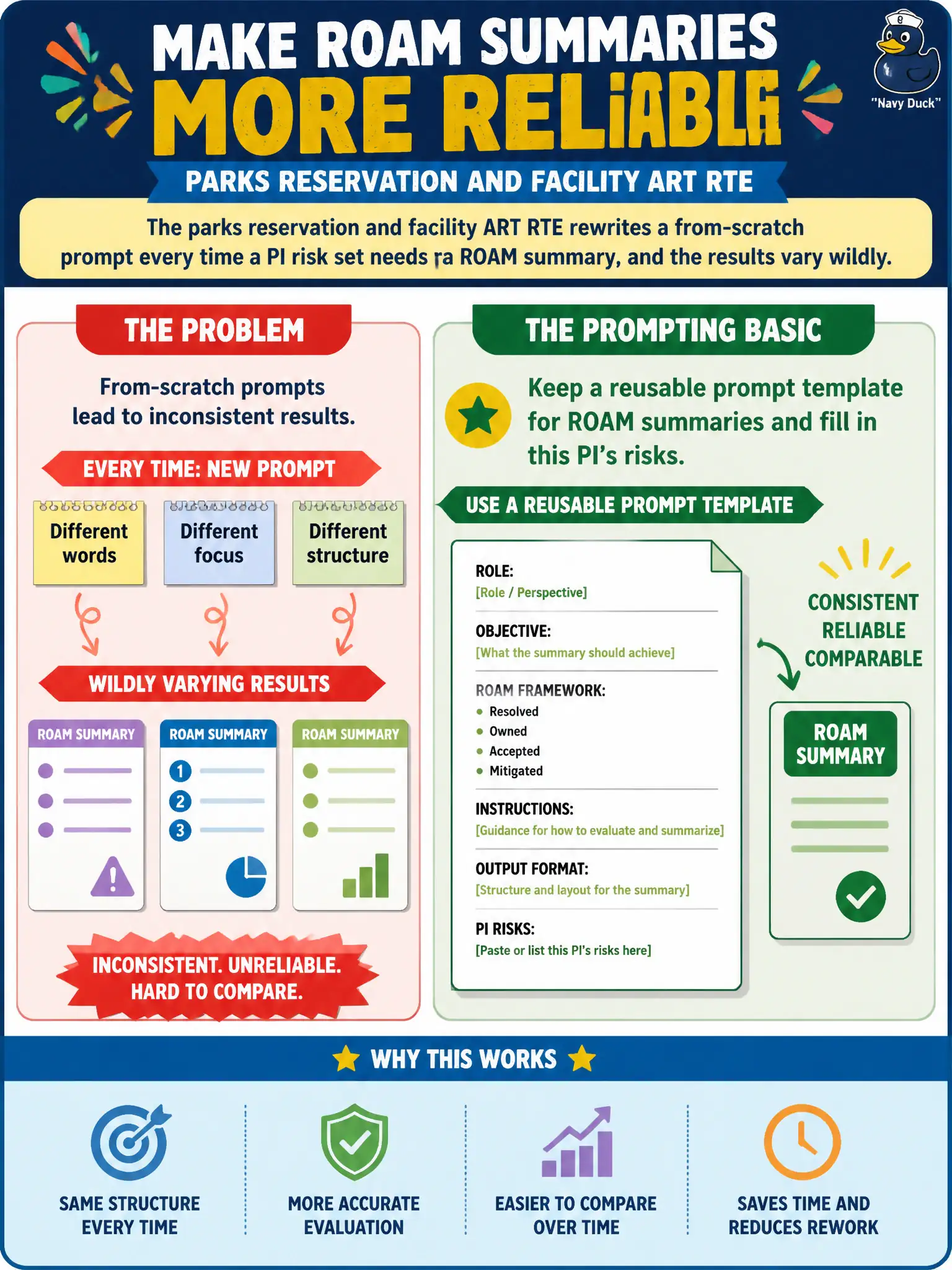
The parks reservation and facility ART RTE rewrites a from-scratch prompt every time a PI risk set needs a ROAM summary, and the results vary wildly. What prompting basic would make this work more reliable?
Select an answer to reveal the explanation.
Short Explanation
If the recipe is rewritten from scratch every Saturday, Saturday's stew never tastes the same. A reusable prompt template for ROAM summaries is that recipe—with this PI's risks dropped in. Consistency is a feature.
Full Explanation
Reusable prompt templates improve reliability for recurring facilitation artifacts. On the parks reservation and facility ART, rewriting a from-scratch prompt every time a PI risk set needs a ROAM summary causes wild variance; keeping a reusable template and filling in this PI’s risks stabilizes quality. Avoiding templates so each summary is a surprise prioritizes novelty over inspectable process. Storing one frozen ROAM output and reusing it for every future PI ignores new risks. Prompting only with the word ROAM and expecting the model to recall last PI’s board relies on memory the chat may not have and skips current inputs. Exam caveat: templates still require fresh risk inputs each PI and human review of Resolved/Owned/Accepted/Mitigated classifications. Operational check: save an approved ROAM-summary template, paste this PI’s parks risks, edit ownership and mitigations with Business Owners, and archive the verified summary—not the raw first draft. Keep the civic mission visible when applying the technique so resident-facing outcomes stay the measure of success. In municipal ART practice, capture the rationale in facilitation notes so future coaches inherit the same standard. Re-validate after the next PI cadence event that the same control still fits current civic constraints.