
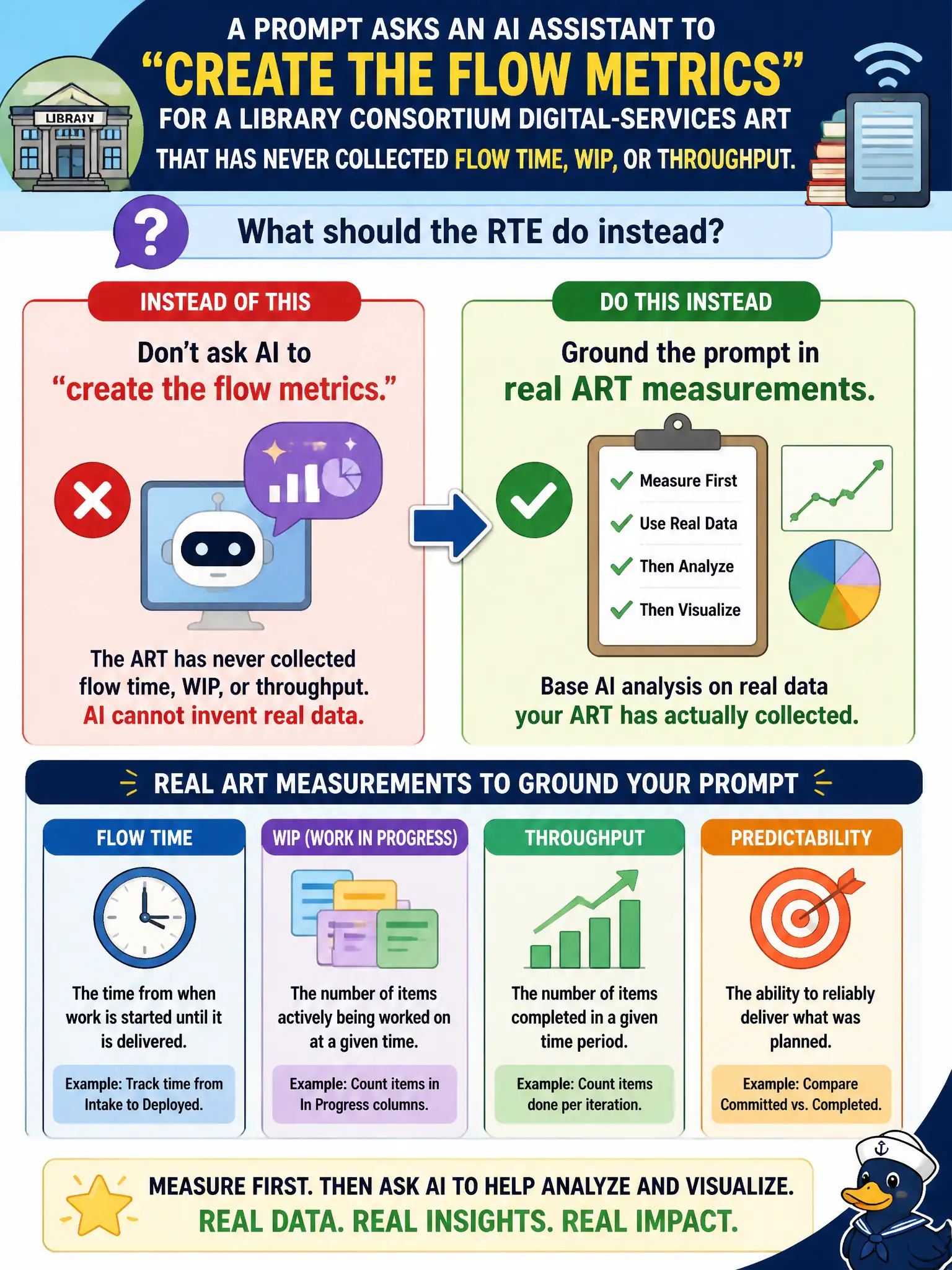
A prompt asks an AI assistant to "create the flow metrics" for a library consortium digital-services ART that has never collected flow time, WIP, or throughput. What should the RTE do instead?
Select an answer to reveal the explanation.
Short Explanation
If the train never timed a Feature, the chatbot cannot magically know flow time. Made-up metrics are fan fiction with decimals. Ground the prompt in numbers you actually have, or go collect them.
Full Explanation
Flow metrics must be grounded in real ART measurements; AI should not invent numbers a train never collected. For a library consortium digital-services ART that has never collected flow time, WIP, or throughput, the RTE should ground prompts in real measurements rather than asking AI to create the metrics. Accepting invented numbers as a baseline because the model sounds confident installs fiction as empiricism. Publishing generated metrics to the city dashboard and backfilling measurement later misleads municipal stakeholders. Asking the model to copy another city’s unpublished library metrics and treat them as this ART’s data is both methodologically wrong and potentially a confidentiality problem. Exam caveat: AI can help format or analyze metrics once real data exists; it cannot substitute for instrumentation. Operational check: start collecting WIP, throughput, and flow time on the library ART, then prompt for analysis or visualization only against those measured values. Keep the civic mission visible when applying the technique so resident-facing outcomes stay the measure of success. In municipal ART practice, capture the rationale in facilitation notes so future coaches inherit the same standard.