
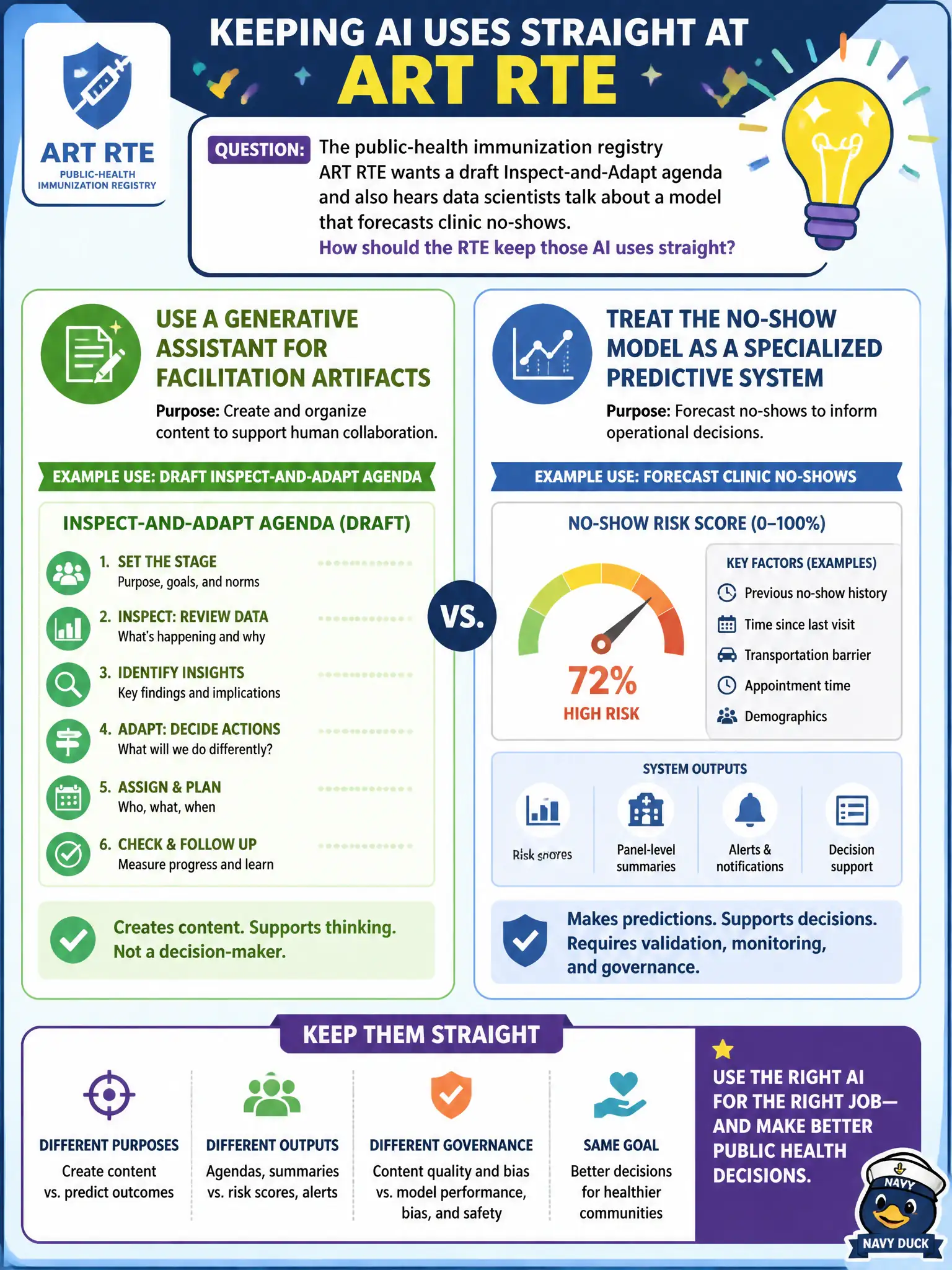
The public-health immunization registry ART RTE wants a draft Inspect-and-Adapt agenda and also hears data scientists talk about a model that forecasts clinic no-shows. How should the RTE keep those AI uses straight?
Select an answer to reveal the explanation.
Short Explanation
Writing an agenda and predicting who will miss a flu clinic are not the same kind of "AI." One is a generative assistant drafting text you edit. The other is a specialized predictive system sitting in the product. Mix them up and the wrong tool gets the wrong job.
Full Explanation
Generative assistants that draft facilitation artifacts are not the same class of system as specialized predictive models. On the public-health immunization registry ART, the RTE should use a generative assistant for an Inspect-and-Adapt agenda draft and treat a clinic no-show forecast model as a specialized predictive system. Collapsing those uses causes the wrong tool to be asked for the wrong job. Treating the no-show forecast as a drop-in replacement for Inspect and Adapt facilitation confuses prediction with ART problem-solving workshops. Assuming any tool labeled AI can both write the agenda and operate the immunization registry overgeneralizes capabilities and risk. Banning predictive models and generative assistants equally because both replace the RTE role throws away legitimate augmentation. Exam caveat: both classes still need human oversight and municipal data governance appropriate to health information. Operational check: keep I&A agenda drafting in the generative workflow with human edit, and route no-show forecasts through the analytics owners who validate model fitness for clinic operations. Keep the civic mission visible when applying the technique so resident-facing outcomes stay the measure of success.