
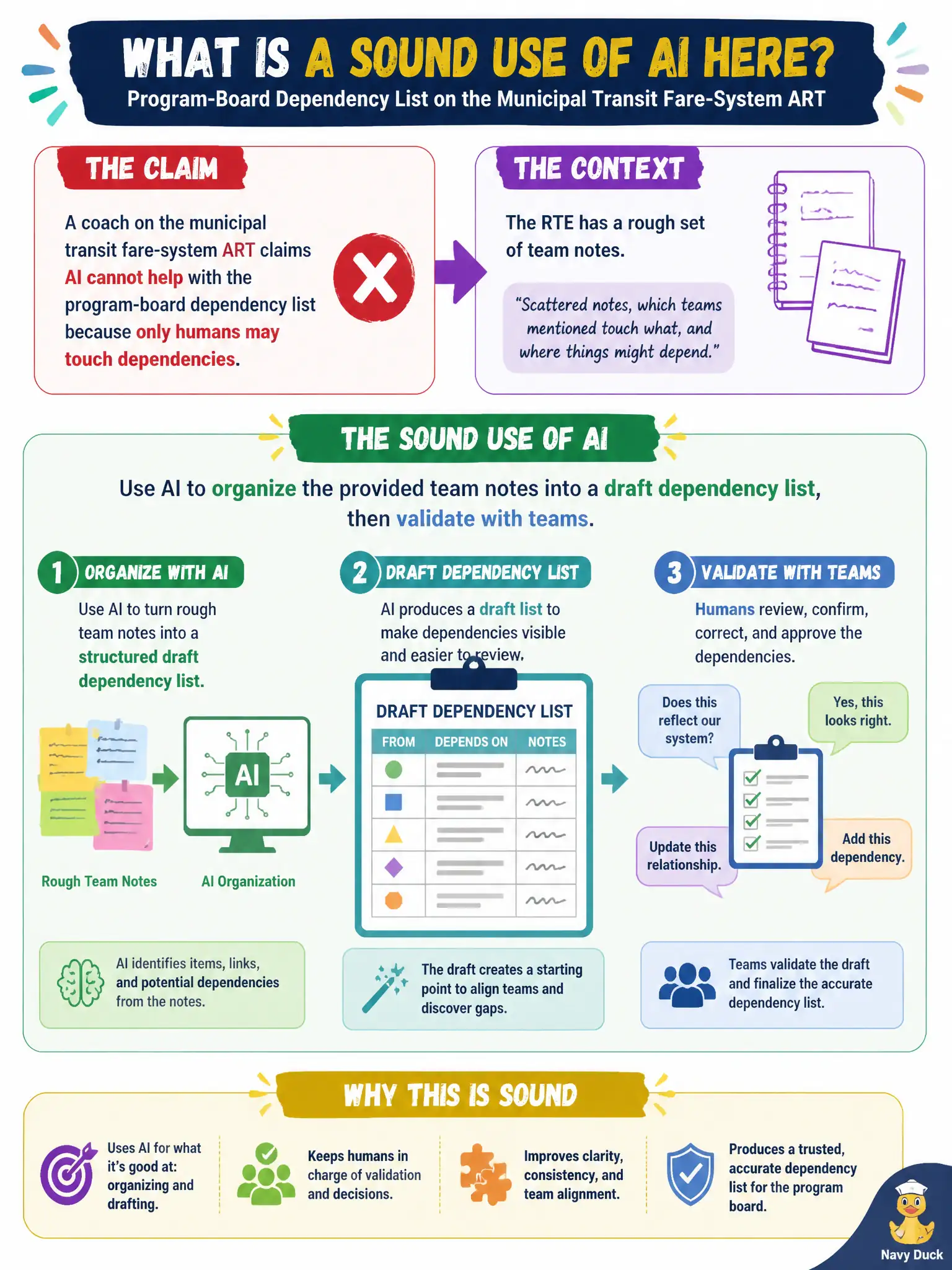
A coach on the municipal transit fare-system ART claims AI cannot help with the program-board dependency list because only humans may touch dependencies. The RTE has a rough set of team notes. What is a sound use of AI here?
Select an answer to reveal the explanation.
Short Explanation
Nobody said the chatbot owns the program board. It can sort a messy pile of notes into a draft list so people can check it. Humans still validate every wire on that board.
Full Explanation
AI may organize provided team notes into a draft dependency list that humans then validate; it must not invent the board. On the municipal transit fare-system ART, when a coach claims only humans may touch dependencies, a sound use is still drafting from real notes, then validating with teams before PI Planning. Letting the model invent cross-ART dependencies no team mentioned so the board looks full fabricates risk and work. Hiding the notes and asking the model to guess fare-gate couplings from public transit trivia replaces evidence with speculation. Replacing the program board with the model’s list and skipping the PI Planning dependency walk removes the collaborative validation SAFe expects. Exam caveat: drafting assistance is allowed; unsupervised publication of invented dependencies is not. Operational check: feed only the team-supplied notes into an approved tool, produce a draft list, walk it with fare-system teams, and update the program board only with confirmed dependencies. Keep the civic mission visible when applying the technique so resident-facing outcomes stay the measure of success. In municipal ART practice, capture the rationale in facilitation notes so future coaches inherit the same standard.