
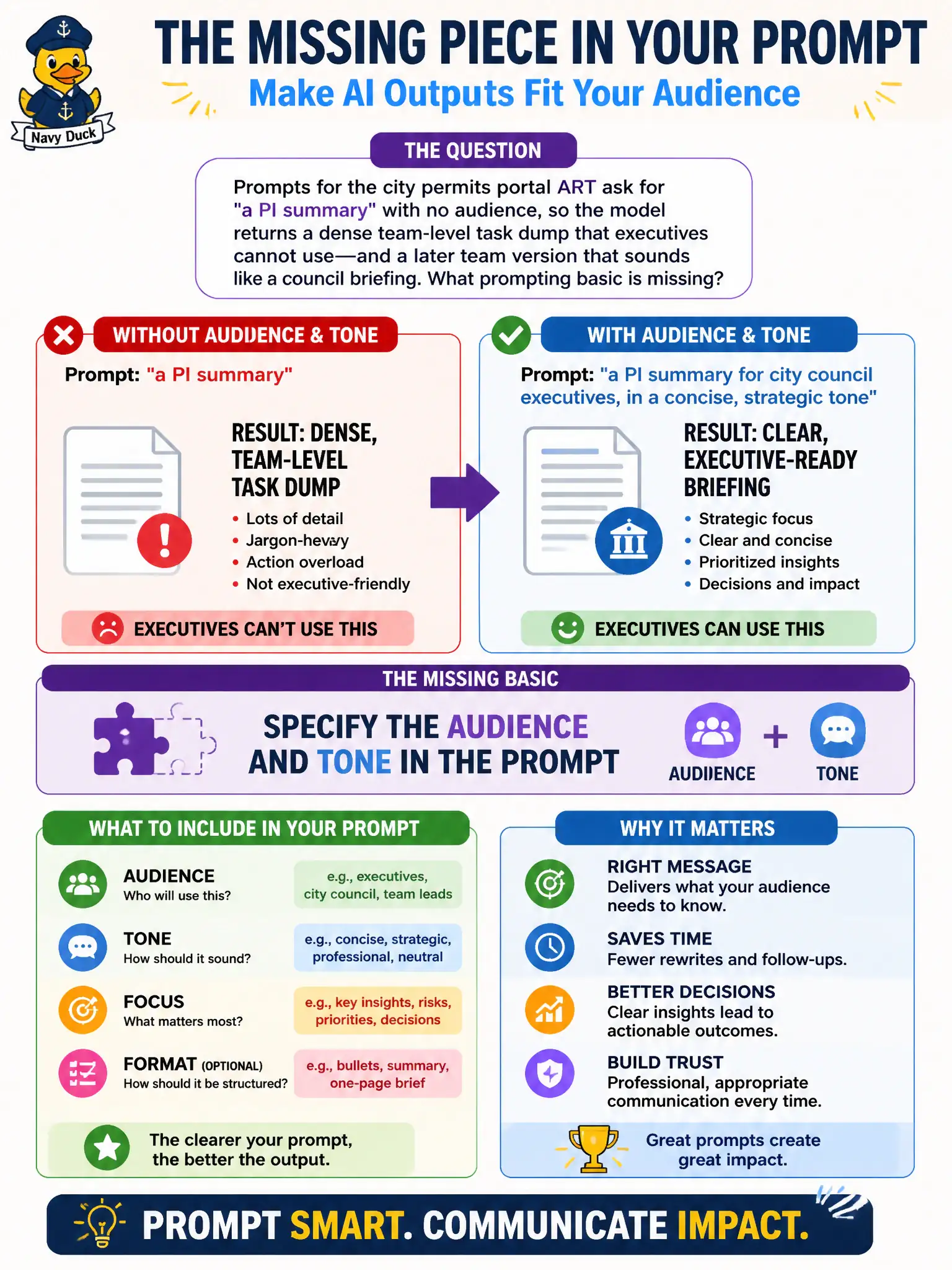
Prompts for the city permits portal ART ask for "a PI summary" with no audience, so the model returns a dense team-level task dump that executives cannot use—and a later team version that sounds like a council briefing. What prompting basic is missing?
Select an answer to reveal the explanation.
Short Explanation
A PI summary for the mayor is not the same note you pin on the team board. If the prompt never says who will read it, the tone will be wrong. Audience is a prompting basic, not extra credit.
Full Explanation
Audience and tone are basic prompting parameters for usable facilitation artifacts. On the city permits portal ART, asking for “a PI summary” with no audience produces mismatched outputs—dense team task dumps executives cannot use, or team versions that sound like council briefings. Specifying audience and tone so the artifact fits executives or teams is the missing basic. Always requesting the longest possible summary so every audience can skim the same document ignores that different readers need different altitude. Omitting permit-domain words so the model defaults to generic corporate tone strips civic meaning. Asking the model to address executives and teams in one undifferentiated paragraph recreates the mismatch in a single blob. Exam caveat: separate artifacts for separate audiences beat one overloaded summary, even if that means two short prompts. Operational check: prompt once for a council-facing permits PI narrative and once for a team-facing iteration summary; verify each uses the right altitude before publishing. Keep the civic mission visible when applying the technique so resident-facing outcomes stay the measure of success. In municipal ART practice, capture the rationale in facilitation notes so future coaches inherit the same standard.