
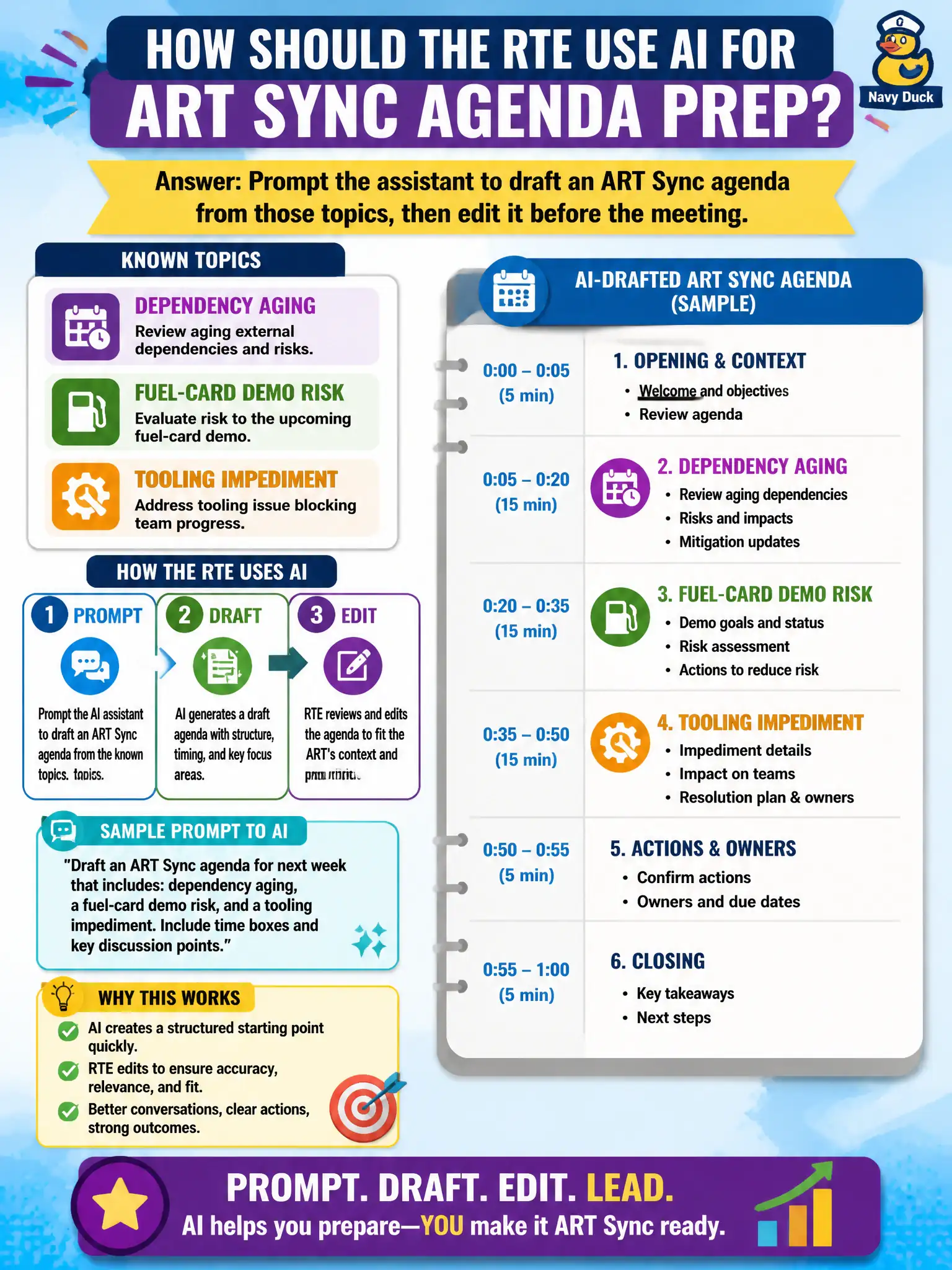
The fleet telematics ART RTE wants help assembling next week's ART Sync agenda from known topics: dependency aging, a fuel-card demo risk, and a tooling impediment. How should the RTE use AI for this?
Select an answer to reveal the explanation.
Short Explanation
Drafting an agenda is exactly the chore an assistant is good at—if a human still owns the meeting. Feed it the real topics, take the draft, and tune it. Do not hand the gavel to the chatbot.
Full Explanation
Sound RTE augmentation uses AI to draft facilitation artifacts that humans then edit. For the fleet telematics ART, prompting an assistant to draft next week’s ART Sync agenda from known topics—dependency aging, a fuel-card demo risk, and a tooling impediment—then editing before the meeting is appropriate. The draft saves prep time; the RTE still owns facilitation quality. Skipping the ART Sync and emailing the model’s agenda as the official record replaces collaboration with a document. Asking the model to facilitate the live ART Sync in place of the RTE and Scrum Masters/Team Coaches removes human facilitation from a core ART event. Using AI only for jokes because agendas must be handwritten invents a false purity rule and wastes a legitimate draft aid. Exam caveat: draft-then-edit still requires approved tools and no sensitive citizen data in prompts. Operational check: generate a draft agenda from the three topics, edit owners and timeboxes, circulate to Scrum Masters, and run the telematics ART Sync as a human-facilitated conversation. Keep the civic mission visible when applying the technique so resident-facing outcomes stay the measure of success. In municipal ART practice, capture the rationale in facilitation notes so future coaches inherit the same standard.