
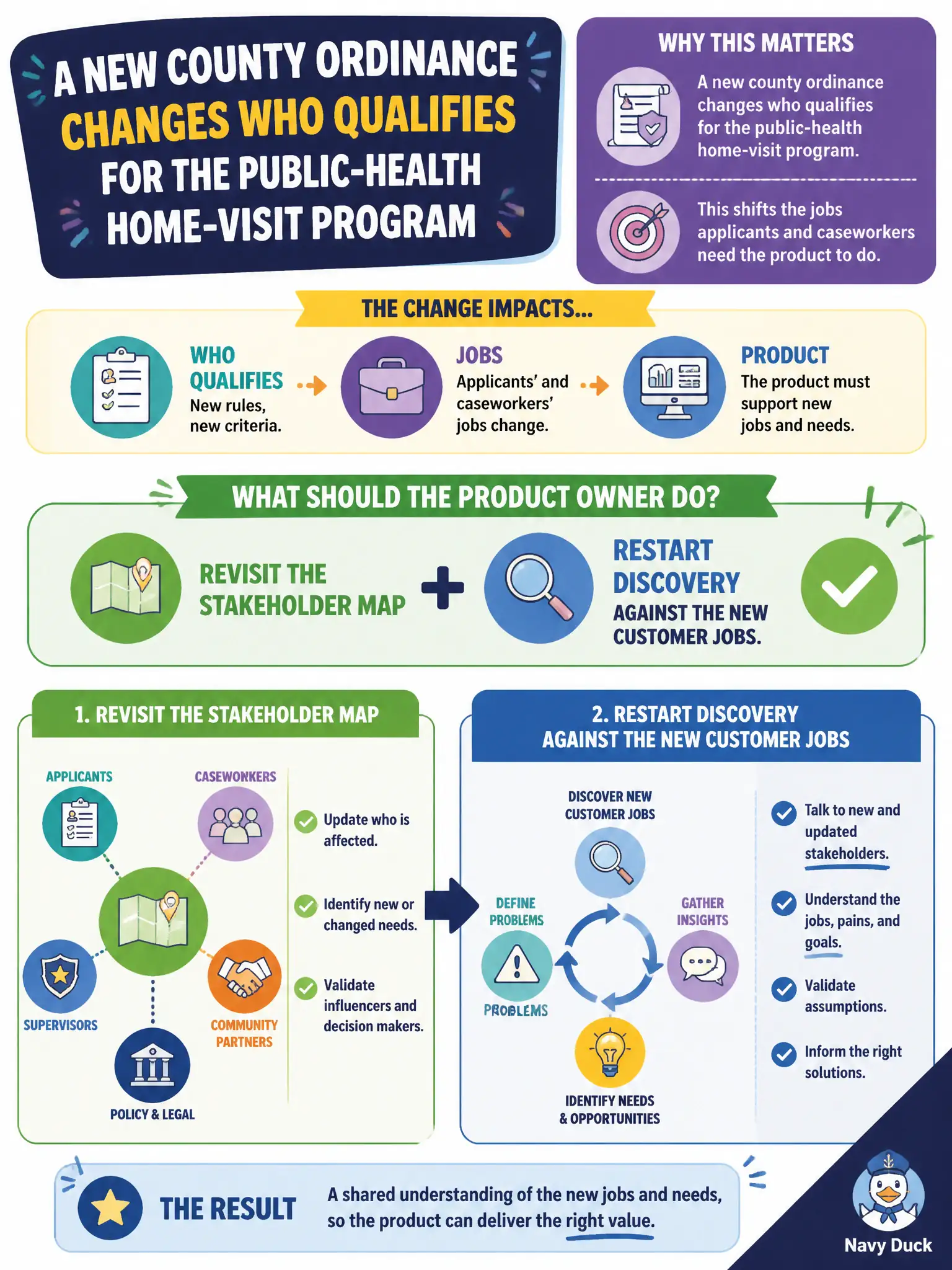
A new county ordinance changes who qualifies for the public-health home-visit program, shifting the jobs applicants and caseworkers need the product to do. What should the Product Owner do?
Select an answer to reveal the explanation.
Short Explanation
When the rulebook changes, yesterday’s customer map is a souvenir. Go find who the product is for now and what job they hire it to do. Shipping the old journey faster just helps the wrong people more efficiently.
Full Explanation
Policy and context shifts can invalidate prior customer understanding for public-health products. When a new county ordinance changes who qualifies for a home-visit program, the jobs applicants and caseworkers need the product to do also shift. Advanced Product Owners revisit the stakeholder map and restart discovery against the new customer jobs, and may even revisit Product Goal assumptions. Continuing on the old map treats the Product Backlog as a requirements warehouse rather than an empirical value instrument.
Keeping the existing stakeholder map and Product Goal because “policy is outside product work” fails because policy changed the job-to-be-done the product must serve. Freezing the backlog until legal rewrites every item fails by turning adaptation into a legal batch gate. Asking finance to keep funding the old workflow fails because it preserves obsolete value for the wrong user set.
Exam caveat: When eligibility rules change, refresh discovery and stakeholders; do not ship the old journey faster. Operational check: Within one Sprint of the ordinance, redraw who applies and who caseworks the new criteria, run discovery sessions with both, and reorder the backlog against the new jobs.