
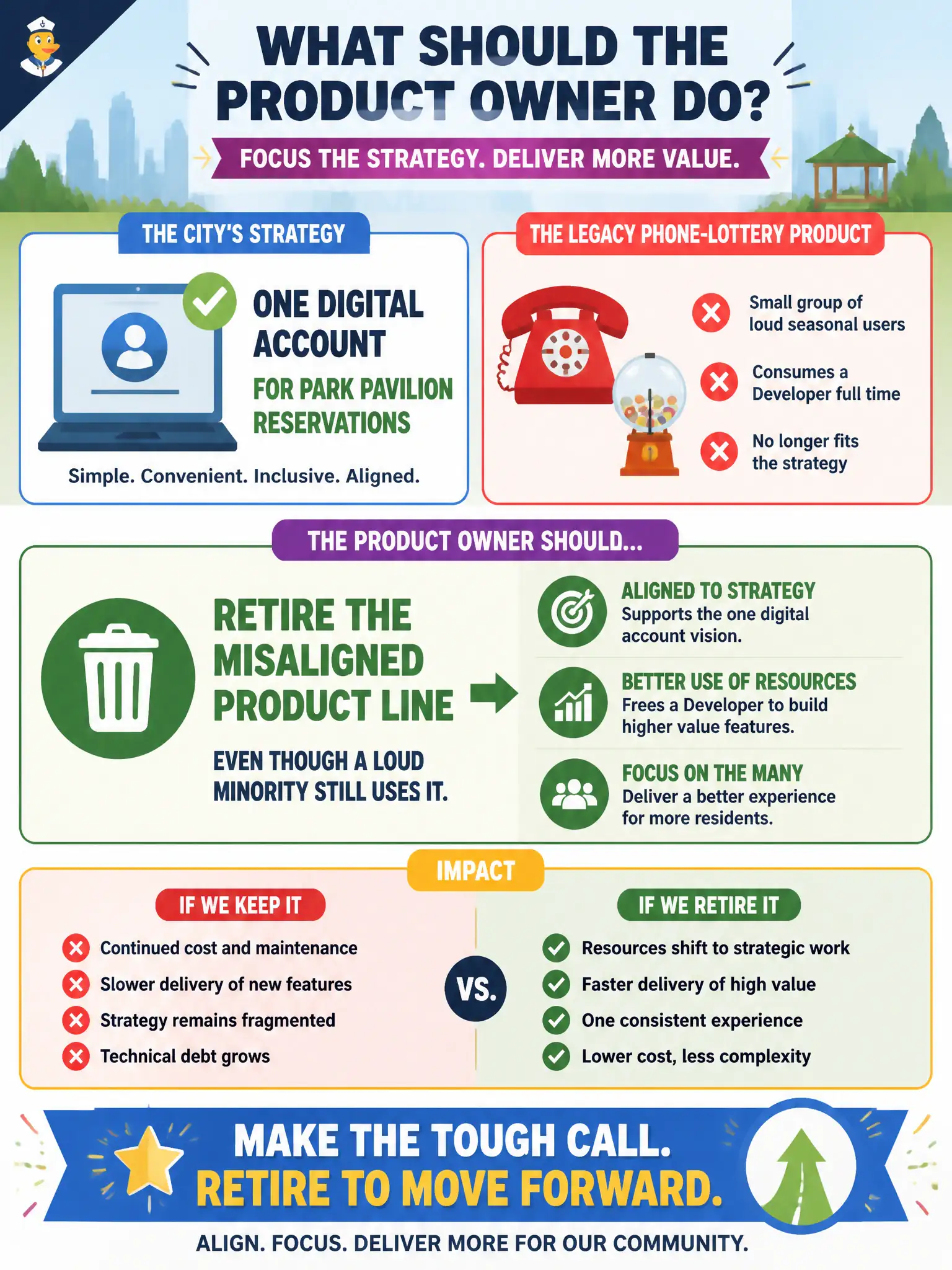
The city's strategy is one digital account for park pavilion reservations. A legacy phone-lottery product still has a small group of loud seasonal users and consumes a Developer full time. It no longer fits the strategy. What should the Product Owner do?
Select an answer to reveal the explanation.
Short Explanation
A few loud callers do not get to keep a second kitchen open. The city picked one digital account for pavilions; the phone lottery is leftover menu. Retire it, help people move, and stop feeding a product that no longer matches strategy.
Full Explanation
Strategy alignment can require retiring a product line even when a loud minority still uses it. When the city’s strategy is one digital account for park pavilion reservations and a legacy phone-lottery product consumes a full-time Developer while no longer fitting that strategy, the Product Owner should retire the misaligned line rather than fund nostalgia. Keeping the lottery forever because any usage proves strategic fit confuses residual usage with strategy. Adding more lottery features so loud users become quieter invests further in misalignment. Transferring the lottery to a shadow team so it is invisible on the Product Backlog hides opportunity cost instead of resolving it. Exam caveat: retirement may include a migration path and communication plan for seasonal users; retirement is still the product decision when strategy has moved. Operational check: communicate sunset and migration to the unified account, remove lottery expansion from the Product Backlog, reallocate capacity to the strategic reservation experience, and inspect whether pavilion booking completes through the city account without secret lottery maintenance. Preserve a single ordered Product Backlog so municipal stakeholders can inspect opportunity cost without shadow lists or vanity launch calendars.