
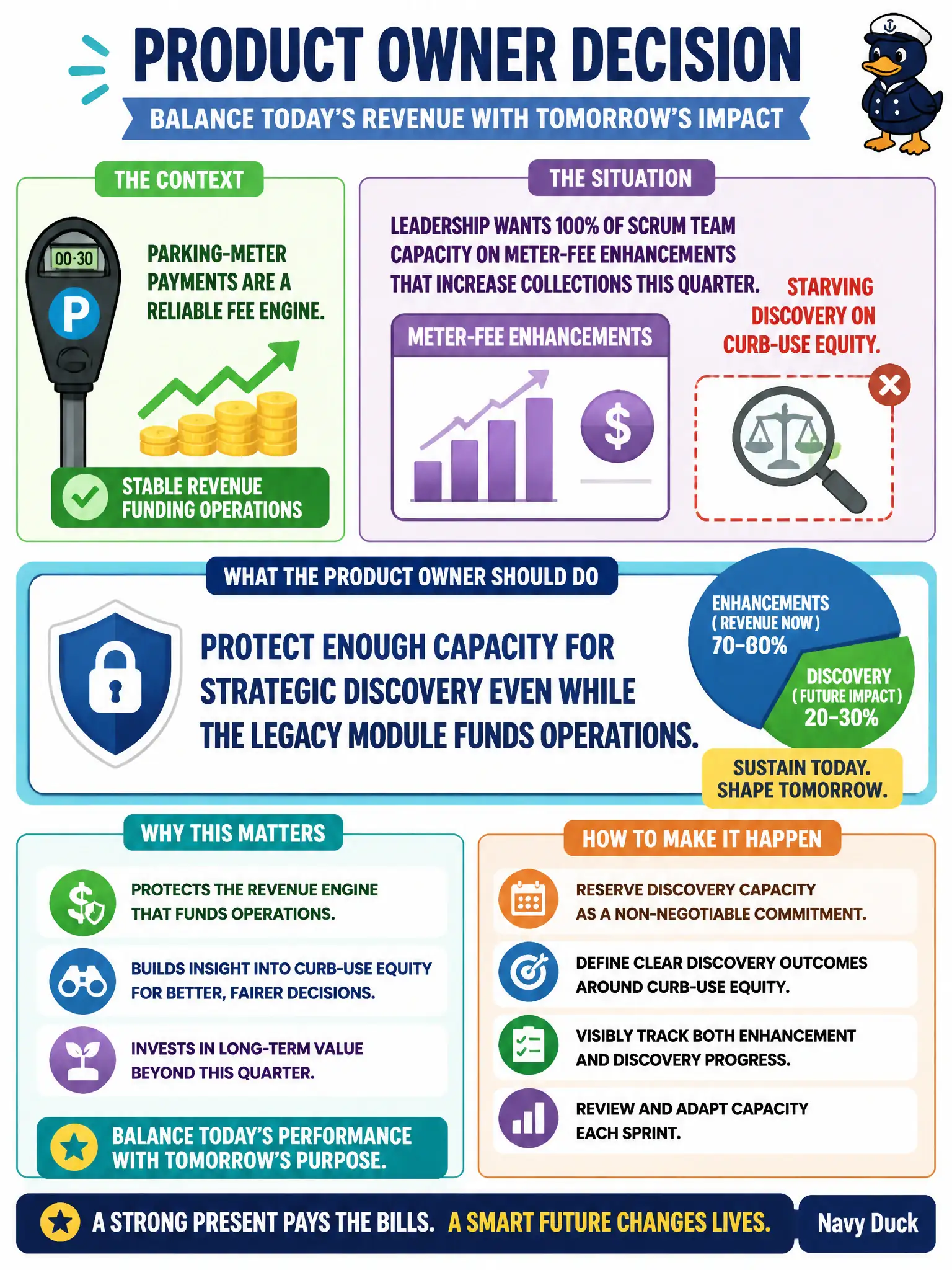
Parking-meter payments are a reliable fee engine. Leadership wants 100% of Scrum Team capacity on meter-fee enhancements that increase collections this quarter, starving discovery on curb-use equity. What should the Product Owner do?
Select an answer to reveal the explanation.
Short Explanation
A cash cow that eats the whole pasture leaves nothing for next season. Meter fees can fund the city and still leave a slice of the team to learn about fairer curb use. One hundred percent collections work is milking, not strategy.
Full Explanation
Cash-cow modules fund operations, but starving discovery destroys future value. When parking-meter payments are a reliable fee engine and leadership wants one hundred percent of Scrum Team capacity on meter-fee enhancements this quarter—starving discovery on curb-use equity—the Product Owner should protect enough capacity for strategic discovery even while the legacy module funds operations. Milking the legacy fee module until collections peak and only then considering discovery next year mortgages the product’s future. Outsourcing all discovery to a vendor so the Scrum Team never leaves the cash cow separates learning from the people who build the Increment. Stopping meter-fee collection until a new vision is approved is an unnecessary extreme. Exam caveat: short bursts of harvest focus can be deliberate; permanent one-hundred-percent harvest is not advanced Product Ownership. Operational check: reserve explicit Product Backlog capacity for curb-equity discovery experiments, keep high-value fee work ordered transparently, define learning measures, and report both collection health and discovery progress to leadership. Harvest work on meter fees and discovery on curb equity should both appear in Product Backlog order with explicit capacity shares.