
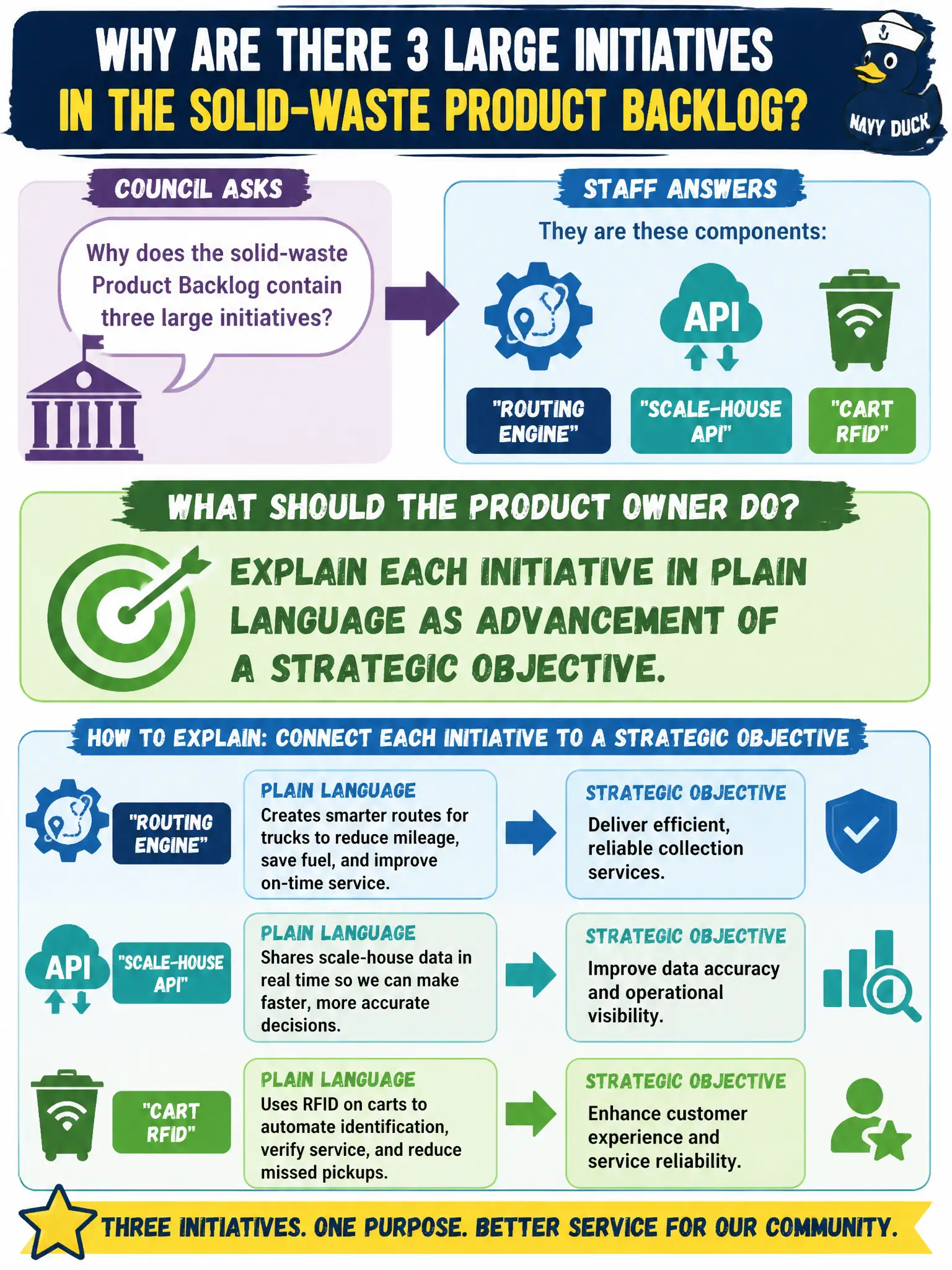
Council asks why the solid-waste Product Backlog contains three large initiatives. Staff answers with component names: routing engine, scale-house API, cart RFID. What should the Product Owner do?
Select an answer to reveal the explanation.
Short Explanation
Council did not ask for a parts catalog. Routing engines and RFID carts only matter if they move a city goal—cleaner alleys, cheaper collection, fairer service. Say that in plain language so the strategy link is obvious.
Full Explanation
Initiatives should be explained as progress toward strategic objectives, not as component names. When council asks why the solid-waste Product Backlog contains three large initiatives and staff answers with routing engine, scale-house API, and cart RFID, the Product Owner should reframe each initiative in plain language as advancement of a strategic objective such as cleaner collection, accurate billing, or safer yards. Keeping component names because council should learn the architecture burdens elected stakeholders with implementation jargon. Withdrawing the initiatives from view until after the budget vote reduces transparency. Replacing strategy talk with a story-point burn-up as the only briefing reports output without intent. Exam caveat: technical detail belongs with the Scrum Team; executive inspection needs outcome linkage. Operational check: rewrite initiative summaries as citizen/ops outcomes, show how Product Backlog order advances those objectives, brief council in that language, and inspect whether funding conversations stay tied to waste-service results rather than API labels. Council can fund cleaner collections and accurate billing; they should not need to decode RFID and API component labels to inspect strategy.