
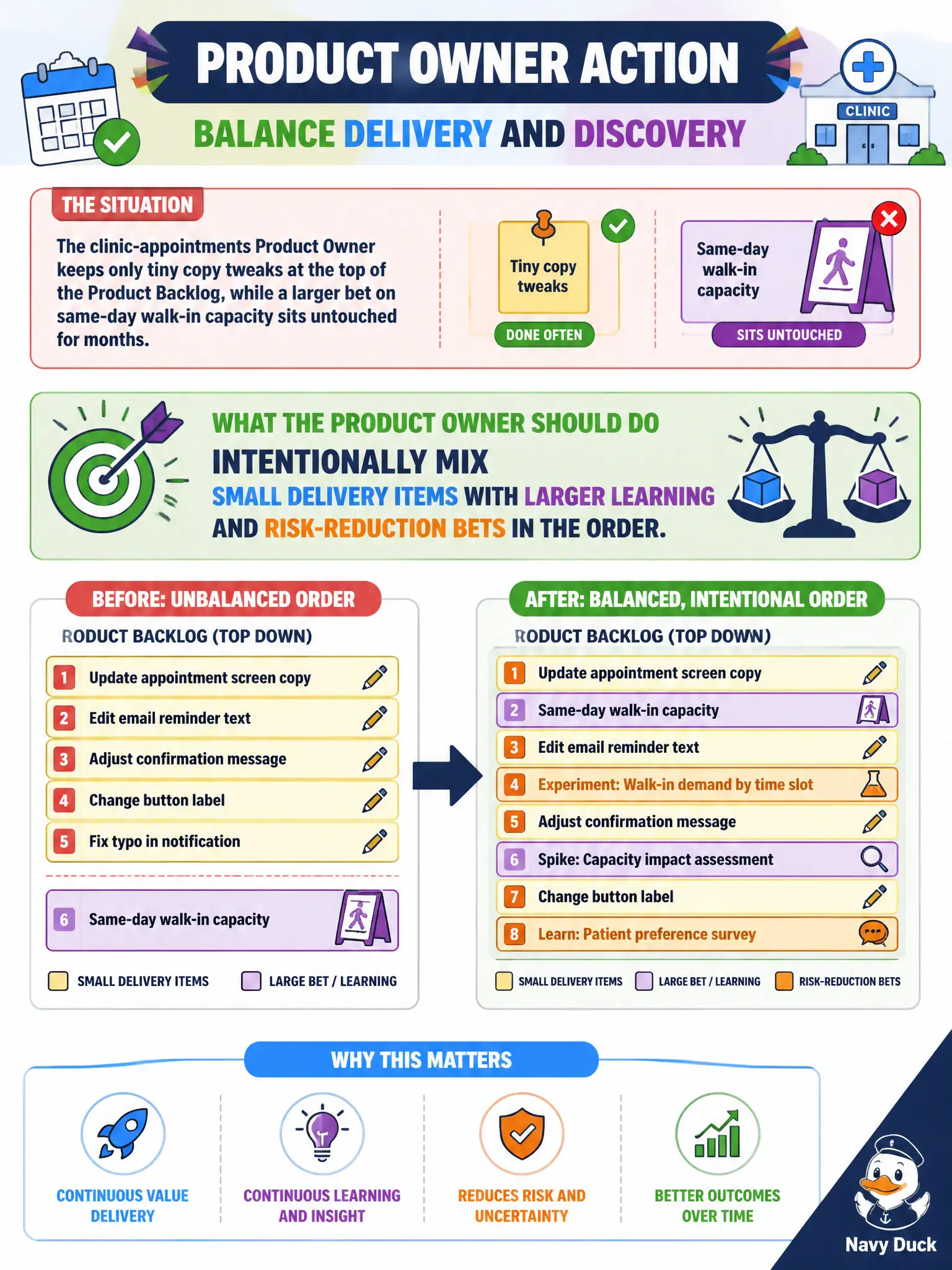
The clinic-appointments Product Owner keeps only tiny copy tweaks at the top of the Product Backlog, while a larger bet on same-day walk-in capacity sits untouched for months. What should the Product Owner do?
Select an answer to reveal the explanation.
Short Explanation
A clinic menu that is only parsley garnish never serves the walk-in crowd. Tiny copy tweaks feel busy, but the risky same-day bet still sits in the freezer. Order a mix: some quick plates, some learning, some bigger bets—on purpose, not by accident.
Full Explanation
A healthy Product Backlog intentionally mixes near-term delivery with larger learning and risk-reduction bets. When a clinic-appointments Product Owner keeps only tiny copy tweaks at the top while a larger bet on same-day walk-in capacity sits untouched for months, the Product Owner should rebalance order so strategic learning is not starved by endless polish. Finishing every small tweak first so strategic bets wait until the backlog is clean is a perfection trap that delays outcomes for patients. Moving the large bet to a three-year capital project that Scrum Teams may not touch hides the work from empiricism. Splitting capacity fifty-fifty forever regardless of evidence replaces judgment with a rigid formula. Exam caveat: small items often dominate near-term forecasts, but advanced Product Ownership still reserves intentional capacity for high-value uncertainty. Operational check: place a thin walk-in experiment among top items, define success measures for same-day capacity, continue useful small fixes without letting them monopolize order, and inspect clinic access outcomes in Sprint Review. Tiny copy tweaks can ship weekly; without intentional larger bets, clinic access strategy never gets an Increment that can be inspected.