
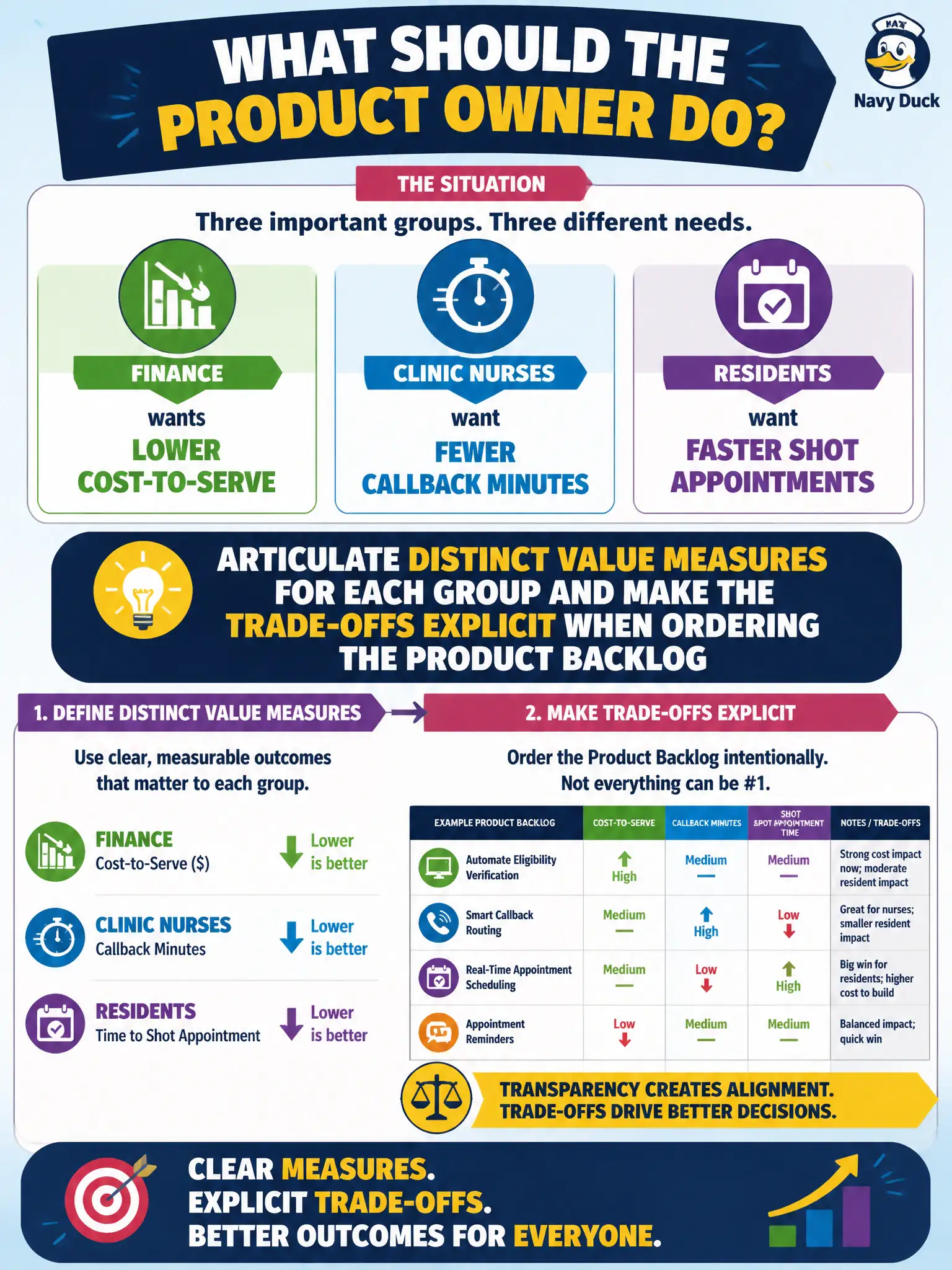
Finance wants lower cost-to-serve, clinic nurses want fewer callback minutes, and residents want faster shot appointments on the immunization product. What should the Product Owner do?
Select an answer to reveal the explanation.
Short Explanation
Different folks keep different scoreboards, and pretending they share one is how arguments go underground. Write each measure down — cost, nurse time, appointment speed — then show the trade when work is ordered. Honesty beats a fake average.
Full Explanation
Stakeholders on an immunization product rarely share identical value measures: finance wants lower cost-to-serve, clinic nurses want fewer callback minutes, and residents want faster shot appointments. The Product Owner should articulate distinct measures for each group and make trade-offs explicit when ordering the Product Backlog. Picking one group and ignoring the others creates hidden opposition. Averaging the three wishes into a single value point hides real conflict behind a fake number. Waiting for the city manager to publish one metric that replaces all three delays ordering and usually still fails to capture multi-stakeholder value. Exam caveat: advanced Product Ownership makes plural value measures transparent rather than collapsing them prematurely. Operational check: publish the three measures, show how candidate backlog items move each, choose an order with explicit trade-offs, and inspect all three measures at Sprint Review after releases. Immunization products need explicit plural measures for finance, nurses, and residents; averaging or waiting for one executive metric hides trade-offs. Show how backlog candidates move each measure, choose transparently, and inspect all three after release.