
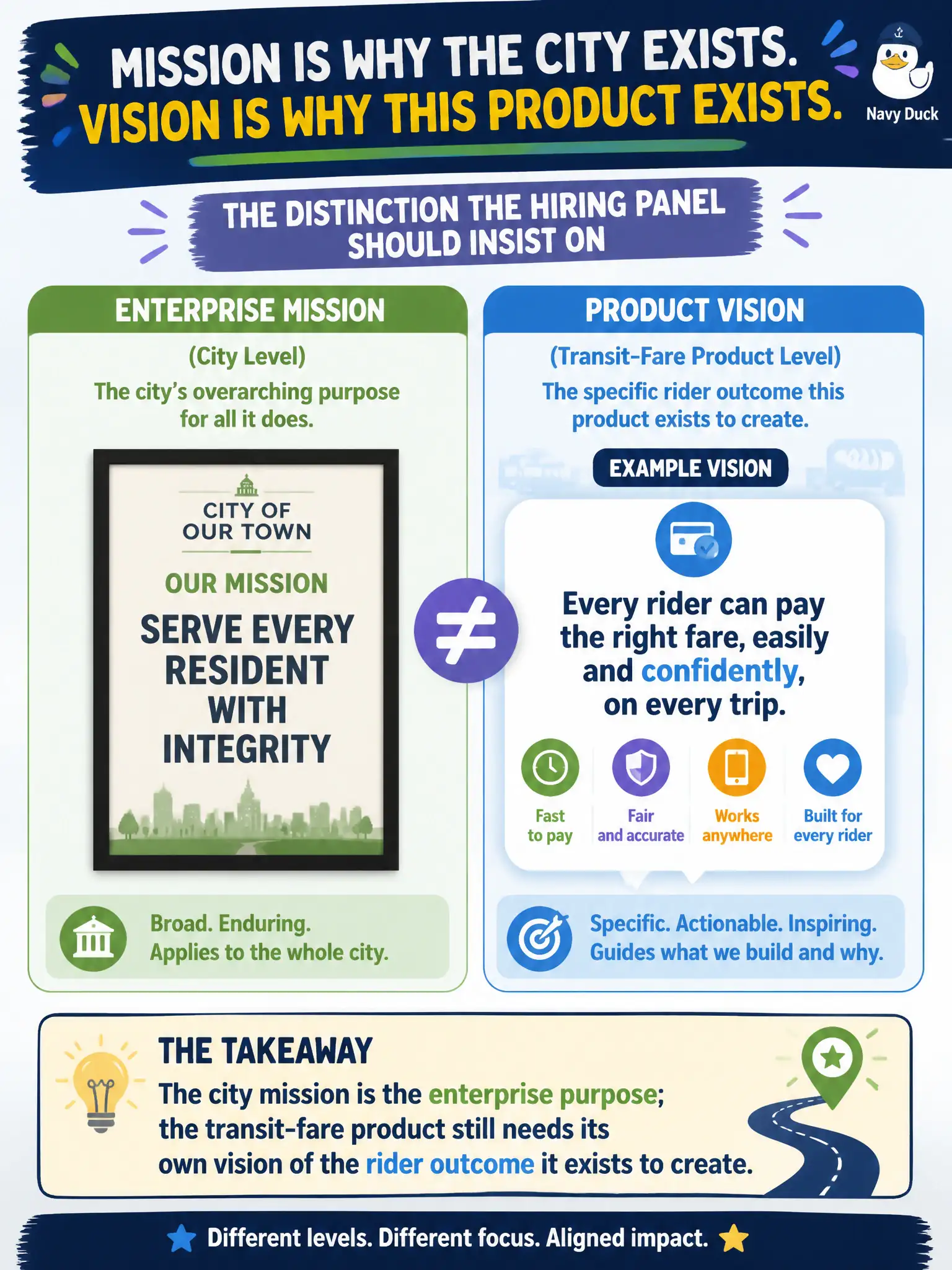
A Product Owner candidate for the municipal transit-fare product treats the city's framed mission poster ("Serve every resident with integrity") as the Product Vision. What distinction should the hiring panel insist on?
Select an answer to reveal the explanation.
Short Explanation
A city mission poster is the whole city's "why we exist." A fare product still needs its own picture — maybe riders tap once and go, without a window line. Hanging the poster on the backlog does not tell the team which rider outcome to chase this year.
Full Explanation
An enterprise mission poster such as serve every resident with integrity is the city-level purpose; a municipal transit-fare product still needs its own Product Vision describing the rider outcome it exists to create. Treating the framed mission as sufficient Product Vision leaves fare trade-offs without a product-specific filter. Copying the mission onto every Product Backlog item as the Sprint Goal misuses both mission and Sprint Goals. Claiming enterprise mission and Product Vision are the same artifact and next writing a project charter still skips product-level outcome direction. Exam caveat: PSPO II distinguishes organizational mission from product vision—both matter, at different altitudes. Operational check: keep the city mission visible, write a transit-fare vision such as riders pay once quickly and understand fares without staff help, and test hiring candidates on that distinction before they order the backlog. City mission and transit-fare Product Vision sit at different altitudes; riders still need a product-specific outcome statement for fare trade-offs. Test Product Owner candidates on that distinction before they order the backlog. In hiring panels, ask candidates to write a one-sentence transit-fare rider outcome that is narrower than the city mission and could actually reverse a backlog trade-off during refinement.