
A public-health records compliance officer insists the Product Vision should be 'be compliant.' How should the Product Owner reframe it?
Select an answer to reveal the explanation.
Short Explanation
'Be compliant' is the speed limit, not the road trip. You still need a destination — healthier residents, records they can actually use. Rules constrain the drive; they are not why the car exists.
Full Explanation
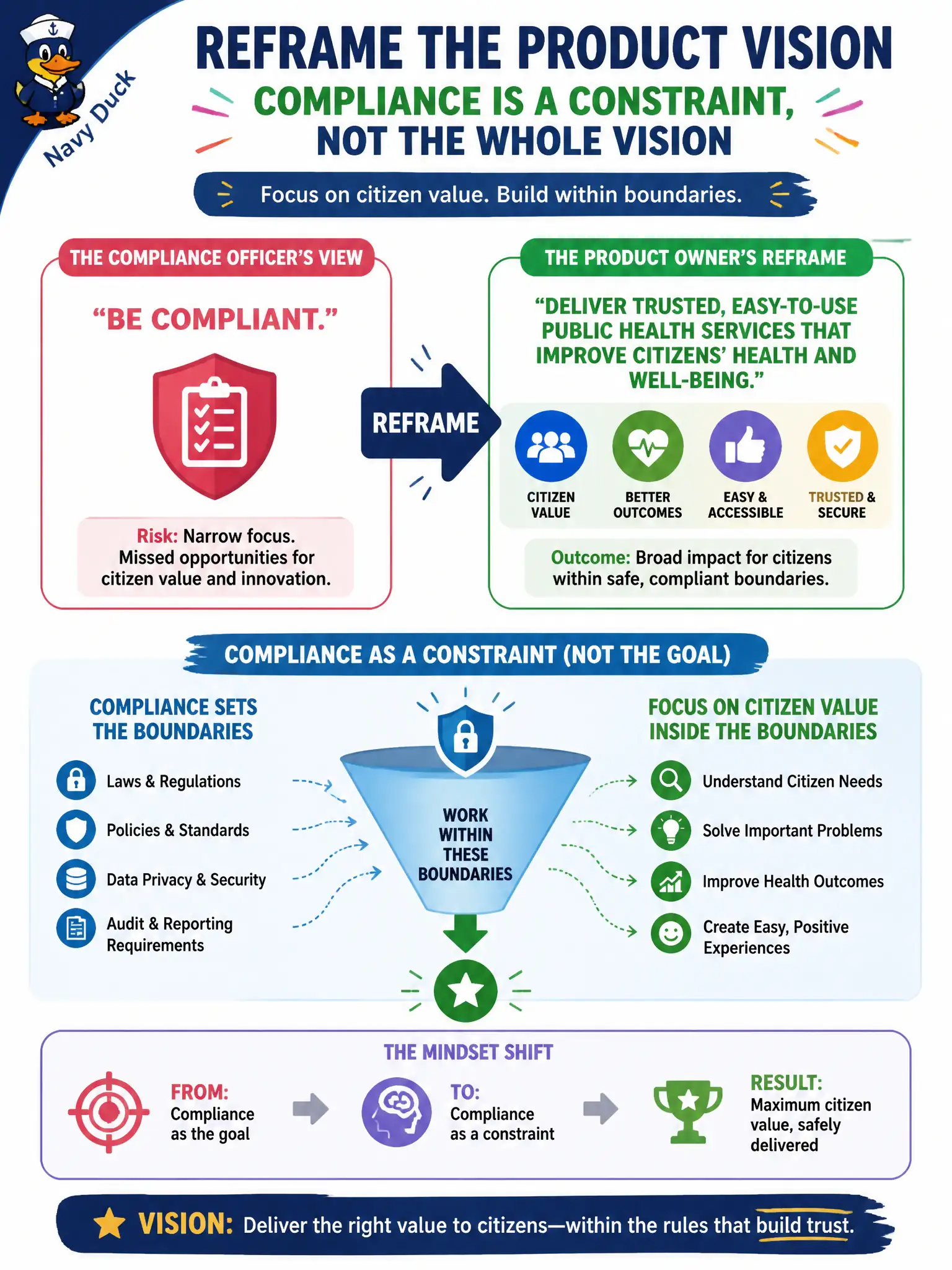
Compliance is often a real constraint for public-health records, but being compliant is not a complete Product Vision because it does not describe citizen or clinician outcomes worth maximizing. The Product Owner should treat compliance as a constraint inside a citizen-value vision rather than as the whole vision. Accepting be compliant as the vision because regulatory risk outweighs outcomes collapses product strategy into audit defense. Putting compliance in a separate product with its own Product Owner so the main vision can ignore it fragments accountability for a single records experience. Replacing the vision with a control catalog mapped to every audit finding produces a checklist, not direction. Exam caveat: constraints belong in vision-aware planning; they do not replace outcome vision on PSPO II. Operational check: rewrite the vision around safer, faster records access for care, list compliance rules as non-negotiable constraints on Increments, and order minimal valuable compliant slices first before gold-plated overhauls. Public-health records vision should maximize care outcomes while treating compliance as a hard constraint on Increments, not as the entire purpose. Order minimal valuable compliant slices first, then inspect residual risk before gold-plated overhauls.