
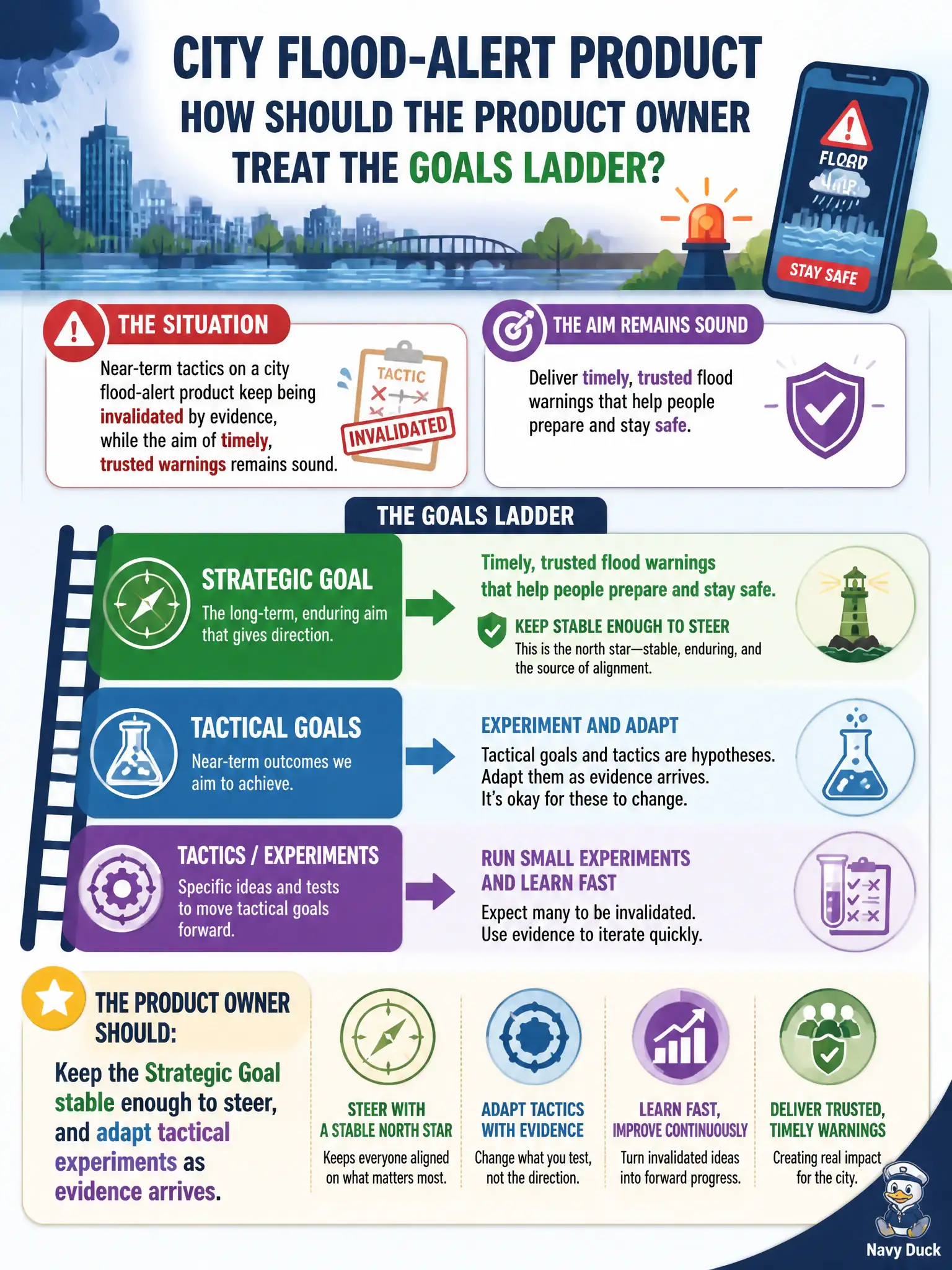
Near-term tactics on a city flood-alert product keep being invalidated by evidence, while the aim of timely, trusted warnings remains sound. How should the Product Owner treat the goals ladder?
Select an answer to reveal the explanation.
Short Explanation
The city still wants timely, trusted flood warnings — that destination can sit still while the next turn keeps changing. Failed tactics are learning, not a reason to invent a new strategy every Sprint or to ignore the evidence for a year. Hold the aim, churn the experiments.
Full Explanation
Evidence-Based Management keeps strategic intent stable enough to align investment, while Immediate Tactical Goals are expected to change as experiments fail or succeed. For a city flood-alert product, timely trusted warnings can remain the Strategic Goal even as channels, timing, and trust experiments churn. The Product Owner should keep the Strategic Goal stable enough to steer and adapt tactical experiments as evidence arrives.
Rewriting the Strategic Goal every Sprint so it always matches the latest tactic destroys orientation and turns strategy into a diary of failures. Freezing Immediate Tactical Goals for a year to protect strategy from noisy evidence ignores empiricism and blocks learning. Replacing both strategy and tactics with a Program Increment feature roadmap substitutes unevidenced output for the goals ladder.
Exam caveat: PSPO II distinguishes stable Strategic Goals from disposable tactics; failed tactics are learning, not automatic strategy rewrites.
Operational check: after a invalidated flood-alert tactic, keep the Strategic Goal text unchanged unless evidence shows the aim itself is wrong, and rewrite only the next Immediate Tactical Goal with a new hypothesis.