
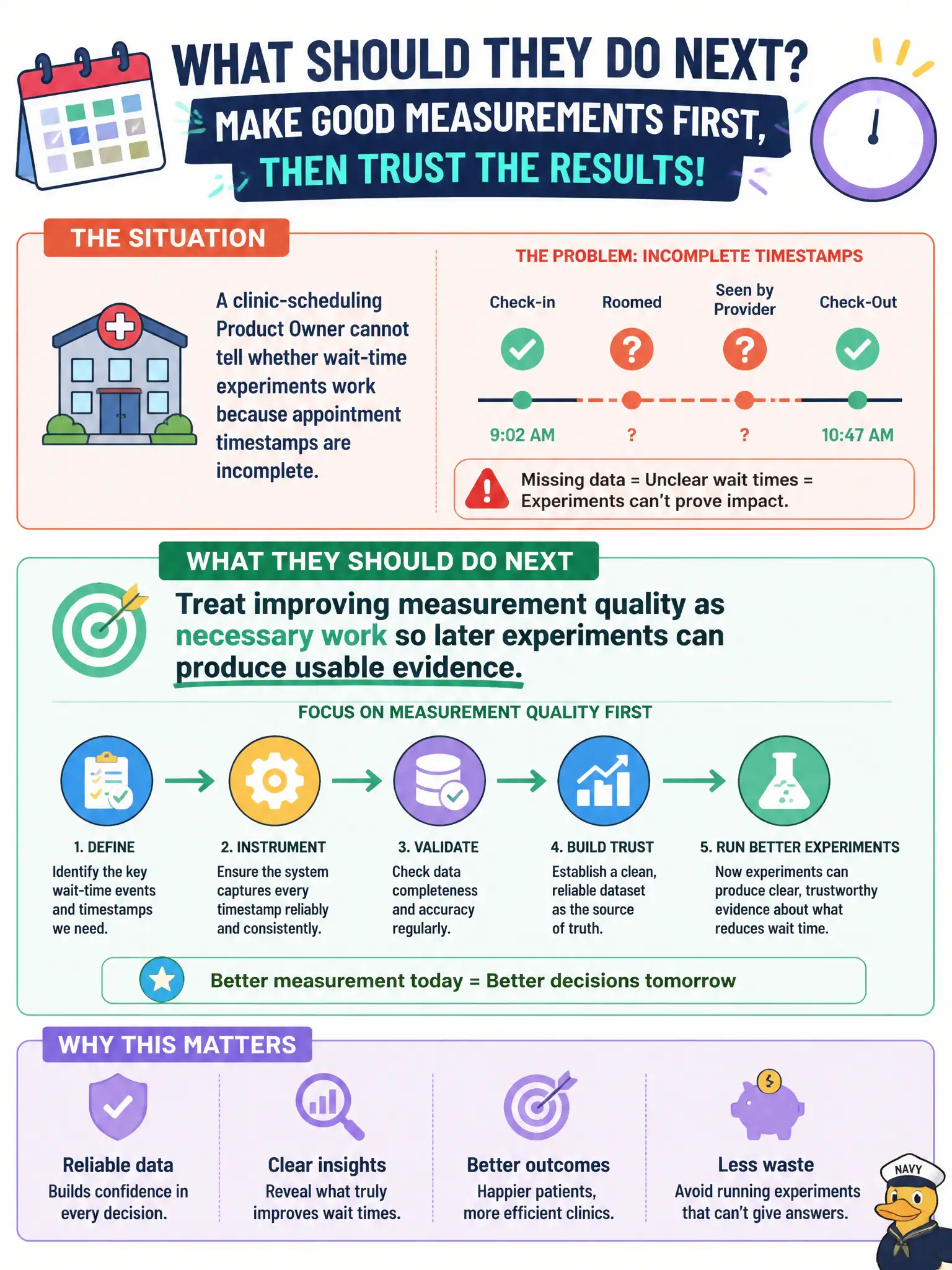
A clinic-scheduling Product Owner cannot tell whether wait-time experiments work because appointment timestamps are incomplete. What should they do next?
Select an answer to reveal the explanation.
Short Explanation
If the clinic clock is broken, running more wait-time experiments is just guessing with extra steps. Sometimes the next Product Backlog slice is better instrumentation, not another feature. Fake scores and counting Sprint Reviews will not tell you whether residents waited less.
Full Explanation
Evidence-Based Management requires evidence of sufficient quality to inspect goals. When appointment timestamps on a clinic-scheduling product are incomplete, wait-time experiments cannot confirm or refute hypotheses, so improving measurement quality is necessary Product Backlog work. The Product Owner should treat instrumentation as legitimate near-term investment so later experiments produce usable evidence.
Keeping shipping features and skipping measurement until a data-warehouse project finishes next year postpones learning indefinitely. Inventing placeholder Key Value Area scores so leadership reviews stay on schedule fabricates evidence and destroys trust. Switching to counting Sprint Reviews held substitutes activity for instrumented outcomes and needs no clinic data because it measures ceremony. Public-health wait-time claims without trustworthy timestamps are political theater, not Evidence-Based Management.
Exam caveat: PSPO II allows measurement capability as ordered work when evidence quality blocks empiricism; fake KVA scores are never acceptable.
Operational check: add a Product Backlog item to make appointment timestamps complete and auditable, define Done for that instrumentation, and delay wait-time tactic claims until the measure works.