
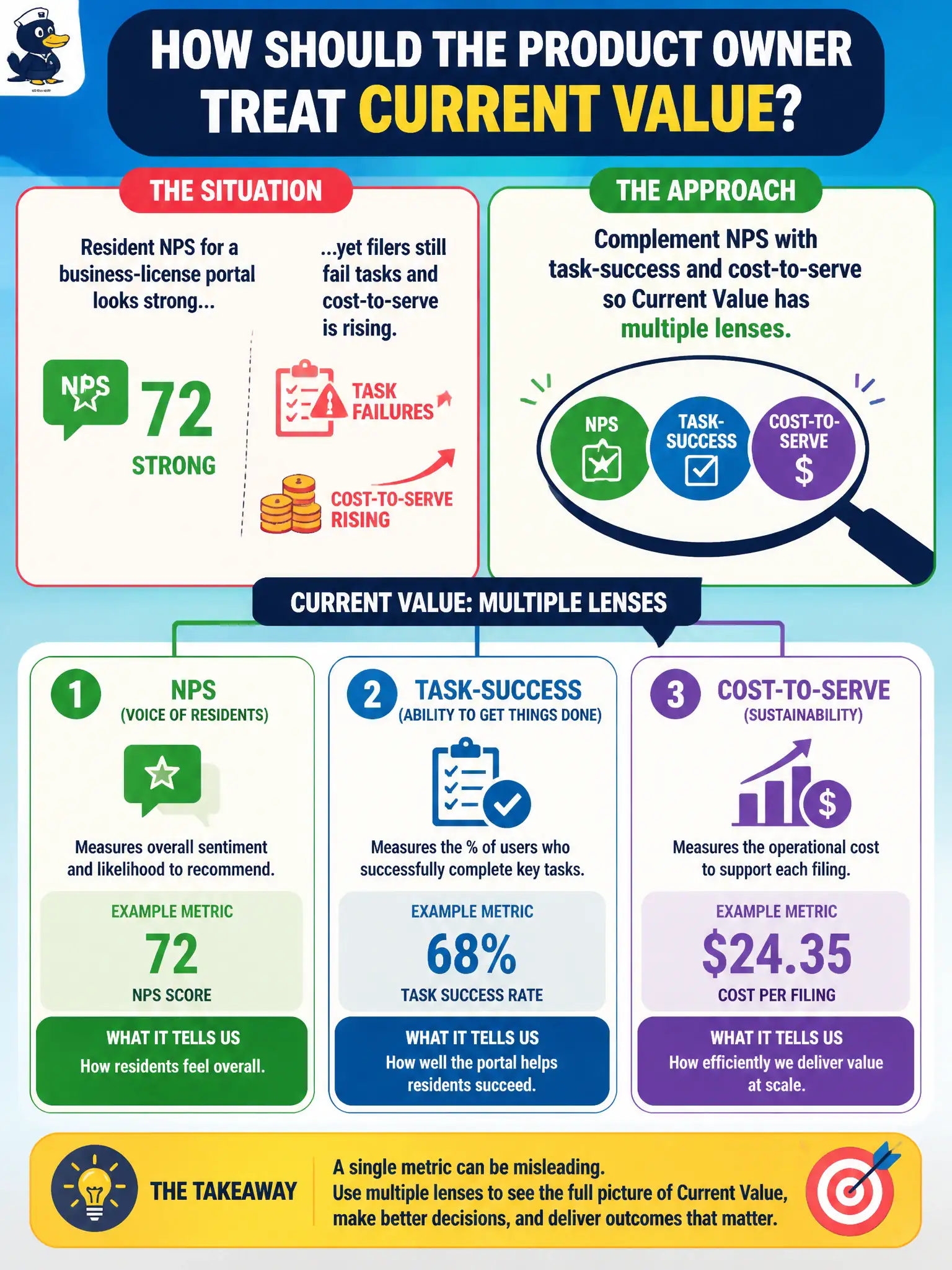
Resident NPS for a business-license portal looks strong, yet filers still fail tasks and cost-to-serve is rising. How should the Product Owner treat Current Value?
Select an answer to reveal the explanation.
Short Explanation
People can like a license portal and still fail to finish the form while clerks quietly redo the work. Current Value is not one smile score. Pair the survey with 'did the job get done' and 'what did it cost the city' or you will congratulate a product that is quietly expensive and broken.
Full Explanation
Current Value typically needs complementary measures rather than a single customer-satisfaction index. Resident NPS for a business-license portal can look strong while filers still fail tasks and cost-to-serve rises, showing that residents and the city are not receiving efficient value. The Product Owner should complement NPS with task-success and cost-to-serve so Current Value has multiple lenses and a flattering survey cannot hide operational failure.
Treating NPS as sufficient Current Value because it is a customer measure ignores task failure and municipal cost. Replacing NPS with employee utilization misreads cost-to-serve as an HR metric and drops resident task success. Moving cost-to-serve into Time-to-Market and ignoring task success misassigns Key Value Areas and leaves the broken filing journey unmeasured. Taxpayer stewardship demands that a liked portal still prove it completes licenses efficiently.
Exam caveat: PSPO II Current Value is multi-lens; satisfaction alone is a common distractor when effectiveness and cost diverge.
Operational check: add license-form task-success rate and cost-per-completed-filing beside NPS on the next Current Value review, and order backlog work against the weakest lens.