
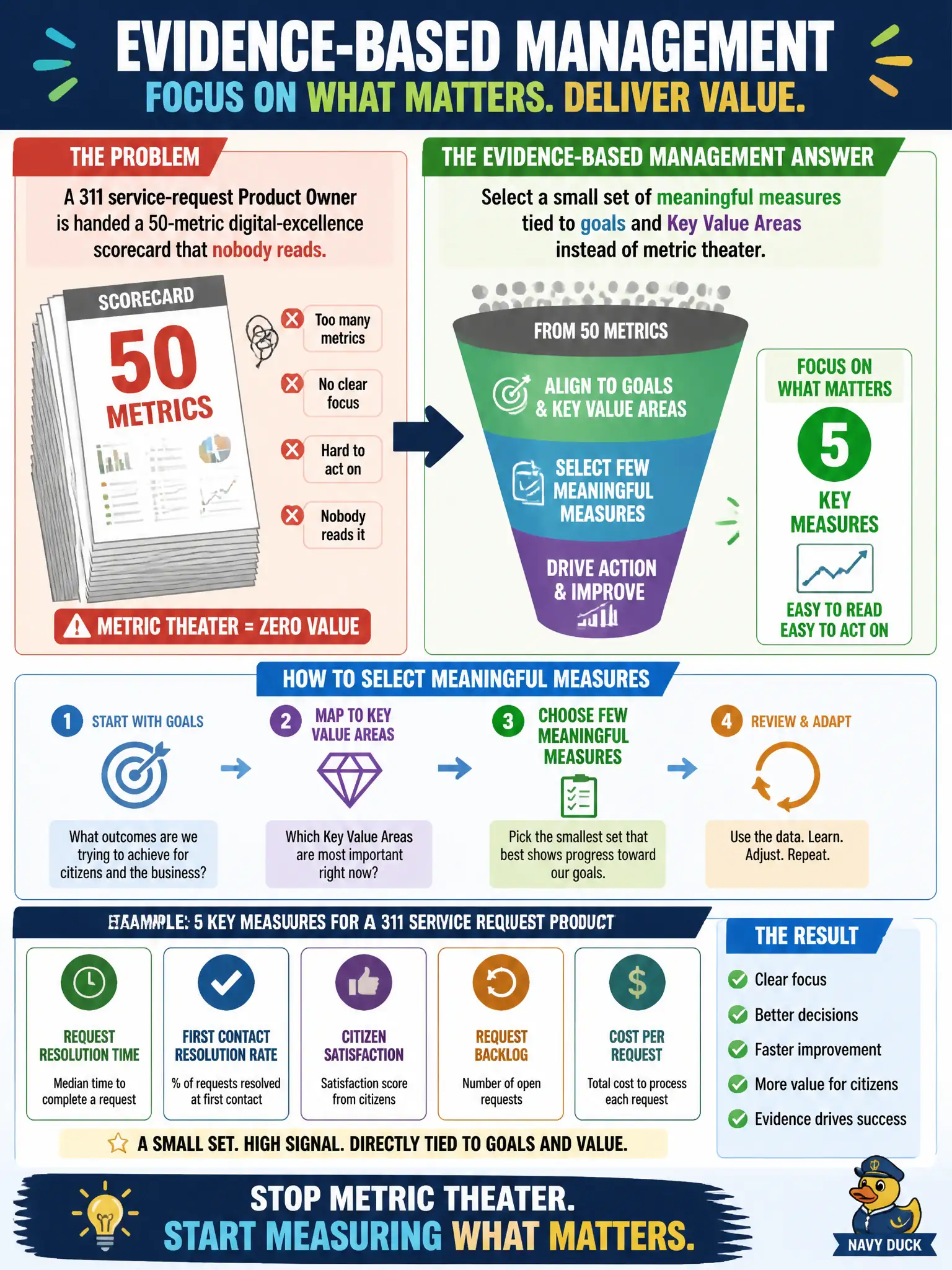
A 311 service-request Product Owner is handed a 50-metric digital-excellence scorecard that nobody reads. What should they do under Evidence-Based Management?
Select an answer to reveal the explanation.
Short Explanation
Fifty unread numbers is a museum, not a cockpit. A few measures people will actually look at — tied to 311 goals and the Key Value Areas — beat a wall of digital-excellence trivia. Story points are not a clever compression of fifty vanity charts; they are a different kind of noise.
Full Explanation
Evidence-Based Management favors a few meaningful measures that inform goals through the Key Value Areas. A 50-metric digital-excellence scorecard that nobody reads for a 311 service-request product is metric theater: it creates the appearance of control without supporting inspection or adaptation. The Product Owner should select a small set of used measures tied to goals and KVAs rather than preserving unread fields.
Keeping all 50 metrics so Unrealized Value cannot hide confuses volume of data with quality of evidence; unread measures reveal nothing. Automating the scorecard into the Daily Scrum injects leadership theater into a Developer planning event. Replacing the 50 metrics with a single story-point KPI collapses civic outcomes into an internal output number. Residents experience whether 311 requests resolve, not whether fifty digital-excellence fields were collected.
A Product Owner who cannot name who will look at a metric next Sprint should not keep that metric on the 311 board.
Exam caveat: PSPO II prefers sparse, goal-linked measures over scorecard sprawl; unused metrics are not Unrealized Value detection.
Operational check: cut the 311 scorecard to five or fewer measures that someone actually inspects each Sprint, each mapped to a goal and a Key Value Area, and archive the rest.