
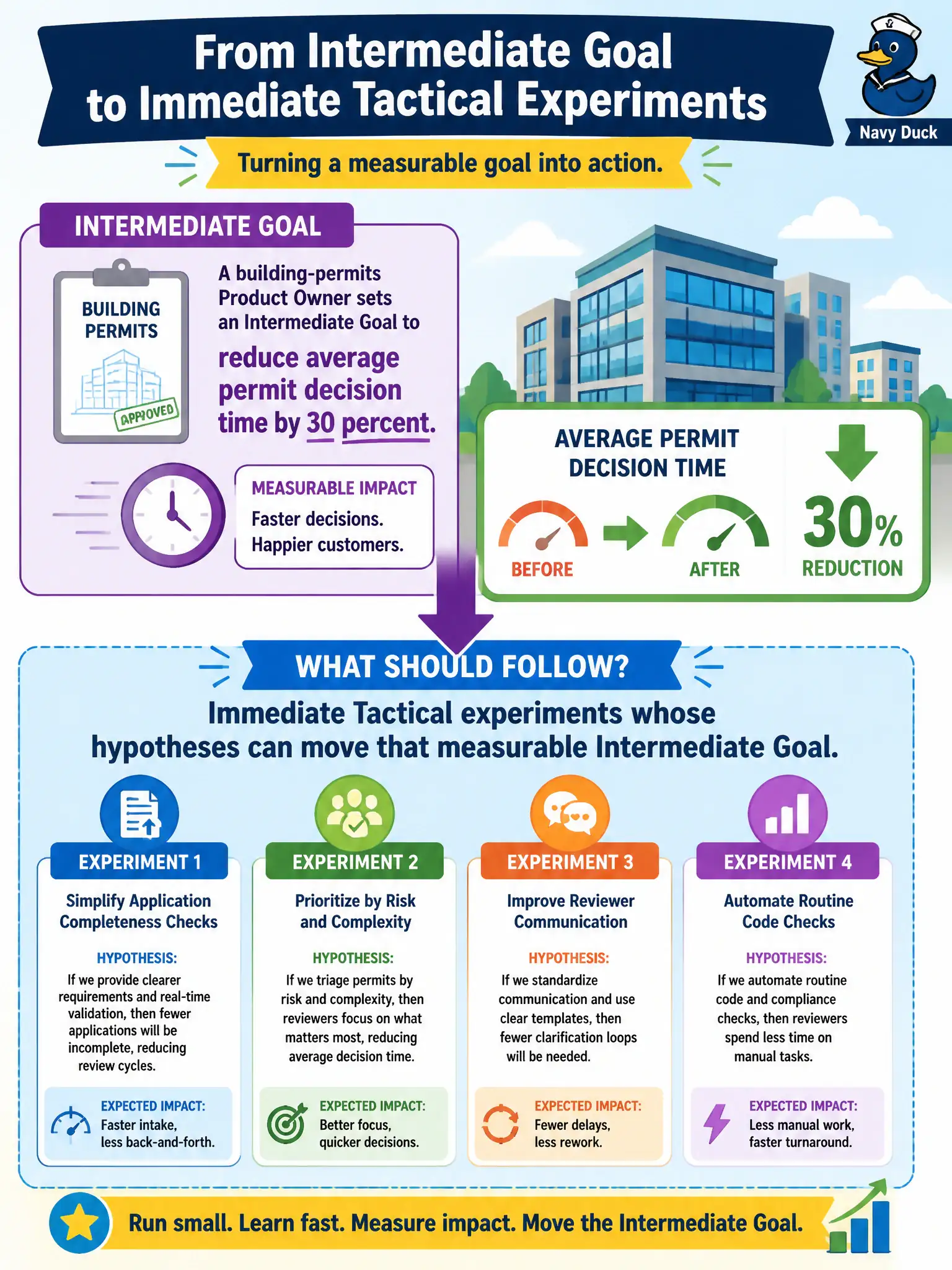
A building-permits Product Owner sets an Intermediate Goal to reduce average permit decision time by 30 percent. What should follow?
Select an answer to reveal the explanation.
Short Explanation
Thirty percent faster permit decisions is a checkpoint, not a promise you bake into a three-year Gantt. Next you run small bets — different intake, fewer handoffs, earlier completeness checks — and see which ones actually move the clock. Ticket volume is a different game and will not tell you if decisions got quicker.
Full Explanation
Intermediate Goals should be measurable and should guide near-term tactics. A building-permits Product Owner who sets an Intermediate Goal to reduce average permit decision time by 30 percent should follow with Immediate Tactical experiments whose hypotheses can move that measure—different intake, fewer handoffs, earlier completeness checks—then inspect whether the clock actually improved.
A frozen three-year feature schedule that guarantees the 30 percent by construction season converts an Intermediate Goal into predictive theater and blocks adaptation. Immediate conversion of the 30 percent into a Sprint Goal of closing 30 percent more tickets swaps decision-time outcomes for ticket volume output. Retiring Time-to-Market measures because decision time is only Current Value misassigns Key Value Areas and discards useful capability evidence.
Exam caveat: PSPO II expects Intermediate Goals to spawn tactical experiments with measurable hypotheses—not Gantt guarantees or ticket-count Sprint Goals.
Operational check: write one Immediate Tactical experiment that names the expected movement in average permit decision time, the baseline, and the inspection date after the Increment ships.