
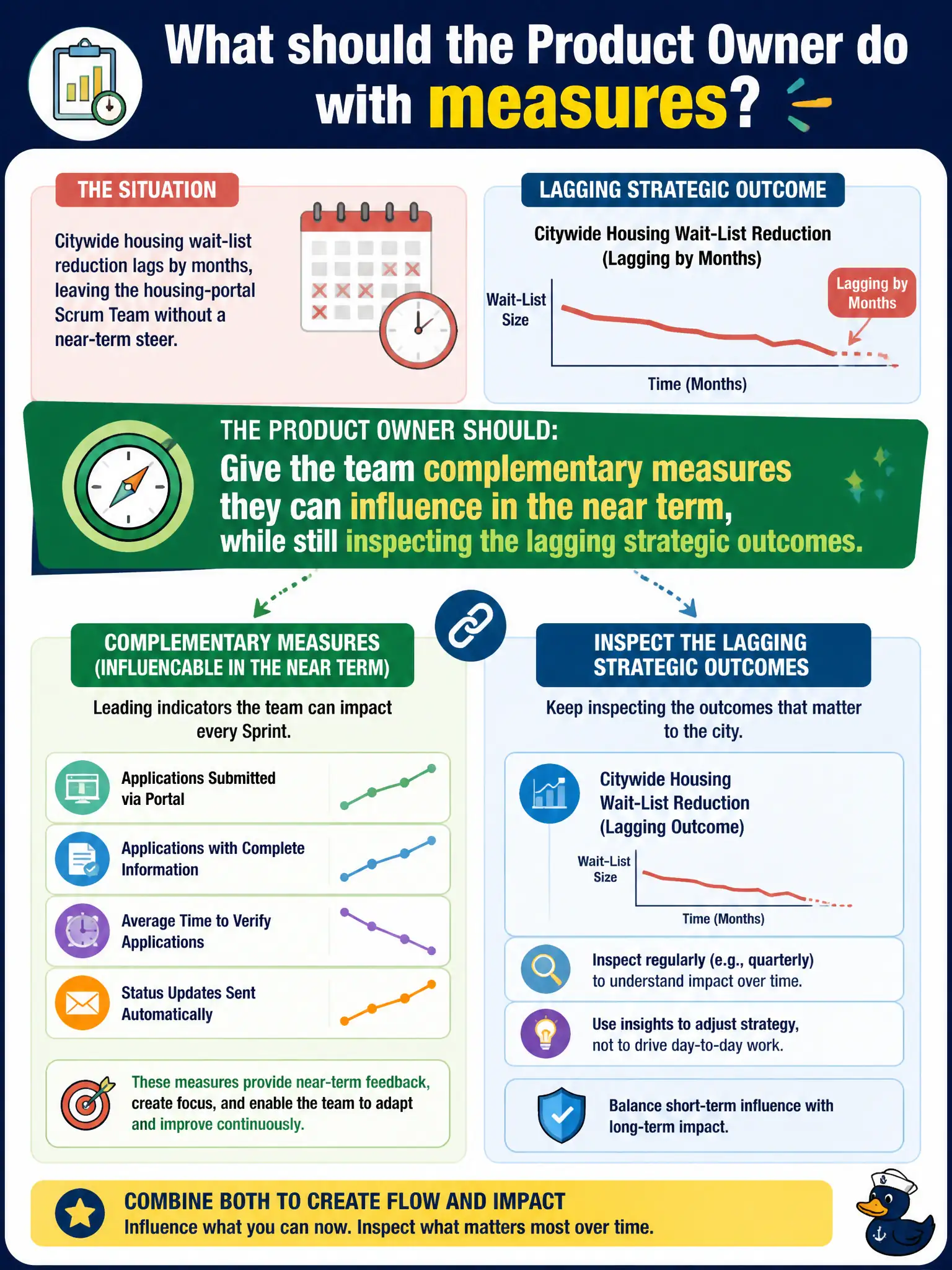
Citywide housing wait-list reduction lags by months, leaving the housing-portal Scrum Team without a near-term steer. What should the Product Owner do with measures?
Select an answer to reveal the explanation.
Short Explanation
Citywide wait lists move like a glacier; the team still needs a speedometer for this week's driving. Pair lagging strategy measures with nearer numbers they can actually nudge — complete applications, time-to-decision, drop-off. Throwing out the glacier, or pretending points are housing outcomes, leaves everybody guessing.
Full Explanation
Strategic outcomes are often lagging and only partly controllable by one team. Citywide housing wait-list reduction may lag by months, yet the housing-portal Scrum Team still needs near-term steer. Evidence-Based Management keeps those lagging strategic outcomes visible and adds complementary measures the team can influence soon enough to inspect and adapt—completion rate, cycle time, abandonment, or time-to-decision.
Dropping all measures the team cannot fully control, including the Strategic Goal, abandons ambition and severs the portal from city outcomes. Using only citywide wait-list reduction as the Sprint Goal stuffs a lagging, multi-actor metric into a Sprint commitment the team cannot own. Substituting story-point burn-up for both team and strategy measures replaces housing outcomes with internal output charts. Public housing stewardship still needs the glacier on the board even while the team steers with nearer instruments.
Exam caveat: PSPO II allows complementary leading measures without discarding lagging strategic outcomes; control is not a reason to erase the Strategic Goal.
Operational check: keep citywide wait-list reduction on the strategy board and add two portal measures the team can move within a Sprint or two; inspect both at the same review cadence.