
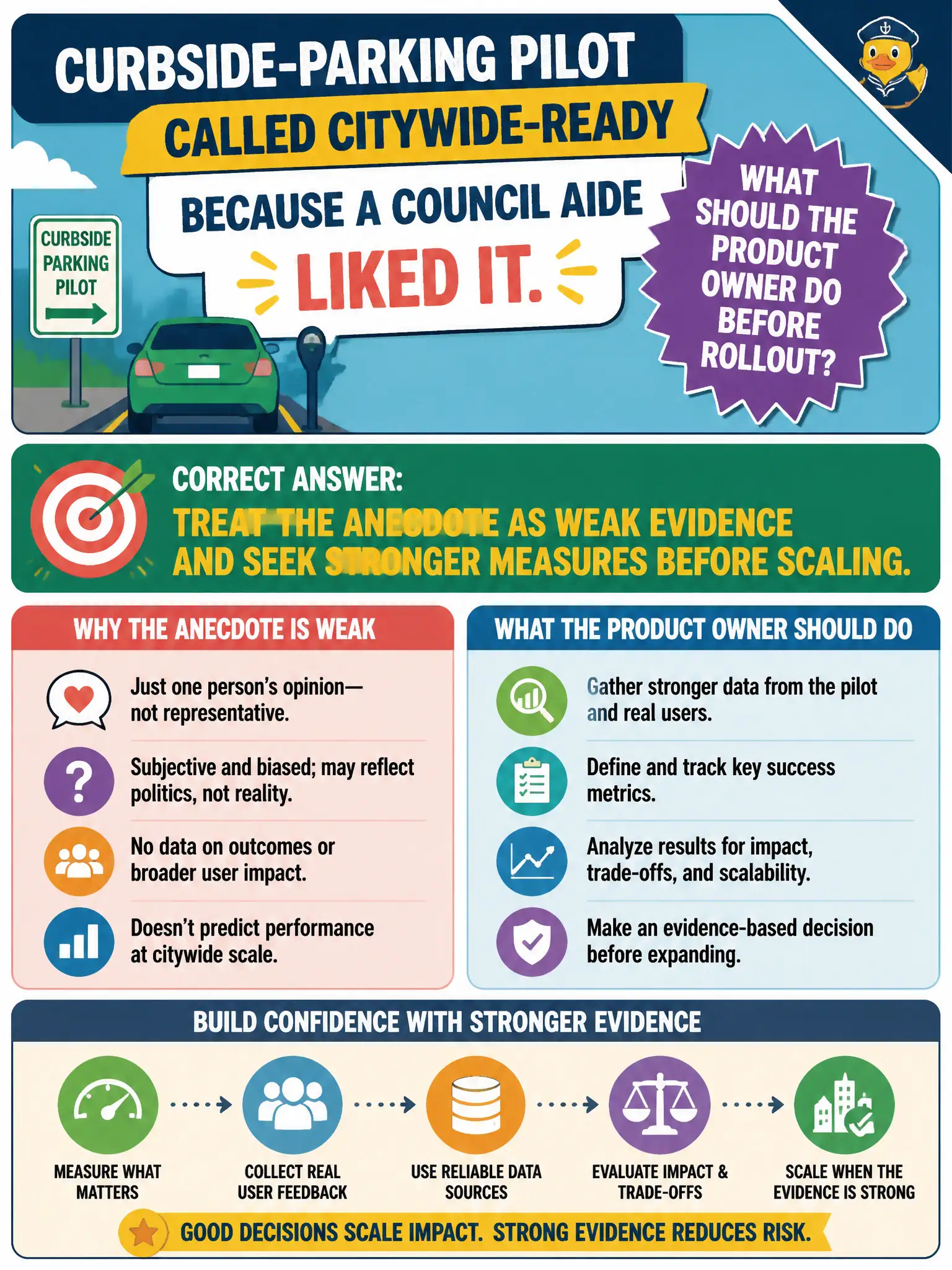
A curbside-parking pilot is called citywide-ready because a council aide liked it. What should the Product Owner do before rollout?
Select an answer to reveal the explanation.
Short Explanation
One aide liking a parking pilot is a compliment at a ribbon cutting, not a citywide dataset. Weak evidence is still evidence — it just is not enough to bet every curb on. Get stronger measures of whether the pilot actually worked, then scale.
Full Explanation
Evidence has different strengths; anecdotes and individual enthusiasm are weak compared with outcome measures, usage patterns, and repeatable results. Scaling a curbside-parking pilot citywide because a council aide liked it treats weak evidence as proof and invites costly reversal for residents and operations. The Product Owner should treat the anecdote as a weak signal and seek stronger measures before rollout so empiricism—not compliment—gates civic expansion.
Rolling out citywide immediately to capture Unrealized Value before other cities copy the idea races UV without validating local outcomes. Converting the anecdote into a Strategic Goal confuses political alignment with an evidence-based destination. Having the Scrum Master facilitate a working agreement that forbids further measurement actively blocks the inspection Evidence-Based Management requires.
Exam caveat: PSPO II frequently tests evidence strength before scale; political praise is not Current Value proof and must not freeze learning.
Operational check: define success metrics for the parking pilot (occupancy fairness, payment completion, complaint rate, equity across neighborhoods), gather them across a representative sample of curbs, and only then decide citywide rollout.