
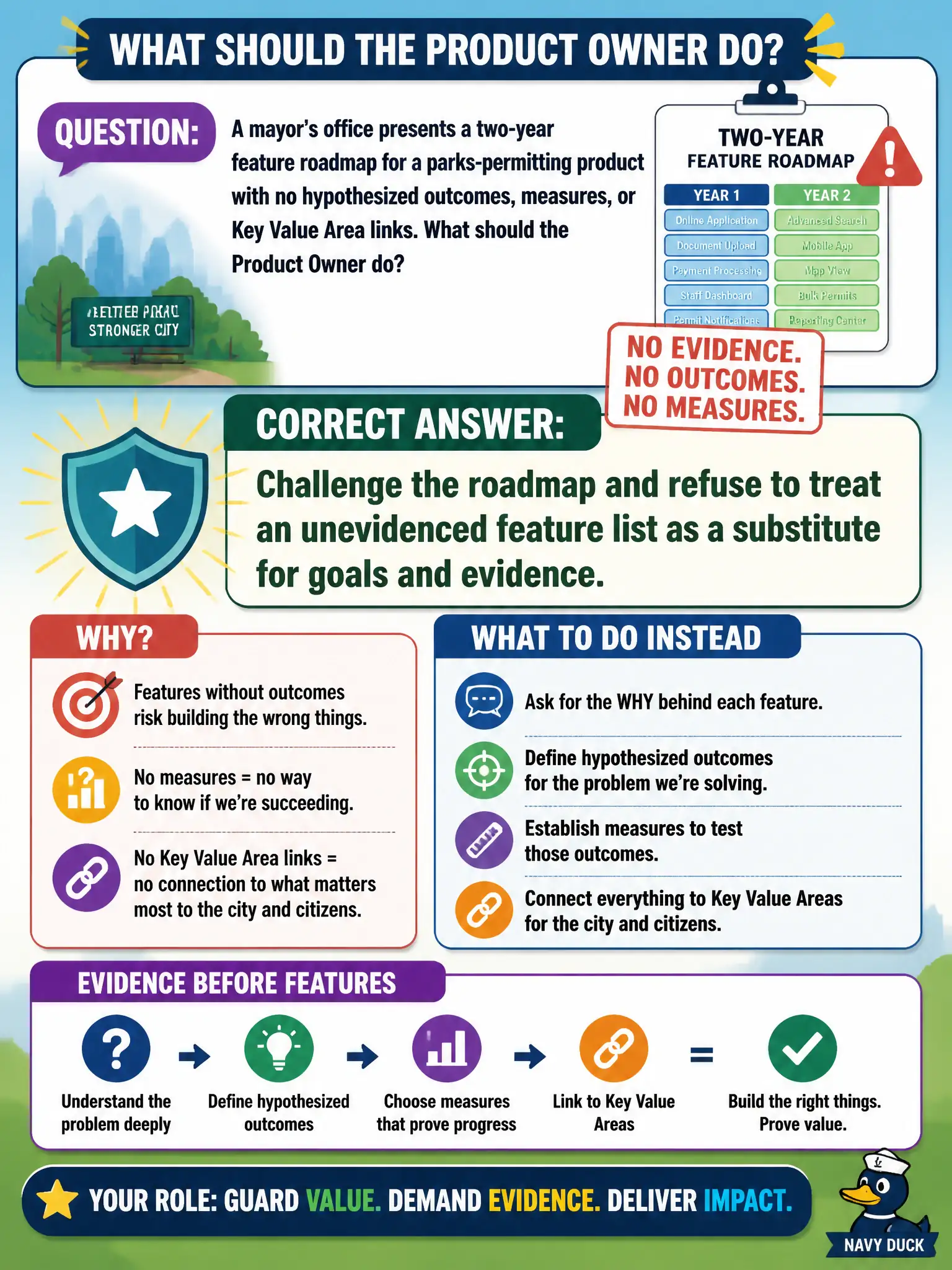
A mayor's office presents a two-year feature roadmap for a parks-permitting product with no hypothesized outcomes, measures, or Key Value Area links. What should the Product Owner do?
Select an answer to reveal the explanation.
Short Explanation
A feature list with no 'so that' is a shopping list, not a strategy. Evidence-Based Management asks what should get better and how you will know — not which screens are promised for two years. The Product Owner's job is to push back, not to copy the list into the backlog and call it a Product Goal.
Full Explanation
Under Evidence-Based Management, plans are hypotheses about value that must connect to goals and measures. A two-year parks-permitting feature roadmap with no hypothesized outcomes, measures, or Key Value Area links cannot be inspected empirically. The Product Owner should challenge that roadmap and refuse to treat an unevidenced feature list as a substitute for goals and evidence, recasting work as goals plus experiments.
Loading the entire roadmap into the Product Backlog as the Product Goal converts a shopping list into a false commitment and blocks empiricism. Splitting the roadmap into Program Increments so delivery dates can be promised institutionalizes predictive delivery without outcomes. Accepting the roadmap because it appears on official city letterhead confuses authority stationery with evidence.
Exam caveat: PSPO II expects Product Owners to challenge unevidenced feature roadmaps even when executives present them as strategy; letterhead is not a Key Value Area.
Operational check: for each top parks-permitting roadmap theme, require a hypothesized outcome, a measure, and a KVA link before it enters ordered Product Backlog work; refuse items that cannot meet that bar.