
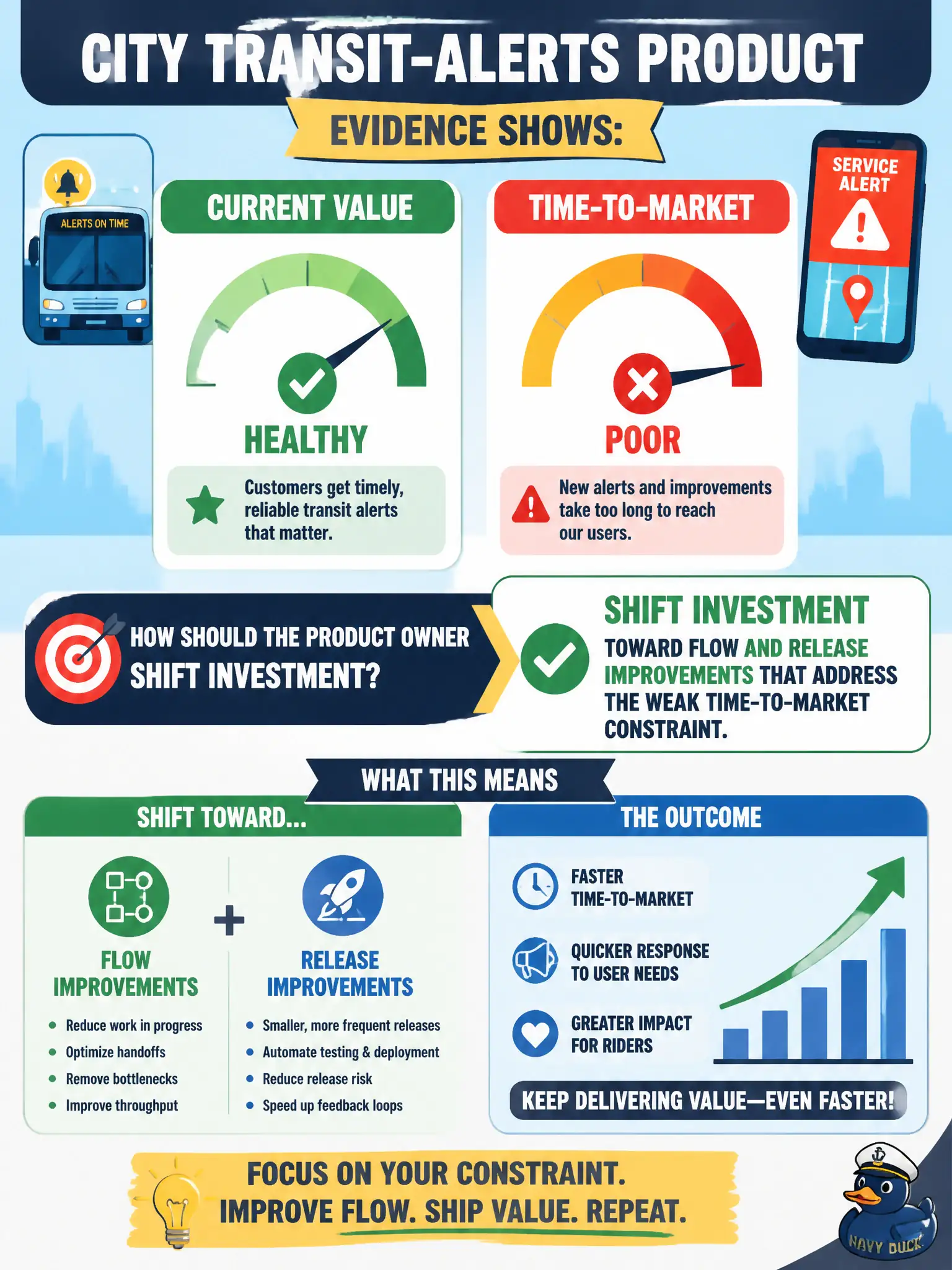
Evidence for a city transit-alerts product shows Current Value is healthy while Time-to-Market is poor. How should the Product Owner shift investment?
Select an answer to reveal the explanation.
Short Explanation
Riders like today's alerts, but new alert types take forever to land — that is a healthy store with a loading dock that is jammed. You do not fix a jammed dock by stocking more of the same snacks. Put money on flow and release so the next useful alert can actually get out the door.
Full Explanation
Evidence-Based Management investment should strengthen the Key Value Areas that currently constrain goals. Healthy Current Value with poor Time-to-Market on a transit-alerts product means the organization can satisfy today's riders but cannot move new value quickly. The Product Owner should shift investment toward flow and release improvements that address the weak T2M constraint rather than pouring more features into the satisfied base.
Pouring more rider-facing features into the satisfied base leaves the bottleneck in place while Current Value already looks healthy. Ignoring Time-to-Market until Unrealized Value also turns red waits for a second failure before treating a known constraint. Stopping releases until a six-month train restores forecast accuracy lengthens cycle time and worsens the weak KVA. Rider trust in today's alerts is not permission to ignore a jammed release path; civic Time-to-Market debt compounds while new alert types sit undeployed.
Exam caveat: PSPO II investment choices should follow the constraining KVA; strong CV does not justify ignoring poor T2M.
Operational check: freeze one Sprint of net-new alert features and fund a release/flow experiment with an explicit T2M measure (idea-to-rider-use cycle time) inspected at the next Review.