
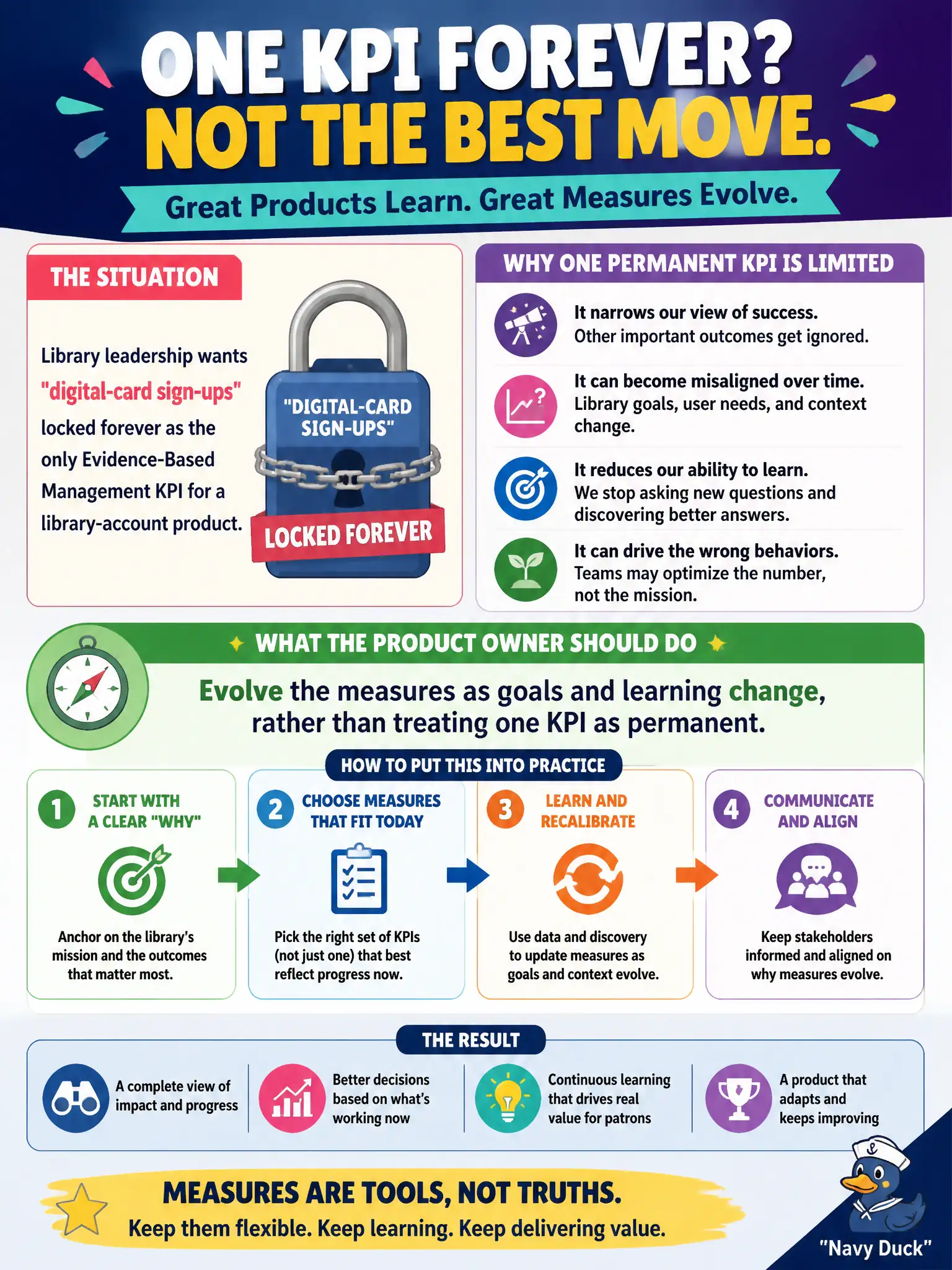
Library leadership wants digital-card sign-ups locked forever as the only Evidence-Based Management KPI for a library-account product. What should the Product Owner do?
Select an answer to reveal the explanation.
Short Explanation
A library that only ever counts new cards will miss overdue access, failed logins, and staff time sunk in workarounds. Goals change, and the questions you need to answer change with them. Keep the destination in view, and let the dashboard grow up instead of bronzing one number.
Full Explanation
Measures are servants of goals and of learning; they are not a permanent contract. Digital-card sign-ups may be useful while acquisition is the Intermediate Goal for a library-account product, then become insufficient when the product must improve ongoing use, cost-to-serve, or Time-to-Market. The Product Owner should evolve the measure set as goals and evidence change rather than bronzing one KPI forever.
Agreeing that a single frozen KPI is the definition of a Strategic Goal confuses a metric with strategic intent. Switching to story-point velocity so the measure never goes stale replaces outcome evidence with an internal output proxy. Handing measurement to finance so the KPI can be audited without product involvement severs Product Owner accountability for product evidence. Library account stewardship for the public requires the Product Owner to keep measurement aligned to the current Intermediate Goal rather than defending last year's acquisition vanity number.
Exam caveat: PSPO II Strategic Goals are not synonymous with a locked KPI; measures should change as Intermediate Goals and learning change.
Operational check: review the library-account measure set against the current Intermediate Goal; retire or demote sign-ups if the goal has shifted to retention, access equity, or cost-to-serve, and name the replacement measure.