
A utilities-billing Product Owner must define Time-to-Market so it reflects true delay from idea to value. Which measure should they use?
Select an answer to reveal the explanation.
Short Explanation
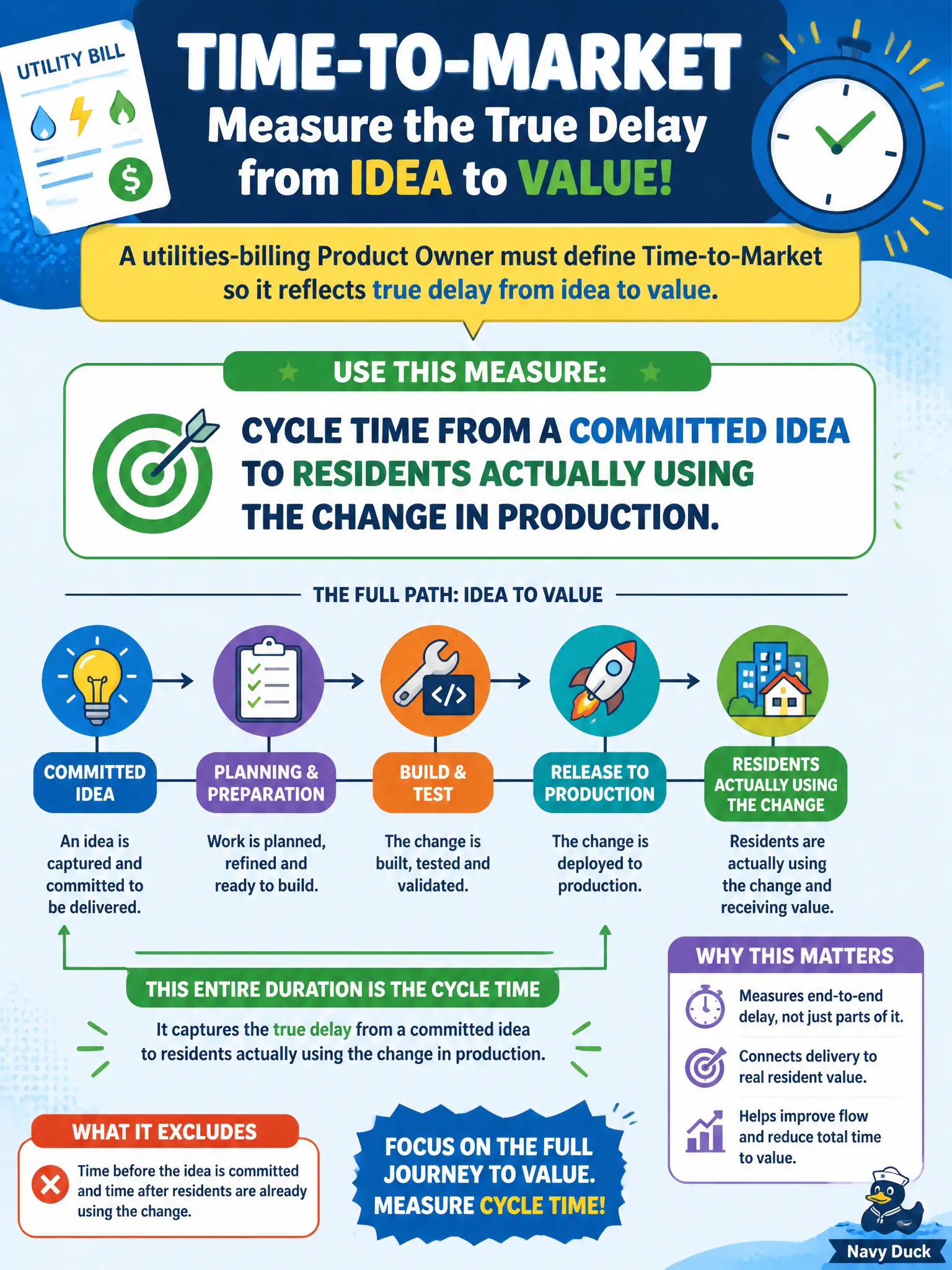
Time-to-Market is the wait between 'we should change this bill' and a resident actually seeing the new bill. Meetings, announcement theater, and leftover charter Sprints are clocks that do not measure value in use. If the change is not in production and being used, the clock is still running.
Full Explanation
Time-to-Market should capture idea-to-value delay, typically as cycle or lead time from a committed idea until the change is in production use. For utilities billing, residents actually using the change in production is the moment value can occur, so that definition keeps experiments aimed at real delay rather than at ceremony or original estimates.
Average minutes Developers spend in Daily Scrum measures collaboration ceremony, not idea-to-value speed. Calendar time from the mayor's announcement to the first Sprint Review slide measures presentation theater. Number of Sprints remaining on the original project charter measures a plan document, not value received by ratepayers. Municipal billing changes only create value when ratepayers encounter them in the live system, so T2M clocks that stop at meetings or slides systematically understate delay.
Exam caveat: PSPO II Time-to-Market definitions fail when candidates substitute meeting duration, demo readiness, or charter leftovers for production use.
Operational check: pick the last billing change that reached residents, record start-of-commitment and first-production-use dates, and use that cycle time as the T2M baseline for the next experiment.