
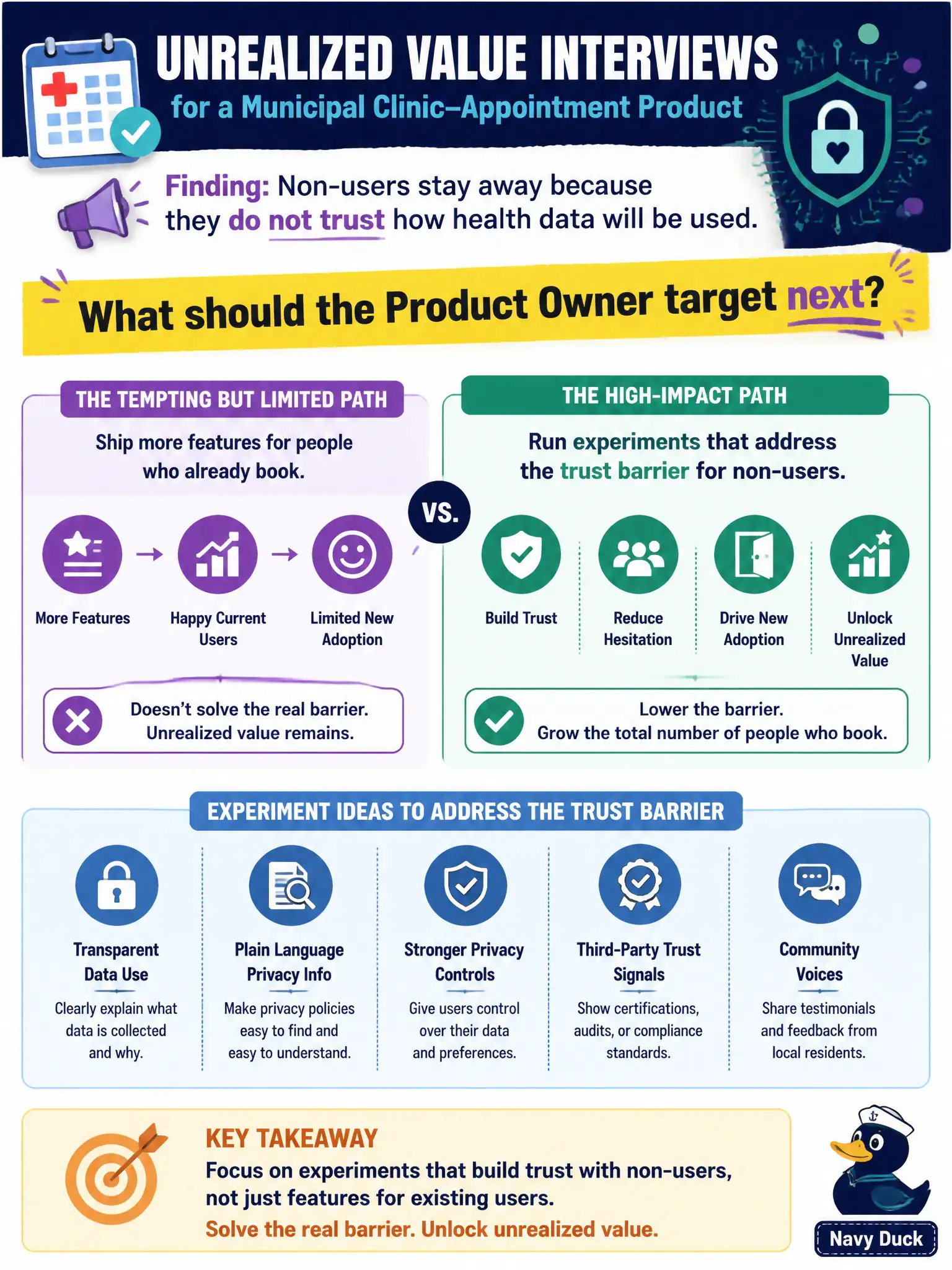
Unrealized Value interviews for a municipal clinic-appointment product show non-users stay away because they do not trust how health data will be used. What should the Product Owner target next?
Select an answer to reveal the explanation.
Short Explanation
The people already booking are not the ones telling you why the waiting room is empty. Unrealized Value often lives with non-users, and here they named the door they will not walk through: trust. Fixing reminders for fans does not unlock the crowd that never showed up.
Full Explanation
Unrealized Value frequently sits in unmet needs and barriers of people who do not yet use the product. Trust fears among clinic non-users about how health data will be used are a UV signal, so the next investment should be experiments that reduce that barrier and test whether non-users then book appointments—not more features for people who already book.
Adding reminder features for existing users improves Current Value at best and leaves the trust barrier for non-users intact. Pausing all product work until legal publishes a five-year privacy program freezes learning instead of running bounded trust experiments. Reclassifying trust as an Ability to Innovate encryption backlog mislabels a non-user value barrier as a capacity metric and may never address the stated fear. Civic products often lose the majority of potential value among people who never start; Unrealized Value work must chase that door, not the lobby already inside.
Exam caveat: PSPO II Unrealized Value items often hide in non-consumption; improving Current Value for fans does not automatically unlock UV.
Operational check: interview or survey non-bookers about the trust barrier, design one experiment that changes consent, messaging, or data-use clarity, and measure whether booking among former non-users moves.