
A housing-portal team met its Immediate Tactical Goal of launching an income-verification widget, but Intermediate Goal measures for faster eligibility decisions have not moved. What should the Product Owner do?
Select an answer to reveal the explanation.
Short Explanation
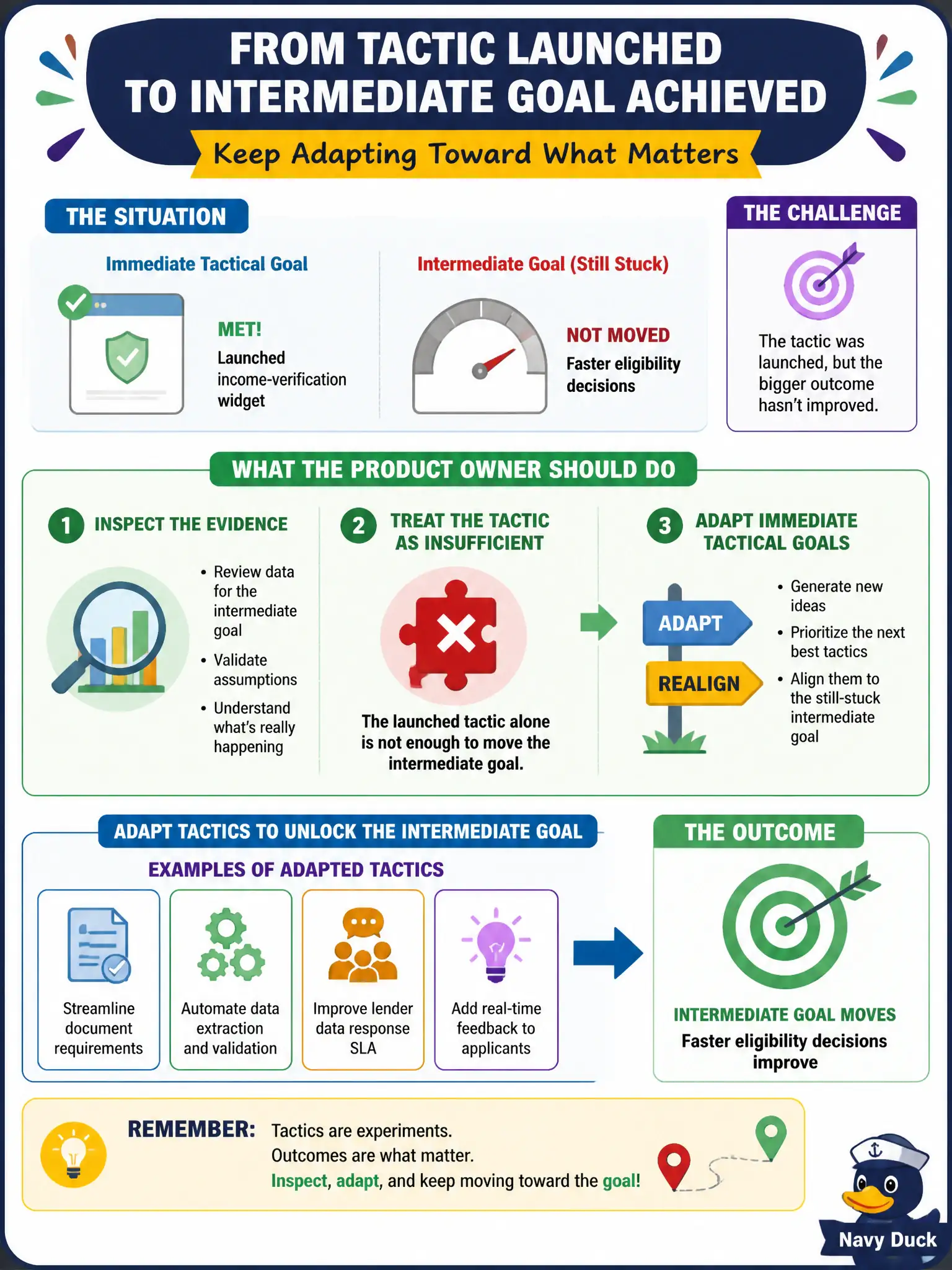
Shipping the widget is like putting a new door on a house that is still cold — the tactic happened, the outcome did not. Intermediate Goals care about faster eligibility, not about whether a widget exists. When the lower goal succeeds and the higher one sits still, change the tactic instead of celebrating the output.
Full Explanation
Immediate Tactical Goals are experiments toward Intermediate Goals, not proof that strategy moved. If a housing-portal team launched an income-verification widget yet Intermediate Goal measures for faster eligibility decisions did not move, the evidence says the tactic was insufficient or aimed at the wrong constraint. The Product Owner should inspect that gap and adapt the next Immediate Tactical Goals toward the still-stuck Intermediate Goal.
Declaring the Intermediate Goal achieved because the tactic shipped confuses output with outcome and falsely resets strategy. Repeating the same widget work until verification velocity recovers doubles down on a failed hypothesis. Escalating to the Scrum Master for a conflict workshop converts an evidence problem about eligibility speed into a facilitation ritual that does not adapt the goals ladder.
Exam caveat: On PSPO II, shipping a tactical Increment without Intermediate Goal movement is a signal to adapt tactics—not a victory, and not a reason to rewrite the Strategic Goal by default.
Operational check: after the next housing tactic ships, compare the Intermediate eligibility-time measure to its baseline before celebrating; if unchanged, rewrite the next Immediate Tactical Goal to attack a different constraint named by the evidence.