
The Product Owner of a city housing-assistance portal is establishing Evidence-Based Management goals. Which ladder should they set and inspect with evidence?
Select an answer to reveal the explanation.
Short Explanation
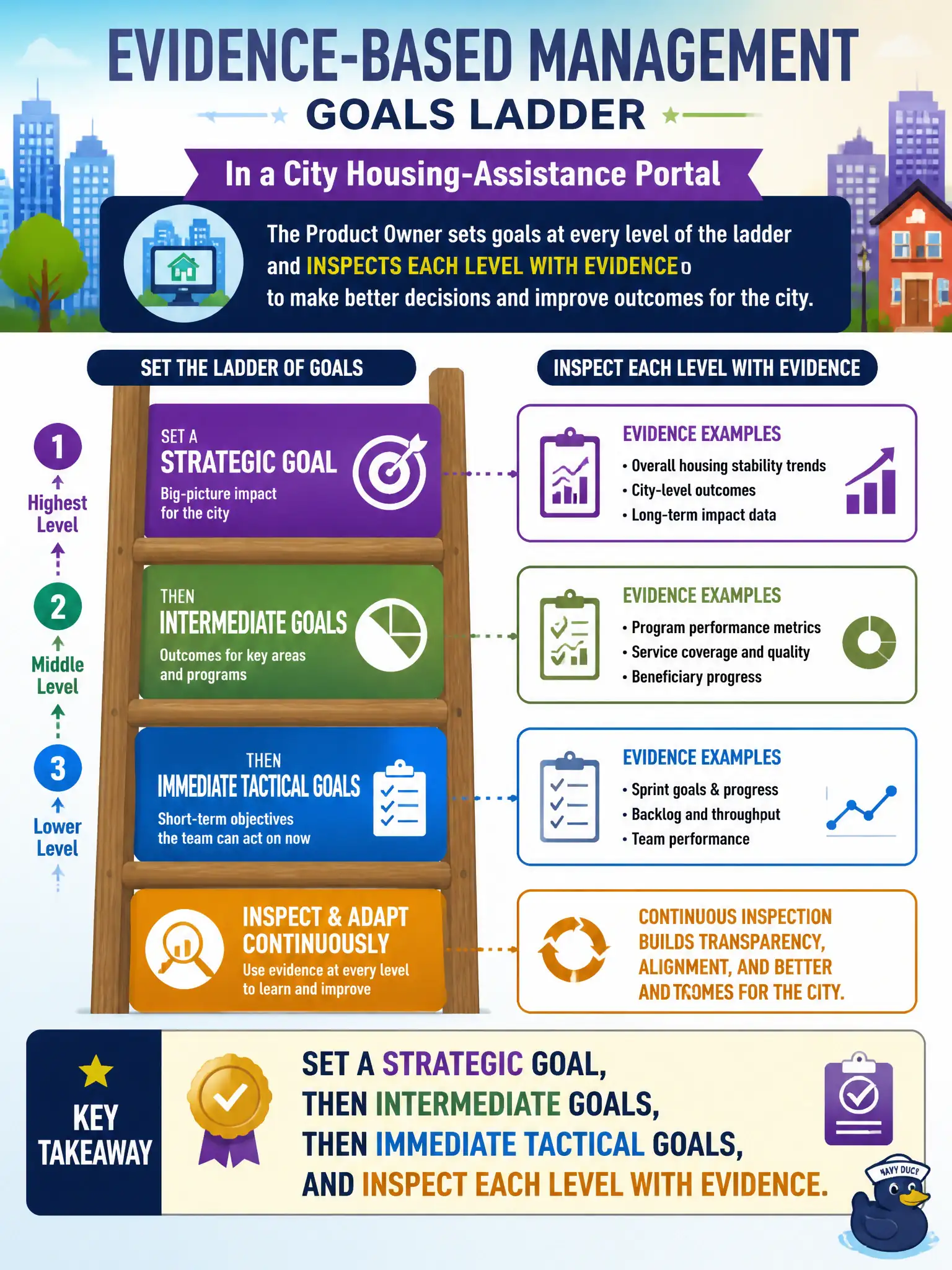
Think of the housing portal like a trip: the city needs a destination, some checkpoints, and the next turn — not a binder of features. Strategic Goal is the destination, Intermediate Goals are the checkpoints, Immediate Tactical Goals are the next experiments. Evidence tells you whether to keep driving or change the turn, not whether the slide deck looks complete.
Full Explanation
Evidence-Based Management organizes ambition as a goals ladder: a relatively stable Strategic Goal, measurable Intermediate Goals that show progress toward it, and Immediate Tactical Goals that are near-term experiments. For a city housing-assistance portal, the Product Owner should set that ladder and inspect each level with evidence so tactics can change without pretending a feature roadmap is strategy.
Starting only with Immediate Tactical Goals for the next Sprint and inventing a Strategic Goal later if council wants a vision slide reverses the ladder and leaves investment without a durable aim. Replacing goals with a two-year feature roadmap sequences output instead of outcomes and blocks empiricism. Letting housing, finance, and IT each write a Strategic Goal federates conflicting destinations for one portal and scatters evidence.
Exam caveat: PSPO II EBM items test whether candidates can distinguish a Strategic–Intermediate–Tactical ladder inspected with evidence from feature roadmaps and department-owned competing strategies.
Operational check: write one Strategic Goal for the housing portal, two Intermediate measures that would prove progress, and the next Immediate Tactical experiment; confirm each level will be inspected with named evidence at a stated cadence.