
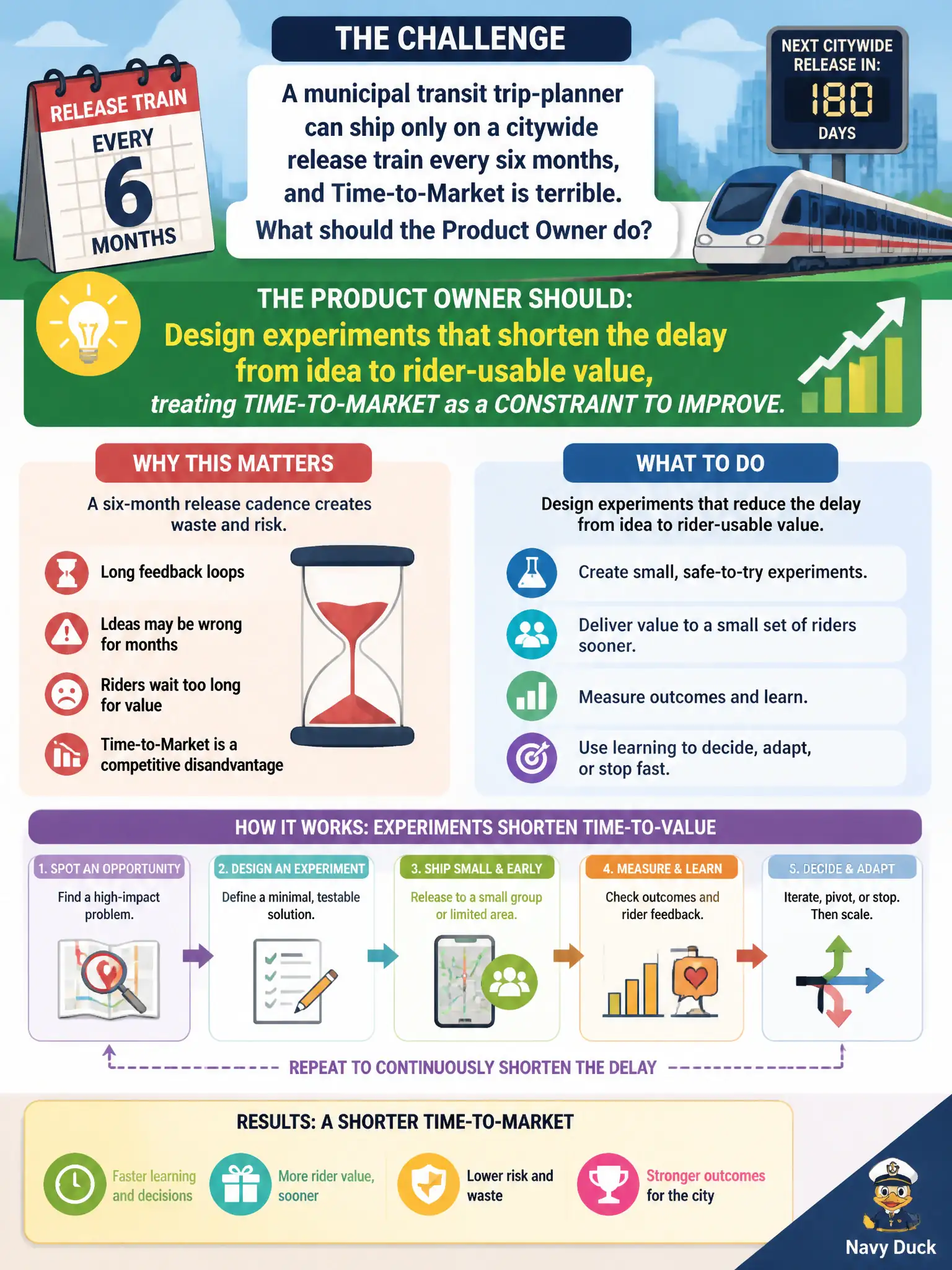
A municipal transit trip-planner can ship only on a citywide release train every six months, and Time-to-Market is terrible. What should the Product Owner do?
Select an answer to reveal the explanation.
Short Explanation
A bus that leaves twice a year is not a Time-to-Market strategy — it is a traffic jam with a schedule. Time-to-Market is how long an idea sits before riders actually get value. The Product Owner's job is to run experiments that shrink that wait, not to hide the number or freeze the backlog until the next parade.
Full Explanation
Time-to-Market measures how quickly an organization turns an idea into value in use. A municipal transit trip-planner trapped on a six-month citywide release train has a structural delay that Evidence-Based Management makes visible so it can be improved. The Product Owner should design experiments—smaller releases, fewer handoffs, earlier rider-usable Increments—that shorten idea-to-value delay rather than normalizing the train as inevitable.
Hiding Time-to-Market from council briefings until a large feature bundle lands conceals the constraint and prevents adaptation. Asking the Scrum Master to add Program Increment Planning so the six-month train becomes official cadence institutionalizes the delay instead of challenging it. Freezing the Product Backlog between trains to maximize utilization optimizes busyness inside a long batch window and does nothing to improve rider Time-to-Market.
Exam caveat: On PSPO II, Time-to-Market is an inspectable organizational capability, not a political number to suppress or a scaled ceremony to celebrate when cycle time is terrible.
Operational check: pick one trip-planner idea already on the Product Backlog, measure calendar time from commitment to rider use in production, and propose one experiment next Sprint that removes a handoff or release gate from that path.