
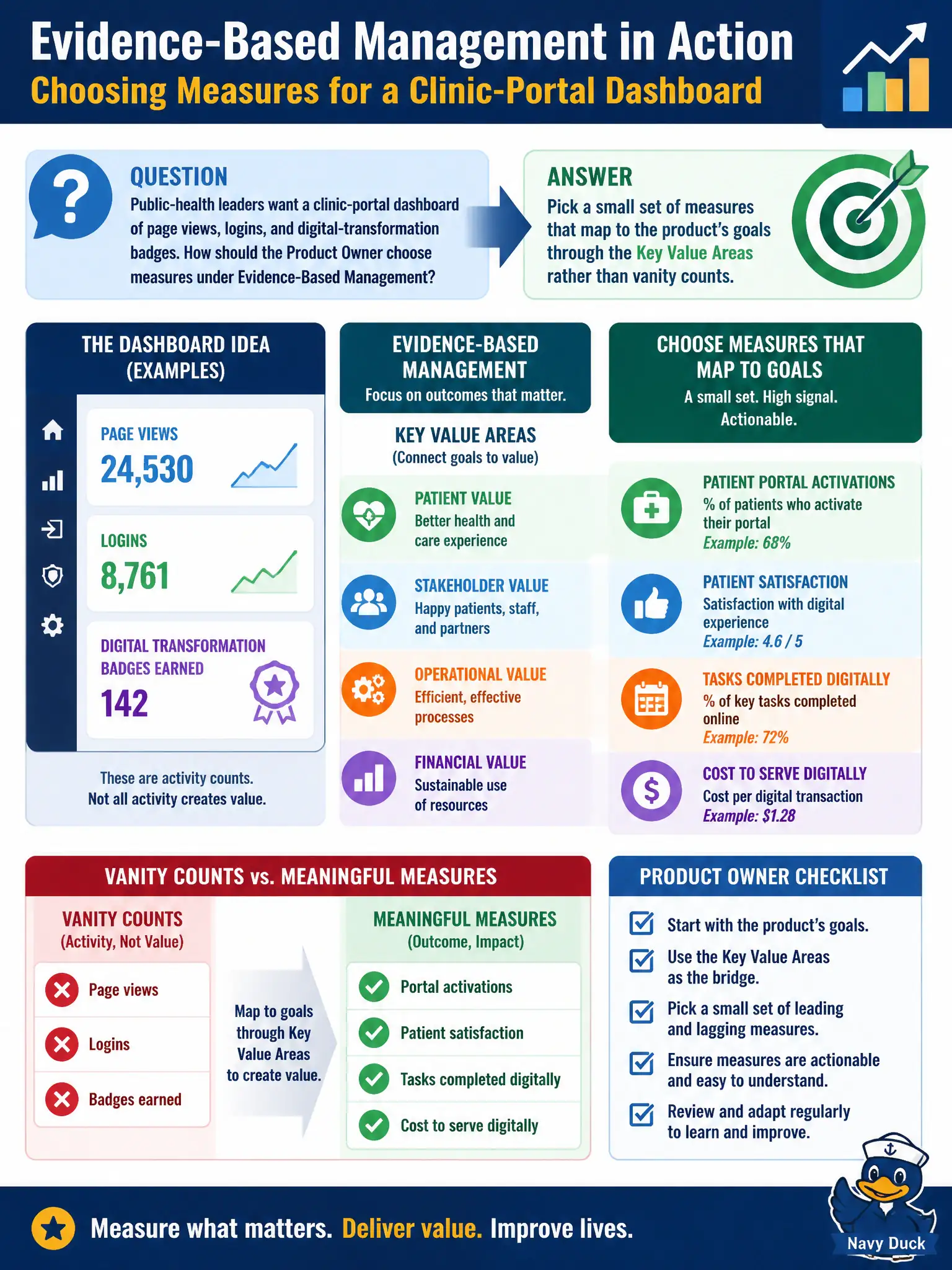
Public-health leaders want a clinic-portal dashboard of page views, logins, and digital-transformation badges. How should the Product Owner choose measures under Evidence-Based Management?
Select an answer to reveal the explanation.
Short Explanation
Counting how many people walked past the clinic is not the same as knowing whether anyone got care. Page views and badges look busy and tell you almost nothing about goals. Evidence-Based Management wants a few measures that actually inform Current Value, Unrealized Value, Time-to-Market, or Ability to Innovate.
Full Explanation
Under Evidence-Based Management, measures exist to inform product goals through the four Key Value Areas, not to decorate a leadership dashboard. For a public-health clinic portal, the Product Owner should select a small set of measures that show whether residents receive better health outcomes or whether the organization improved its ability to deliver clinic value—linking counts to Current Value, Unrealized Value, Time-to-Market, or Ability to Innovate rather than to vanity theater.
Accepting page views, logins, and digital-transformation badges as Current Value confuses visibility with outcomes residents actually need. Replacing the dashboard with a clinic story burn-down elevates Scrum activity artifacts into the only evidence source and still fails to map to Key Value Areas. Publishing every analytics field creates noise that hides Unrealized Value rather than revealing it through purposeful measurement.
Exam caveat: PSPO II items often contrast vanity metrics with goal-linked EBM measures; leadership enthusiasm for a badge board does not convert activity into evidence.
Operational check: for each proposed clinic-portal metric, write which Key Value Area and which Product or Intermediate Goal it informs; drop any metric that cannot complete that sentence before the next leadership review.