
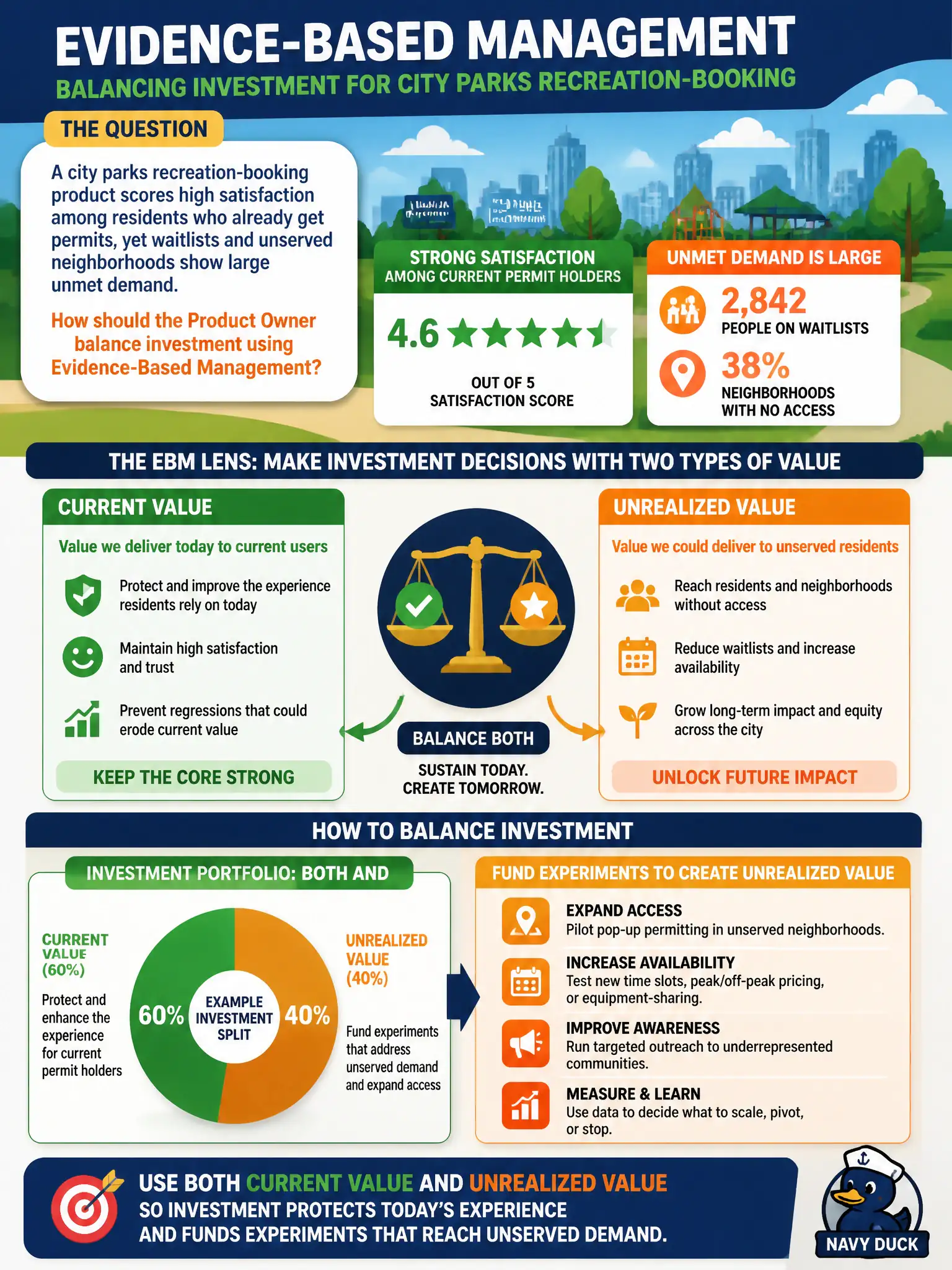
A city parks recreation-booking product scores high satisfaction among residents who already get permits, yet waitlists and unserved neighborhoods show large unmet demand. How should the Product Owner balance investment using Evidence-Based Management?
Select an answer to reveal the explanation.
Short Explanation
Happy people already on the ride do not tell you about the line around the block. Current Value says today's bookers like the product; Unrealized Value says a lot of parks access is still sitting on the table. A serious Product Owner funds both keeping the good experience good and opening the gate for neighborhoods that never got in.
Full Explanation
Evidence-Based Management treats Current Value and Unrealized Value as complementary Key Value Areas that together steer investment on a civic product. High satisfaction among residents who already obtain parks recreation permits is Current Value evidence that today's bookers are served well; waitlists and unserved neighborhoods are Unrealized Value evidence that substantial access still sits outside the product. Balancing investment means protecting the experience that already works while funding experiments that reach unmet demand, so the Product Owner does not milk a satisfied base while strategic opportunity decays.
Investing only in features that delight current users treats Current Value as the sole funding signal and systematically ignores Unrealized Value. Freezing the product and moving the team to a capital project outside Scrum abandons empiricism on both KVAs rather than using them to order work. Replacing satisfaction research with story-point velocity substitutes an internal output proxy for outcome evidence and does nothing to illuminate parks access gaps.
Exam caveat: PSPO II expects Product Owners to use multiple Key Value Areas together—especially when Current Value looks healthy while Unrealized Value shows civic exclusion—not to maximize a single flattering score.
Operational check: before the next parks investment review, place at least one CV measure (for example, booker satisfaction or successful permit completion) and one UV measure (waitlist size or unserved-neighborhood reach) on the same slide, and name the backlog experiments funded against each.