
Nearly every transit product — fare, alerts, and paratransit scheduling — now runs on a single vendor platform. What should the Product Owner ensure at the portfolio level?
Select an answer to reveal the explanation.
Short Explanation
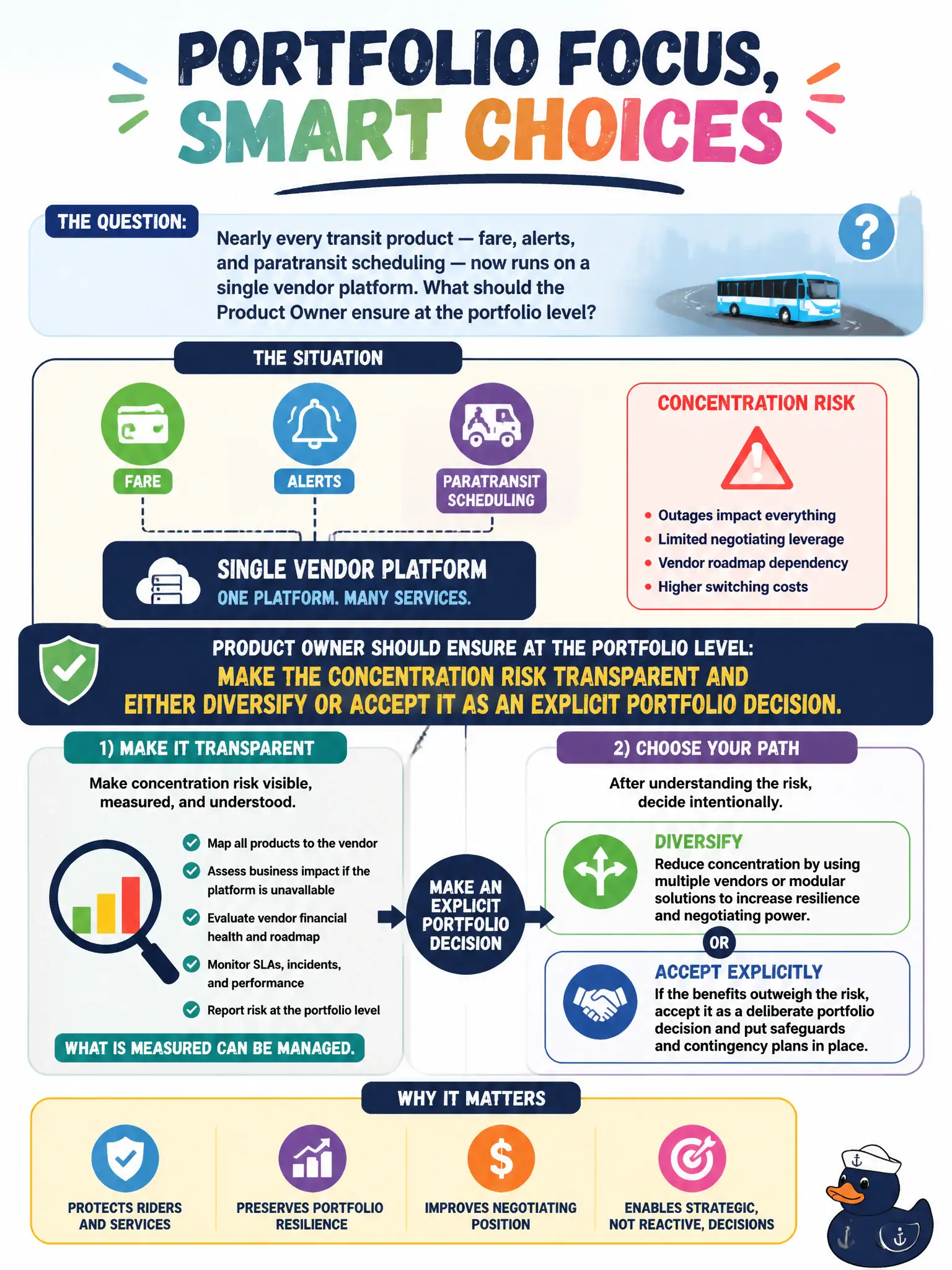
If every city bus product lives in one vendor's garage, a lock on that garage door stops the whole fleet. Concentration is not automatically wrong — but it is a portfolio risk, not a secret. Name it, then diversify or accept it with eyes open.
Full Explanation
Portfolio risk includes vendor and platform concentration, not only delivery RAG. When nearly every transit product—fare, alerts, and paratransit scheduling—runs on a single vendor platform, a lock on that platform stops the whole fleet of citizen capabilities. The Product Owner should make the concentration risk transparent and either diversify or accept it as an explicit portfolio decision. Hiding the vendor, blindly doubling down, or forcing emergency rewrites this quarter are not inspectable risk decisions. Advanced Product Owners put concentration next to value and cost of delay when the portfolio is ordered.
Doubling down on the vendor immediately because switching costs already make concentration rational fails by treating sunk switching cost as automatic acceptance without an open decision. Hiding the vendor name from leadership fails by blocking risk inspection. Requiring each Scrum Team to rewrite its product this quarter on a different stack fails by forcing reckless diversification without a plan.
Exam caveat: Name vendor concentration as portfolio risk; diversify or accept it consciously. Operational check: Brief leadership on how many transit capabilities share one vendor, the blast radius of an outage or lock-in, and a decision to diversify critical paths or formally accept the concentration.