
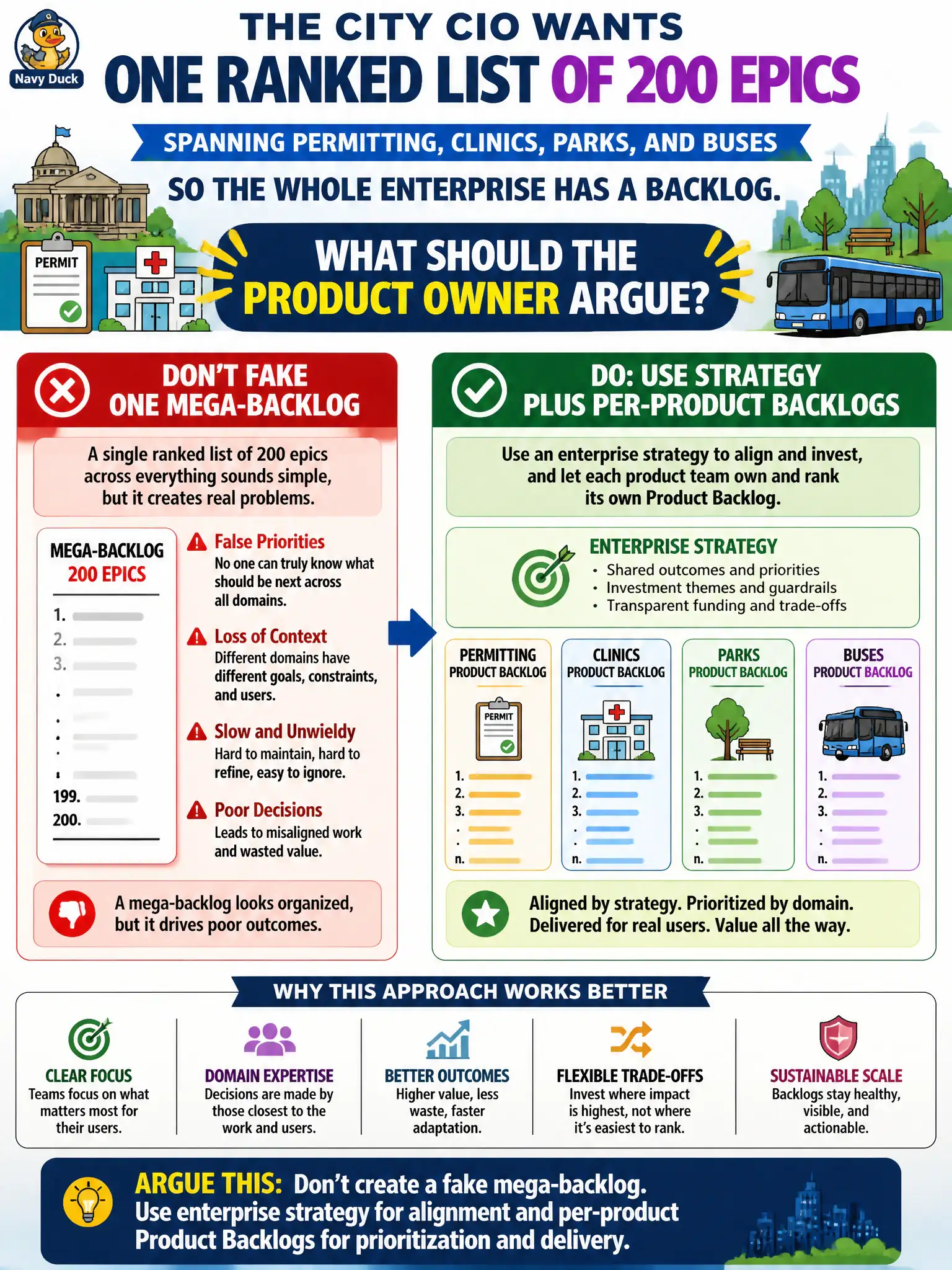
The city CIO wants one ranked list of 200 epics spanning permitting, clinics, parks, and buses so the whole enterprise has a backlog. What should the Product Owner argue?
Select an answer to reveal the explanation.
Short Explanation
Ranking 200 epics from permits to buses as if they were one backlog is like ranking every item in the grocery store, the hardware store, and the pharmacy on one shopping list. The result is a very long list and a fake sense of control. Strategy plus real Product Backlogs is how cities actually order work.
Full Explanation
An enterprise mega-ranking of unrelated epics creates the appearance of control while destroying product-level empiricism. When the city CIO wants one ranked list of 200 epics spanning permitting, clinics, parks, and buses, those domains have different users, value measures, and Product Owners. The Product Owner should argue not to fake one mega-backlog; use strategy plus per-product Product Backlogs instead. Strategy sets allocation and Product Goals; each product keeps an ordered Product Backlog. Point-based ranking, PMO roadmaps, and annual steering lists are substitutes for that design.
Ranking the 200 epics by remaining story points so the shortest work floats to the top fails because effort remaining is not strategic value. Converting the 200 epics into a program roadmap owned by the PMO fails by centralizing feature fiction. Keeping ranking only at a citywide steering committee that meets annually fails by making order too slow and too coarse for empiricism.
Exam caveat: Do not fake one enterprise mega-backlog across unlike civic products. Operational check: Keep separate Product Backlogs for permitting, clinics, parks, and transit; use portfolio strategy only to allocate capacity and set Product Goals—not to rank 200 mixed epics as one list.