
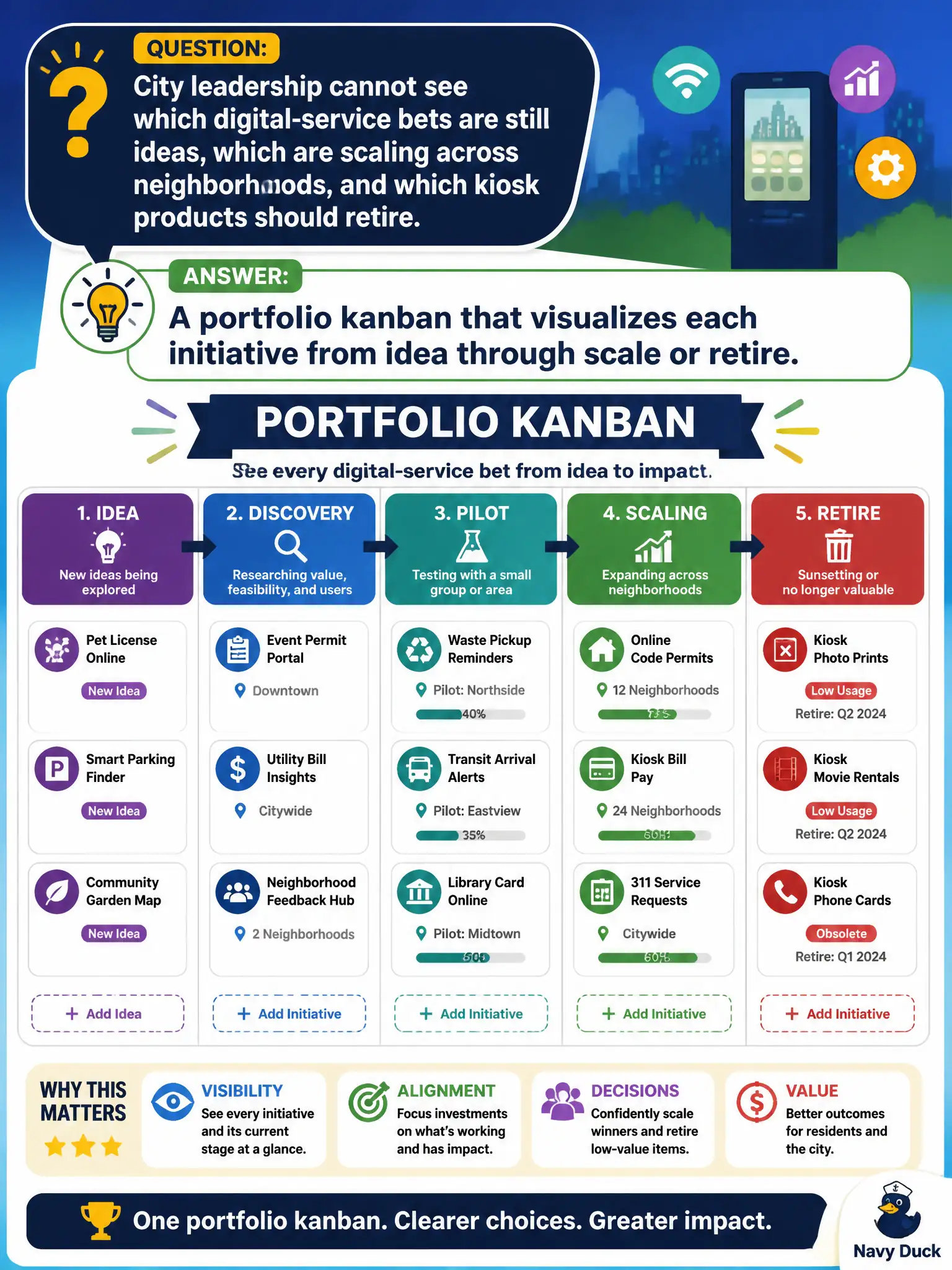
City leadership cannot see which digital-service bets are still ideas, which are scaling across neighborhoods, and which kiosk products should retire. What should the Product Owner establish?
Select an answer to reveal the explanation.
Short Explanation
A city portfolio without a board is a closet with the light off — the expired kiosk program is found by tripping on it. A kanban from idea to scale-or-retire shows flow, stuck work, and what should leave the closet. Lights on beat another RAG spreadsheet.
Full Explanation
Visualizing the initiative lifecycle from idea to scale or retire makes portfolio work-in-progress, aging, and exit criteria transparent for city digital-service bets. When leadership cannot see which bets are still ideas, which are scaling across neighborhoods, and which kiosk products should retire, a portfolio kanban that visualizes each initiative from idea through scale or retire turns the lights on. Gantt remaining-task charts and RAG sheets describe activity and status, not flow. Instantly staffing every idea as a Scrum Team explodes work-in-progress and hides what should leave the closet.
A detailed Gantt of every initiative’s remaining tasks through year-end fails by centering predictive task charts over lifecycle flow. A RAG spreadsheet updated after each department staff meeting fails by recycling status theater without exit criteria. Requiring every idea to immediately become a funded Scrum Team fails by exploding WIP and starving finish.
Exam caveat: Use a portfolio kanban from idea to scale-or-retire, not Gantt/RAG alone. Operational check: Place each digital-service initiative on a kanban with explicit columns for idea, validate, build, scale, and retire, and review aging and exit criteria monthly with leadership.