
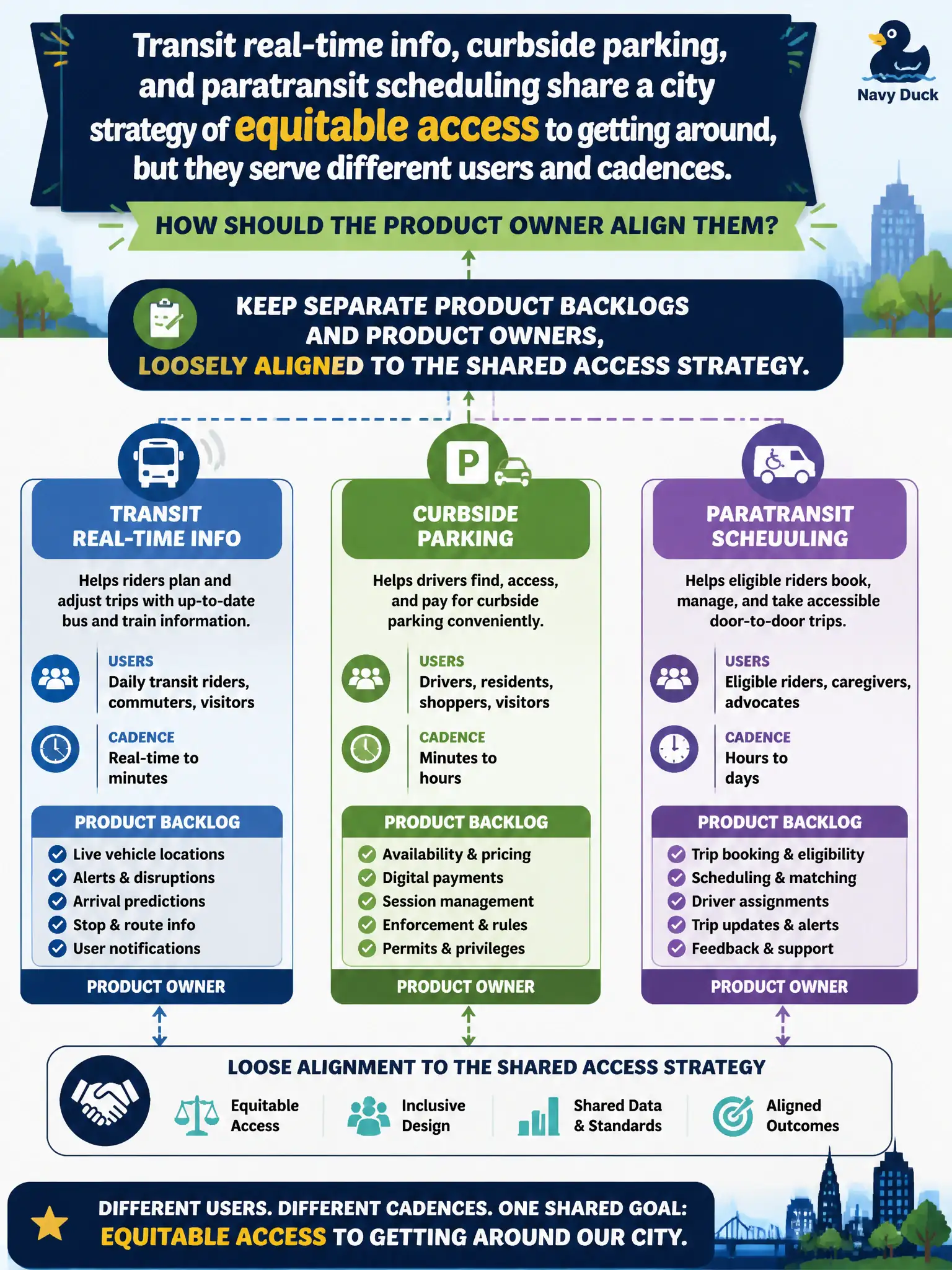
Transit real-time info, curbside parking, and paratransit scheduling share a city strategy of equitable access to getting around, but they serve different users and cadences. How should the Product Owner align them?
Select an answer to reveal the explanation.
Short Explanation
Three buses on one route map isn't the same as welding them into one vehicle. You can share an equitable-access strategy without merging transit real-time info, curbside parking, and paratransit scheduling into one backlog. Keep separate Product Backlogs and Product Owners, loosely aligned.
Full Explanation
Related municipal products should align to shared strategic outcomes without collapsing distinct products, users, and cadences into a single backlog. Transit real-time info, curbside parking, and paratransit scheduling may share a city strategy of equitable access to getting around, yet they serve different users and cadences. The right alignment is to keep separate Product Backlogs and Product Owners, loosely aligned to the shared access strategy. The approach that uses one Product Owner and one backlog for all three products to simplify citywide reporting fails by inventing a single ranking across unlike products and creating false control. The approach that has a city PMO write one ordered feature list that all three teams pull from fails by removing Product Owner ordering and turning coordination into coordination theater rather than Product Ownership. The approach that requires identical Sprint lengths and identical Sprint Goals across the three products fails by forcing sameness where cadences differ. Exam caveat: Align related products to shared strategy; do not fake one mega-backlog. Operational check: Write Product Goals for real-time info, parking, and paratransit that each reference equitable access, keep three backlogs and three Product Owners, and review alignment—not identical Sprint Goals—at portfolio cadence.