
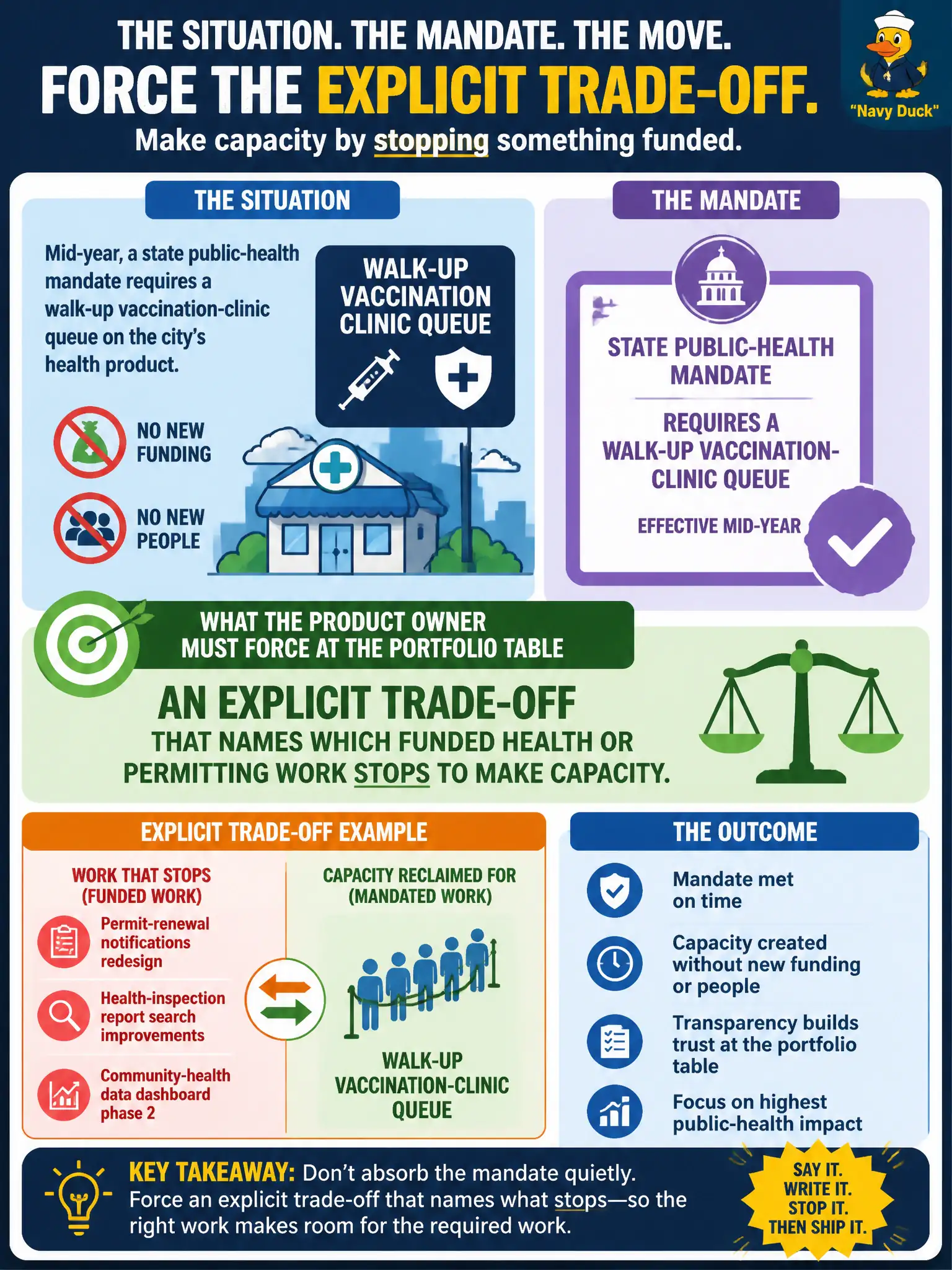
Mid-year, a state public-health mandate requires a walk-up vaccination-clinic queue on the city's health product, with no new funding or people. What should the Product Owner force at the portfolio table?
Select an answer to reveal the explanation.
Short Explanation
An unfunded mandate is a new guest at a table that already has a full plate. If nobody takes a dish away, someone just eats standing up and drops food. Name what stops — a permit slice, a clinic report — so the overload is not silent.
Full Explanation
New mandatory work still consumes real capacity even when a state public-health mandate arrives mid-year with no new funding or people. Silent overtime and parallel unstaffed project codes destroy transparency and forecast integrity for the city’s health product. Scrum does not authorize ignoring a legal mandate, but it does require an explicit portfolio trade-off: which Product Goal, initiative, or forecasted outcome is deferred to make capacity for a walk-up vaccination-clinic queue. That conversation is how empiricism survives unplanned demand.
Absorbing the mandate as hidden overtime so existing Product Goals stay on the slide deck fails by lying with the forecast. Rejecting the mandate because Scrum Teams only pull from their own backlog fails by misunderstanding legal obligations versus transparent trade-offs. Opening a parallel unstaffed project code so finance can track the mandate separately fails by creating phantom capacity.
Exam caveat: Unfunded mandates require an explicit named trade-off of what stops—not silent heroics. Operational check: At the portfolio table, name which funded health or permitting work stops or slows to staff the vaccination queue, update forecasts, and record the decision publicly.